Hierarch of Cyprus Church: Autocephalous mosaic is a road to catastrophe
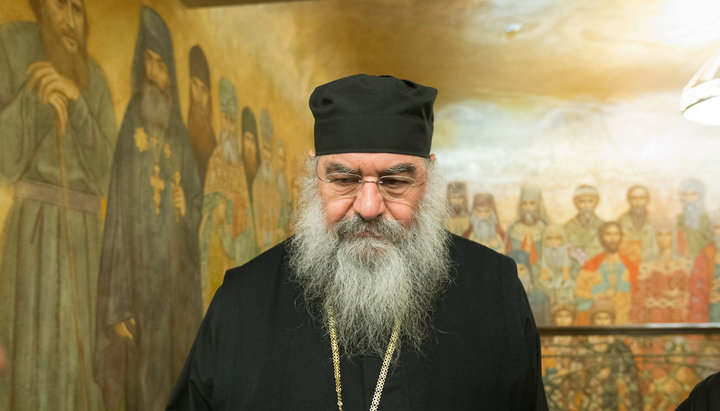
Metropolitan Athanasios of Limassol. Photo: V.Hodakov / Orthodoxy.Ru
Metropolitan Athanasios of Limassol believes that granting church independence by the principle “every state has the right to autocephaly” is a path to disaster. He stated this in an interview published on the website of the Synodal Information and Education Department of the UOC.
Commenting on the communique of the Cyprus Orthodox Church regarding the situation in Ukraine, His Eminence stressed that he had not signed it. The reason is his disagreement with some formulations of the document.
In particular, the first paragraph in the document says that “every nation has the right, with the arrival of national independence, also to claim church autocephaly”.
Metropolitan Athanasius considers this item unacceptable, since “if we accept it as a rule, then each country will create its own autocephalous Church”.
As an example of the incorrect use of such a thesis, Vladyka cited the Patriarchate of Antioch, which "spiritually nourishes many countries: the United Arab Emirates, Lebanon, Syria, and others". In his words, "according to the above rationale, Lebanon needs to have autocephaly alongside other countries."
A similar situation, according to the bishop, is with the Alexandrian Patriarchate, which encompasses many countries in Africa.
“According to this logic, Kenya should then be autocephalous, as well as Mozambique and Tanzania. These are all separate countries and separate nationalities,” said the Metropolitan.
He is confident that the granting of autocephaly cannot be based only on state independence or the existence of separate nationalities, because “if we apply this logic to everyone, then it will be an autocephalous mosaic”. Such a vision, in the opinion of the hierarch of the Cyprus Church, can also have a side effect: if a state loses its political independence, does its church have to disappear as well?
That is why, according to Vladyka, “when undertaking something, we must first think about the consequences, assessing strengths and weaknesses of each individual Church,” since giving autocephaly to each independent state is a road to disaster.
The Metropolitan of Limassol is convinced that such an approach can lead to serious disorder within the Church, as information is coming on the possible granting of autocephaly to unrecognized structures in Northern Macedonia and Montenegro:
“I will give you the example of Skopje, Northern Macedonia as it is now called, which we do not recognize. According to this logic, they should have an autocephalous church and Montenegro, too. You understand that this is the way to disaster with a lot of problems? That is why for me personally the text of the statement (Church of Cyprus – Ed.) is unacceptable. I respect the decision of the Church, I fulfill the obedience of the Church, but expressing my personal opinion on these issues, I can say that I disagree.”
As the UOJ reported, earlier Metropolitan Nicephoros (Kikkotis) stated that the Church of Cyprus cannot recognize schismatic Epiphany.
Read also
OCU activist admits breaking into UOC church in Sloviansk
Oleksandr Onyshchenko said that the OCU held its first "service" at the Seraphim Church, which had previously been broken into by forcing the locks and doors.
Archimandrite Ioustinos, longtime keeper of Jacob's Well, dies in Jordan
Archimandrite Ioustinos (Mamallos), the keeper of Jacob's Well in Nablus, has died after a prolonged illness.
Pilgrim group from Kyiv Theological Seminary visits Mount Athos
KTS students are making a pilgrimage to the holy sites of Romania, Greece, Mount Athos and Italy.
UOC cathedral celebrates its patronal feast in Ternopil
The service in the cathedral of the Holy Martyrs Faith, Hope, Love and their mother Sophia was led by Metropolitan Serhii of Ternopil, concelebrated by four hierarchs.
MinCulture marks centenary of Soviet-era reserve at Lavra's Refectory Church
Representatives of the Ministry of Culture presented awards to the Reserve's employees on the occasion of the anniversary at the Refectory Church of the Lavra.
Conference to mark 1700th anniversary of Christianity adoption held in Georgia
In Georgia, representatives of the Church and the state noted the defining role of Christianity in the country's cultural development.