Met. Anthony: “No dialogue can occur at the backdrop of seized temples”
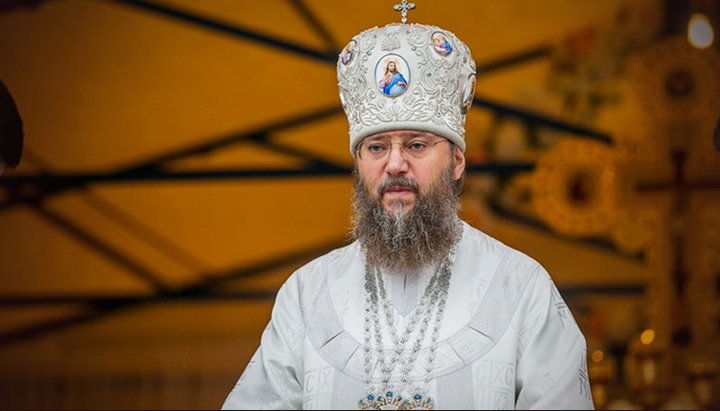
Metropolitan Anthony (Pakanich). Photo: UOC website
On July 28, 2019, on the Day of the Baptism of Rus, President of Ukraine Vladimir Zelensky called for an interfaith dialogue so that faith would unite rather than divide Ukrainians.
These are important and necessary words, since the religious sphere of Ukraine has been in a state of immense turbulence for several years now. It is shaken by various blows – both planned and knee-jerk, which are fueled by the work of a number of unethical media. It is about the adoption of "anti-church" laws, the activities of the so-called black registrars (employees of some regional state administrations who, on the basis of forged documents, transfer the UOC communities to another jurisdiction), information campaigns against one particular confession, and many other things that undermine the interfaith and public peace.
But even against this background, such blatant lawlessness as a large-scale and systematic campaign on raider seizure of the temples of the canonical Church is really outstanding.
In the context of this campaign, our believers are humiliated, beaten, maimed, throwen into the street of those temples which they built with their own hands and in which they put a piece of their soul.
In some cases, the situation reaches quite unimaginable limits. For example, in June, in the village of Postoinoye, Rovno region, supporters of the so-called OCU rushed with their fists to grab the house in which the believers of our Church had been praying after the seizure of the temple. Three women from the UOC community were hospitalized as a result of the ensuing massacre.
Actually, there are a lot of similar cases. Unfortunately, they are occurring even now, when the old government is gone and there is hope that the situation will stabilize.
Of course, we do not mind having a dialogue and have repeatedly stated this publicly. But any full-fledged dialogue can be sustained only on trust and absence of the intentions of one of the parties to bend its opponents across its knee.
Back in 2015, we openly stated that it was impossible to advocate for reconciliation only in words. We need specific cases to prove the sincerity of the words of the representatives of the other camp about the desire to improve mutual relations. On our part, it was stressed that the first important step on this path should be the return to the Ukrainian Orthodox Church of all the temples having been seized from it.
Unfortunately, our appeal fell on deaf ears. Moreover, the pressure and persecution of the UOC stepped up even more afterwards.
Against this background, it is very, very difficult to talk about some kind of full-fledged dialogue. Moreover, the attempts of new raider attacks are still ongoing.
However, we still believe in the best. Our conscience is clear – we are nor raiders but victims of raiding. We do not violate someone’s rights, but our believers’ rights are violated just because there are loyal to God and their faith. It is not we who shed blood and provoke the incitement of sectarian strife.
If the violation of the rights of our flock ceases, if the raiding is put to an end, if all the temples taken from our confession are returned to the Church, the prerequisites for initiating of the dialogue will surely appear. Otherwise, any good words about reconciliation will, unfortunately, remain just words. After all, as Reverend Nilus of Sinai said, "there can never be a friendly talk of a wolf with a sheep, and also merciless and insatiable thoughts cannot be compatible with benevolence."
KP in Ukraine
Read also
The Time of the Soul's Ripening
Modern society has turned youth into a cult and calls old age a period of "living out one's days." The Christian view reveals the deep spiritual meaning of one's later years.
Faith is not a checker piece in a spectator sport
Arguments about faith on social media increasingly resemble no-holds-barred fights. We turn to a saint who, sixteen centuries ago, knew how to speak to those interested only in turning theology into a combat arena.
The metropolitan who fought with a pen
St. Cyprian of Kyiv was robbed, expelled, and barred from his see. He answered with letters, books, and canons – and before his death, forgave everyone.
Loneliness under one roof
Spouses can share a home for years, raise children, and faithfully attend church – yet remain strangers to each other.
The cross – the deepest healing of the human soul
Emotional exhaustion and anxiety have become a way of life. Ancient Christian tradition offers an unexpected way out – embracing one's own cross.
The Prophet Elisha and the mystery of the Bethel massacre
The story of the prophet Elisha and the two bears seems to be the harshest in the Bible. But in reality, it carries a profound theological meaning.