
The courage to be the bride: Why every believing soul is feminine
Great Lent reveals one of the deepest mysteries of human nature: in order truly to encounter God, even the strongest man must learn, spiritually, to become a woman.
There is a thought in Christianity that we usually ignore because it feels uncomfortable. The most perfect human being in history was a Woman. And here lies the awkward implication: every man, if he wishes to be saved, must in some sense become a woman. Not in any mundane or social sense, of course, but in that deeper spiritual meaning of which the Church speaks quietly – a meaning easily drowned out by our modern discussions about gender roles and the nature of the sexes.

The point is this. In Greek the word for soul – psyche – is feminine. In Latin it is anima – also feminine. In Hebrew it is nefesh – again feminine. In all three languages that shaped Christian theology, the soul is grammatically feminine. This is not merely grammar. It points to something profound about how we stand before God.
The soul is the bride. God is the Bridegroom. He is the One who takes the first step toward man, who comes to visit the human soul. And all of us – all humanity – stand before Him on the receiving side.
From bridegroom to spotless virgin
Saint Gregory of Nyssa wrote about this in words that make you pause and read them twice. In the Book of Proverbs, God addresses man as a son. In the Song of Songs, He addresses him as a bride. The person is the same, the path is the same – yet, says the saint, it can be walked only in one way: “by becoming from a bridegroom a spotless virgin.”
For men, this is perhaps the most difficult passage in Scripture to accept. From childhood we are taught something quite different: to take charge, to defend, to endure blows, never to show weakness. These are useful virtues. Yet in the spiritual life that same habit of control often becomes a wall against which grace simply breaks – like water striking a fortress gate that has been bolted from the inside. We tell God, “I will do it myself,” and there is no room left for Him within our souls.
The closed fist and the open hands
In the Bible we see two gestures that reveal everything.
The first is Adam’s clenched fist. He wanted to take the fruit himself, to become a god without God, to seize by cunning what in truth had already been given to him. The devil did not so much break man as persuade him to close his fists before the One who knows only how to give.
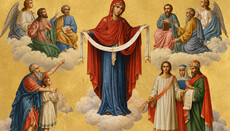
The second gesture is the open hands of the Most Holy Theotokos, which we see in icons of the Annunciation. The hands of the Most Pure Virgin are turned upward. It may well be the most courageous gesture in human history.
When she says to God through the angel, “Let it be unto me according to thy word,” she does not surrender to circumstances – she opens herself entirely to God. She does not break through a wall; she becomes the door through which God Himself enters the world.
The righteous Nicholas Cabasilas wrote plainly in his Homily on the Annunciation: “Without the consent of the Immaculate One, without the cooperation of her faith, this plan would have remained unfulfilled just as surely as without the action of the Three Divine Persons of the Holy Trinity.”
Mary answered not only for herself. She answered for all humanity. And it was her “yes” that reopened the door which Adam’s fist had once slammed shut.
“My Joy!”
In prayer we often try to explain to God how our lives ought to be arranged – that is the voice of the inner Adam with his clenched fists. Lent slowly teaches us to open them. We begin to learn not to dictate terms to God, but to listen attentively to His word. This is the feminine posture of the soul of which the Fathers speak – not passive weakness, but the attentiveness of love.
Here we encounter a paradox that is hard to overlook.
The sternest ascetics – those whom we might imagine to be hard and distant – often prove to be the gentlest of men.
Saint Seraphim of Sarov lived for years in the forest, prayed upon a stone, and survived on wild herbs. One might imagine such a man hardened by fasting and solitude. But everyone who came to him heard the same greeting: “My joy!”
It was not politeness. It was not a role. It was the living cry of a soul so filled with light that it could not help shining upon others. He was not merely “doing things for God.” He was living with God in every moment of his life. And that is why from years of silence and hunger there blossomed in Saint Seraphim a tenderness that was almost childlike.
People came to him not for terrifying rebukes or rigid rules of life. They came for the warmth of the soul – the warmth so often lacking in the world. It was precisely this openness of heart, gained on a stone in the forest, that made him one of the most beloved saints, one to whom we still turn today with our deepest needs.
The courage to remain with God
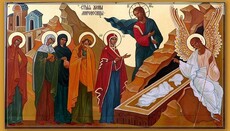
Christianity itself stands upon the faithfulness of the myrrh-bearing women. While the apostles hid behind locked doors – strong, trained, initiated men – those women simply remained beside the Cross. They did not have the strength to roll away the stone from the tomb. But they possessed something the apostles lacked that night: the courage to love when everything seems lost, and simply to remain beside God when He appears already beyond reach.
Our inner Adam clenches his fists not only in sin. He clenches them even in fasting – when we glance with irritation at another’s plate, when our own strictness becomes the measure by which we judge someone else’s weakness. If during these days we catch ourselves in such pride, then Adam has once again reached for the fruit. Fasting as mere self-discipline still belongs to the territory of the old forefather. Fasting as openness of the soul to God belongs to the new story of the Gospel.
The most courageous act we are called to perform in the middle of Lent is simply this: to unclench our hands, like the Virgin Mary, and admit that we cannot overcome the assault of our passions by ourselves.
Not because we are weak. Life has already made us strong and resilient.
But because becoming the “Bride of Christ” is the hardest feat a human being can undertake.
The Mother of God said, “Let it be unto me according to thy word,” and the world was changed. We do not know what will happen to us if we truly say the same. But that is what all of Lent is about.