Novinsky introduces to Parliament bills aimed at protecting believers
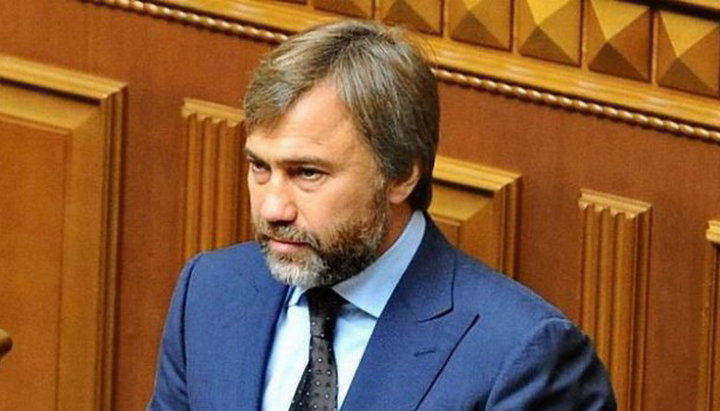
People's Deputy Vadim Novinsky. Photo: 24tv.ua
On August 29, 2019, two new bills were registered on the website of the Verkhovna Rada: draft Law No. 1107 of 29.08.2019 “On amending the Criminal Code of Ukraine Regarding the establishment of criminal liability for obstructing the activities of religious organizations” and draft Law No. 1104 of 29.08.2019 “On amending certain laws of Ukraine regarding the activities of religious organizations”.
The initiators of the bills are a group of deputies of the IX convocation, headed by Vadim Novinsky.
An explanatory note to the draft Law “On amending certain laws of Ukraine regarding the activities of religious organizations” says that the new rules for registration and re-registration of statutes (regulations) of religious communities, introduced by Law No. 2673-VIII, contradict the requirements of the OSCE, and “despite this, a number of significant burdens were introduced for religious communities related to the registration of a new version of the statute (regulation) and / or the introduction of appropriate amendments to the statute (regulation) of a religious community, most of which are explicitly described as prohibited in the Guidelines (of the OSCE – Ed.). ”
In this regard, the deputies proposed to make a number of changes, including on the rules for determining membership in a religious community in accordance with the provisions set out in the statute of the religious community. In addition, community membership is determined by the continued active participation of its member in the statutory activities.
The annex to the law proposed suggests that voting for transfer to a particular jurisdiction is possible only if the organization provides for fixed membership.
The draft Law "On amendments to the Criminal Code of Ukraine regarding the establishment of criminal liability for obstructing the activities of religious organizations" provides for the introduction of criminal liability for obstructing the activities of religious organizations.
An explanatory note to the bill says: “Recently, pressure has begun on representatives of the Ukrainian Orthodox Church of the Moscow Patriarchate, in particular, there are force incursions into the premises of the Eparchial Administration to exert pressure on bishops, pickets organized outside its buildings, and illegal collection of personal data from closed databases of state authorities, etc.
Given this, it became necessary to adopt this bill, which proposes to introduce criminal liability for obstructing the activities of religious organizations.”
On September 5, both bills were sent for consideration by the Humanitarian and Information Policy Committee and the Law Enforcement Committee, respectively.
Read also
432 UOC churches damaged in Ukraine during war, report says
According to the Religion on Fire project, 807 religious buildings in Ukraine have been damaged or destroyed as a result of hostilities.
DESS official gives number of clergy exempt from mobilization in Ukraine
A DESS representative said the actual number of clergy exempt from mobilization is significantly lower than the number of religious organizations designated as critical.
Cabinet keeps gas prices unchanged for religious organizations
The Cabinet has fixed gas prices for religious organizations through the end of the 2026–2027 heating season.
Concert held at seized Cherkasy cathedral
The OCU thanked the musical ensemble for choosing the Cherkasy cathedral as the venue for a Baroque music concert.
OCU activist admits breaking into UOC church in Sloviansk
Oleksandr Onyshchenko said that the OCU held its first "service" at the Seraphim Church, which had previously been broken into by forcing the locks and doors.
Archimandrite Ioustinos, longtime keeper of Jacob's Well, dies in Jordan
Archimandrite Ioustinos (Mamallos), the keeper of Jacob's Well in Nablus, has died after a prolonged illness.