Minister of Culture supports the law on involuntary renaming of UOC
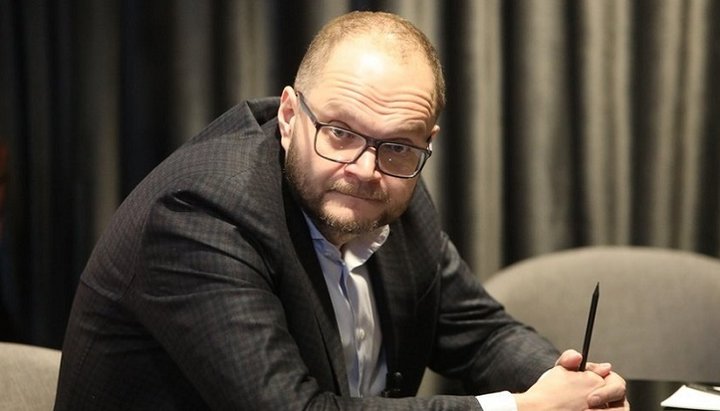
Vladimir Borodiansky. Photo: Ukrinform
The state simply proposes to identify who is who in Ukraine, and there are no problems, said the Minister of Culture, Youth and Sports Vladimir Borodiansky in an interview with “RISU” published on November 6.
“We understand that the centre of influence on the Ukrainian Orthodox Church of the Moscow Patriarchate is located in Russia, in Moscow,” the head of the ministry said. “Of course, Ukraine must somehow take this into account. And I consider the principle that the Church should identify in its name that it refers to the Russian Orthodox Church is an understandable norm that simply determines who is who. Everyone should understand that the center of influence on the Ukrainian Orthodox Church of the Moscow Patriarchate is in Moscow – through the same Synod.”
At the same time, he clarified that he considers it not very correct when the state intervenes in such things as the name of the Church, however, he agrees with this law on forced renaming.
“During the war, during the period of aggression against our country, when events in the East take place, and they have been going on for a long time, and when the Crimea has been occupied, I think that it’s normal when the country indicates who is who. And it seems to me that (these requirements – Ed.) cannot be considered interference in this context so that people can consciously choose. The state did nothing, it simply said: let's denominate. That’s all. Freedom of religion remains, but let's specify who is who in this territory. I don’t see any problems in this,” said Borodiansky.
As reported by the UOJ, on December 20, 2018, the Verkhovna Rada adopted a law obliging the UOC to indicate in its name affiliation with the Russian Orthodox Church. On December 22, the law was signed by Petro Poroshenko. The UOC began to defend its rights in court.
In March 2019, the District Administrative Court of Kiev opened proceedings in the case of the UOC’s claim for invalidating the decision of the Ministry of Culture, obliging it to indicate its affiliation with the Russian Orthodox Church in its name. On April 22, the court stopped the process of the involuntary renaming of the Ukrainian Orthodox Church. The Ministry of Culture filed an appeal against this decision, but the court dismissed it.
Read also
Met. Meletiy consecrates house of worship for UOC community in Dankivtsi
Members of the persecuted UOC Intercession parish in Dankivtsi have converted a house into a place for communal prayer and worship services.
OCU eparchy sells church center site to developer for housing
The OCU’s Volyn Eparchy sold land intended for a spiritual center to a private developer planning to build townhouses and residential buildings.
SBU names UOC priest’s wife a suspect in Cherkasy region
The SBU accused Matushka Kateryna Prykotenko of “spreading enemy propaganda” through correspondence with parishioners.
UGCC cleric calls Russian Orthodox literature dangerous for clergy
While examining the causes of divisions within the UGCC, Yustyn Boiko concluded that Russian Orthodox literature had influenced Greek Catholic clergy.
UOC will play major role in achieving peace, says Vadym Novynskyi
UOC Protodeacon Vadym Novynskyi believes the Church will help bring about reconciliation within Ukrainian society after the war ends.
Catholic media outraged by forcible conscription of Uniate cleric
The Vatican’s Apostolic Nunciature has demanded the return of a forcibly mobilized Greek Catholic cleric.