"Hitler’s Pope" and ecumenism: why Vatican declassifies dirt on Pius XII
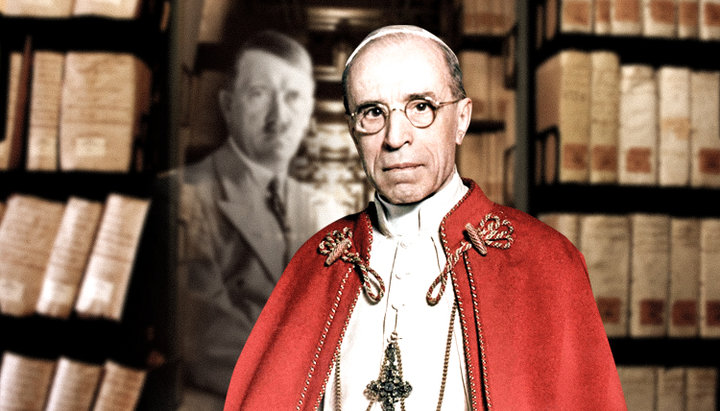
Pope Pius XII. Photo: UOJ
On March 2, 2020, the Vatican opened up secret archives on Pius XII (1939-1958), who some critics call "Hitler’s Pope", for scrutiny. He received this hard-hitting nickname for knowing and keeping silent about Nazi crimes at best, and for approving and even facilitating them at worst.
Why would the Vatican reveal the mysteries of one of the most controversial periods in its history, how could this affect the position of Catholicism, and whether it could affect the relationship between the Latins and Orthodoxy?
Pope Francis decided to open access to the documents of the pontificate of Pius XII about a year ago. More than 200 historians from different countries have applied to work with these archives. Seats in the room where it is possible to work with documents are reserved until the end of 2020.
In total, this part of the archive consists of approximately 16 million pages in dozens of world languages. According to German historian Sascha Hinkel, who is also going to work with these documents, it will take about 20 years to analyze them all. However, five years will be enough to get answers to the most important questions. Thus, by 2025, there may be documented conclusions about the collaboration or at least connivance to the Nazi crimes of the then head of the Vatican.
By a strange coincidence, it is in 2025 that the 1700th anniversary of the First Ecumenical Council (325) will be celebrated. Can this declassified information affect the content of these events? In our opinion, it can.
The part of the Vatican’s Archive opened to historians consists of approximately 16,000,000 pages in dozens of languages.
But first, briefly about the personality of Pope Pius XII.
Eugenio Maria Giuseppe Giovanni Pacelli, future Pius XII, was born on 2 March 1876 in Rome into a family of intense Catholic piety with a history of ties to the papacy (the "Black Nobility"). The descendants of these families, as a rule, held high positions in the Vatican. The grandfather of Pius XII was the Deputy Minister of Finance of the Vatican, his father was the main Vatican lawyer, his brother was the legal advisor to Pope Pius XI, his cousin was a key financial advisor to Pope Leo XIII, etc.
In 1899, having completed the course of theology, Eugenio Pacelli was ordained a priest. In 1901 he entered the Congregation for Extraordinary Ecclesiastical Affairs, a sub-office of the Vatican Secretariat of State. Here he took an active part in the compilation of the Code of Canon Law, as well as one very interesting document – "The Oath Against Modernism".
The anti-modernism oath was required of "all clergy, pastors, confessors, preachers, religious superiors, and professors in philosophical-theological seminaries" of the Catholic Church from 1910 until 1967. It contained the following wording: “I declare that I am completely opposed to the error of the modernists who hold that there is nothing divine in sacred tradition. ...> I firmly hold, then, and shall hold to my dying breath the belief of the Fathers in the charism of truth. ...> dogma may be tailored according to what seems better and more suited to the culture of each age; rather, that the absolute and immutable truth preached by the apostles from the beginning may never be believed to be different, may never be understood in any other way. ...> Thus I promise, this I swear, so help me God."
Designed in an extremely conservative spirit, this document largely determined Pius XII's lifelong commitment to tradition and resistance to modernism. In other words, the world must change and adapt to the teaching of the Vatican.
The conservatism of Pius XII made many Catholic hierarchs realize at the end of his pontificate: such a policy leads to the self-isolation of the Catholic Church. And this resulted in the fact that after the death of Pius XII, the pendulum swung the other way: the “Oath Against Modernism” was revoked and Pope John XXIII who took the throne pursued the exact opposite policy: not the world should adapt to the Church but the Catholic Church should adapt to a changing world.
The result of this turn was the Second Vatican Council, which proclaimed the policy of aggiornamento – the renewal of all aspects of church life. This policy also includes a call for ecumenical unity with the Orthodox and Protestants. However, we ran far ahead ...
The conservatism of Pius XII made many Catholic hierarchs realize at the end of his pontificate: such a policy leads to the self-isolation of the Catholic Church.
In 1914, Eugenio Pacelli became the under-secretary of state of the Vatican, in 1917 – the Papal nuncio (ambassador) to Bavaria, and since 1920 – the nuncio to all of the German Empire. John Cornwell in his book “Hitler's Pope: The Secret History of Pius XII” cites his statements of that time: “constant harping on the Jewishness of this party of power usurpers”; “growing and widespread belief among Germans that the Jews were the instigators of the Bolshevik revolution, their principal aim being the destruction of Christian civilization”; "the capital of Bavaria, is suffering under a harsh Jewish-Russian revolutionary tyranny". At the same time, Pacelli in many speeches was critical of the nascent German National Socialism.
In 1929, Pacelli became Сardinal, and in 1930 he was appointed to the post of Cardinal Secretary of State of the Vatican, i.e. Minister of Foreign Affairs. In this capacity, he signed agreements (concordats) on behalf of the Vatican with a number of states, including Nazi Germany (1933).
On March 2, 1939, Eugenio Pacelli was elected Pope, and he took the name Pius XII after his predecessor Pius XI. The beginning of his pontificate coincided with the beginning of the Second World War. His actions and statements during this period provide grounds for directly opposite assessments.
The British historian John Cornwell in his book “Hitler's Pope ...” strongly criticizes Pius XII for his policy towards Nazi Germany.
In contrast, the American historian David G. Dalin in the book “The Myth of Hitler's Pope” claims that he actually opposed Nazism.
On the one hand, Pius XII declared "hundreds of thousands of people who, without any guilt on their part, sometimes only because of their nationality or race, were put to death and slow destruction".
On the other hand, he kept silent about the mass extermination of Jews and even encouraged the actions of the Croats, who were involved in the forcible catholisizing of the Serbian population, as a result of which more than 800,000 Orthodox Serbs were brutally killed.
For good relations with Croatian fascists, Ustaše, the British Foreign Office even called Pius XII "the greatest moral coward of our time".
According to some sources, at the end of the war, senior officials of the Vatican organized escape routes to South America for the leaders of the Third Reich, which the U.S. Intelligence called “rat paths” in its reports.
For good relations with Croatian fascists, Ustaše, the British Foreign Office even called Pius XII "the greatest moral coward of our time".
After WWII, Pius XII was actively engaged in the struggle against communism and the development of the Vatican's diplomatic relations with other countries.
In 1950, he proclaimed the Catholic dogma of the bodily resurrection of the Mother of God and Her ascension to heaven, followed by coronation.
In fact, the first three centuries of Christianity are characterized by the complete silence of documentary sources about the Assumption of the Blessed Virgin Mary. St. Epiphanius of Cyprus at the end of the 4th century wrote: “Let them search the Scriptures. They will not find whether she died or did not die; they will not find whether she was buried or was not buried.”
Some information about the circumstances of the burial of the Blessed Virgin Mary appears only after the 4th century, and even then in the form of apocryphas. But in the West, this story took root and developed, and from there it partially went to Orthodoxy.
In general, Pius XII was a great admirer of the Holy Virgin and in 1942 even symbolically dedicated the whole world to the immaculate heart of Mary.
He is also known as a scholar-theologian. During his pontificate, he wrote 41 encyclicals and about 1,000 messages and speeches in which he addressed a variety of topics – from dogmatic theology to medical issues.
Pope Pius XII died on October 9, 1958, at the age of 82.
In 2009, the then Pope Benedict XVI declared Pius XII “venerable”, i.e. began the process of canonization. As you know, Benedict XVI adhered to rather conservative views but was forced to submit a petition for his resignation, which had never been in the history of the papacy for the past 600 years. He was replaced by Pope Francis, who can conditionally be related to the liberals. This Pope kisses the feet of Muslim migrants, apologizes to homosexuals for their bad attitude towards them, and participates in the worship of the pagan goddess Pachamama.
The famous theologian Alexei Osipov gave Pope Francis the following characterization: “Perhaps, there has never been such a liberal pope as Francis. I used to think that there couldn't be worse than John Paul II, but it turned out it could. The previous Pope Benedict XVI was a real Catholic, serious, devoted. But no, it turned out he did not fit. Well, Francis is not just a man of our era in terms of time, but a man of our era of thought, our era of spirit. A man who isn’t ashamed to take steps that cross the line of reverence for the Holy Scriptures, the teaching of Christ."
Not surprisingly, the Catholic Church has formed a wing of conditional conservatives in opposition to Francis. It is led by American Cardinal Raymond Burke.
In 2016, the Cardinals, dissatisfied with Francis, even published an open letter to the Pope, which raised very uncomfortable questions for him in connection with the encyclical “Amoris Laetitia”. Considering that the opinion of the Pope expressed ex cathedra is considered infallible, such a letter amounts to open rebellion.
Francis did not consider it necessary to respond to the letter. Instead, he continued the practice of removing conservative-minded cardinals from influential posts in the Vatican.
Thus, if historians who began to study the Vatican’s archives from the time of Pius XII find documents compromising one of the most conservative popes of the 20th century, it’s highly probable that Francis will get an additional trump card in the fight against conservatively-minded cardinals.
The BBC agency, in a message about the opening of the Vatican archives, writes: “If the scientists’ assumptions about his tacit connivance to the extermination of Jews are true, this could further undermine the reputation of the Church, which has recently become mired in scandals, in particular related to pedophilia.”
If historians find documents that compromise one of the most conservative popes of the 20th century, Francis will get an additional trump card in the fight against conservatively-minded cardinals.
The Vatican’s reputation can really be shaken, but along with this, supporters of church reforms and, above all, Pope Francis will have the opportunity to more actively promote the ideas of renewing and adapting the Church to the needs of society.
As for the Vatican’s dialogue with the Orthodox Churches and, above all, with the Phanar, Francis’s victory over his conservative opponents will naturally serve as a catalyst for such a dialogue. Perhaps by 2025, there will no longer be any cardinals in the Vatican who can oppose the policies of Pope Francis, and in the year of the 1700th anniversary of the First Ecumenical Council, we may expect an attempt to unite the Orthodox with Catholics.
Of course, we should not exaggerate the importance of opening archives both for confronting conditional liberals with conditional conservatives in the Vatican and for Orthodox-Catholic relations. However, there is no doubt that Francis's move will play a role in all this.
Read also
Pentarchy with Rome: A return to the roots or a new schism?
Patriarch Bartholomew wants to revive a council of five patriarchates, including Rome. What would reunion with Catholics look like, and what role would be left for the other Churches?
Concubine or daughter? On words that cannot be used about the Church
An archon of the Church of Constantinople likened the UOC to Moscow’s “concubine.” But for St. Epiphanius of Cyprus, “concubines” are heresies.
Shameful chronicle of one week: how the OCU was born
Exarchs under escort, a call from the operations room, and 36 votes for Epifaniy: what a member of the Phanar delegation revealed about the 2018 "Council".
Can UOC eparchies be dissolved before court ruling on Metropolia?
DESS is launching separate proceedings against UOC eparchies, monasteries, and institutions while the case involving the Kyiv Metropolia is still pending.
Two murders, one silence
Zelensky condemned the killing of a Catholic priest in Poland the very same day. A month earlier, a UOC monk was murdered at the Sviatohirsk Lavra – and the president has remained silent ever since.
A bow to Phanar? Why did UOC academy congratulate Constantinople’s exarch?
A delegation from the Kyiv Theological Academy congratulated the Phanar’s exarch, who has remained silent about the persecution of the UOC. Who authorized this gesture, and why did even OCU supporters fail to appreciate it?