Elena Bohdan: OCU is a matter of national security
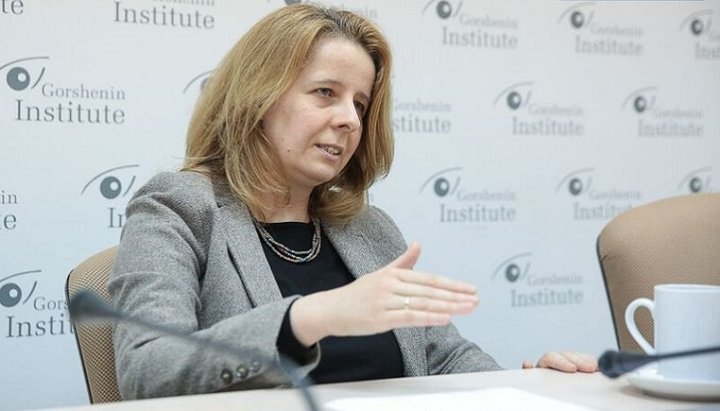
Elena Bohdan. Photo: LB.ua
The OCU as a full-fledged entity on the world stage certainly relates to national security issues. The head of the new State Service for Ethnic Policy and Freedom of Conscience Elena Bohdan told in an interview with LB.ua.
In her opinion, many people do not understand the importance of the Tomos in Ukraine.
“Before the Thomas was received, the Ukrainian Orthodox Church of the Kyiv Patriarchate was not represented in Universal Orthodoxy and, as a result, couldn’t formally communicate with, for example, the Vatican or with European or world interreligious organizations. There were limited opportunities to communicate with embassies, international organizations, that is, it did not have a full voice on the world stage," explained Bohdan. “Now the OCU is a subject on the world stage, including diplomatic negotiations,” Bogdan explained.
She specified that such communication intersects with the Ministry of Foreign Affairs and the Office of the President, “and since our situation goes beyond the purely religious sphere and has a geopolitical dimension, of course, this cannot happen without the attention of all government agencies that are to some extent engaged in issues of state security. Thus, we go to a very wide range of structures – this is the President's Office, the Verkhovna Rada, and the Cabinet of Ministers, the Ministry of Foreign Affairs and the Security Service of Ukraine.”
"At the same time, we must always remember where the line between national security and religious freedom in Ukraine is," the head of the State Service for Ethnic Policy and Freedom of Conscience emphasized. “If someone works to undermine the sovereignty of Ukraine or its territorial integrity, there should be a reaction to it. If someone works to use hate speech, to polarize Ukrainian society, there should be a reaction to it, in particular of the SBU. If we are talking about a choice who to belong to, with whom to pray together, with whom to be in eucharistic communication, we should leave the freedom of choice to the religious community. We may be very sad that someone refuses to pray together with others, but that is the right of this religious organization."
As reported earlier, the head of the liquidated UOC-KP Filaret Denisenko congratulated Elena Bohdan on her appointment to the post of the head of the State Service for Ethnic Policy and Freedom of Conscience, expressing hope that with her appointment "illegal preferences for privileged confessions will finally disappear" in Ukraine and "the UOC-KP and the state will be able to establish mutually beneficial partnership relations".
Read also
DESS declares UOC Zaporizhzhia Eparchy affiliated with ROC
The Zaporizhzhia Eparchy has become the fourth UOC religious organization to be declared affiliated with the Russian Orthodox Church by Ukrainian authorities.
Metropolitan Onuphry leads patronal feast at Kyiv’s Intercession Monastery
The UOC Primate ordained a priest and a deacon at St. Nicholas Cathedral of the Intercession Monastery.
Dumenko: Negotiating with UOC on its terms would mean surrender for OCU
The OCU head expressed confidence that his organization would emerge victorious on Ukraine’s “religious front.”
OCU rep claims UOC parishes in Germany may threaten its national security
OCU cleric Petro Bokanov believes expansion of UOC structures in Germany is a threat to German national security.
UOC priests consecrate cardiology center wards in Uzhhorod
Priests of the Mukachevo Eparchy served a moleben for the health of doctors and patients of the cardiology center in Uzhhorod.
Metropolitan Onuphry explains how to live so as not to grieve Mother of God
The Primate of the UOC said in a sermon on the Protection feast at the Intercession Monastery that one must live by God's commandments even when they are inconvenient for the modern world.