UOC Legal Department head comments on 4 bills on UOC ban submitted to VR
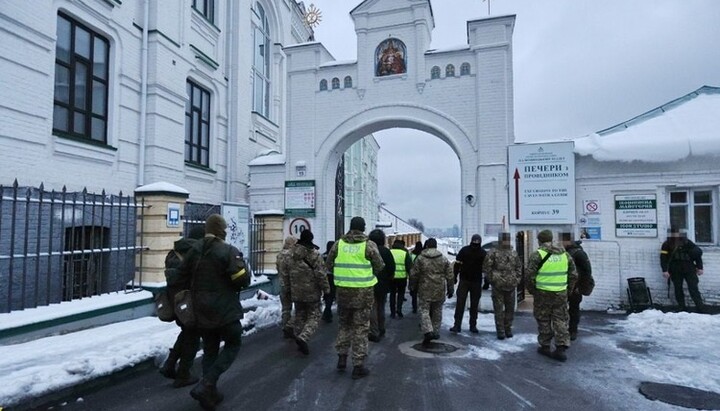
The SBU came to the Kyiv-Pechersk Lavra to conduct counter-intelligence activities. Photo: SBU
At a press conference on 15 December 2022, the head of the UOC Legal Department, Archpriest Oleksandr Bakhov, analyzed four draft laws submitted to the Parliament on limiting the activities or banning the UOC.
Before considering the legal aspects of the bills, the head of the Legal Department called it nonsense that "a European state produces laws that are aimed at banning the activity of the largest denomination in the country”.
Archpriest Oleksandr Bakhov recalled that on December 9, 2022, the VR Committee on Human Policy considered four draft laws against the UOC and recommended that Parliament adopt them. Fr Oleksandr stressed that although none of the bills mentioned the UOC, it was clear from the accompanying documents that they are directed exactly against the Ukrainian Orthodox Church. The authors of the bills do not hide their intentions when giving interviews to the media.
The head of the Legal Department said that all anti-UOC bills are legally illiterate and violate the laws of the Ukrainian Constitution.
The first bill refers to the non-profit status of religious organizations. It proposes to strip off the non-profit status of a religious organization associated with a certain "centre based in an aggressor country’. At the same time, the bill considers only one particular denomination, which violates the principle of equality enshrined in the Constitution. A religious organisation stripped of its non-profit status will be taxed as a business entity. However, no religious organization is in business and all of them exist thanks to donations or contributions from their members, said Fr Oleksandr.
Bill 8262 is aimed at making it easier to forcibly transfer religious communities to another denomination. Changing the subordination no longer requires a notarized copy or the original statute and certificate of registration, and the decision to change the community's affiliation can be approved by two-thirds of those present at the meeting. In other words, if 20 people out of 100 came to the meeting, then two-thirds of those 20 would be enough to change the confession.
The same draft law deals with the procedure of changing the confessional affiliation of eparchies, monasteries and missions – this is done so that it would be possible to take over eparchies and monasteries, as it is now done with churches.
The third draft law concerns the transfer of the Kyiv-Pechersk and Pochaiv Lavra to the OCU. Several violations can be seen here at once. To begin with, the legislative power body interferes with the activity of the executive power body. Next, the subject of the executive initiative itself refers to Article 17 of the Law on Freedom of Conscience and Religious Organisations, explaining that state property can be handed over to religious organisations for alternate use, and if one of the organisations does not agree, then the owner (the state) establishes the procedure for using this property independently.
However, there is a "but" here. The thing is that today the Kyiv-Pechersk and Pochaiv Lavra already have documents, on the basis of which the monasteries use the architectural complexes. And these documents cannot be withdrawn by the decision of the Cabinet of Ministers or other public authority – the right to use them must be withdrawn through the courts.
However, the most blatant is Kniazhytsky's latest draft law.
Firstly, it introduces a monopoly on the use of the word "Orthodox" – only the OCU and organizations that have received permission from it can use this term. Statutes of other religious organizations that use this word must be abolished.
Secondly, such wording as "foreign religious organization" is being introduced, the criteria for which are vague, and such an organization is subject to the denial of rights. Any other religious organisation which interacts with a "foreign" organisation will have to obtain permission from the DESS (the State Service of Ukraine for Ethnopolitics and Freedom of Conscience). However, even after obtaining permission, this "foreign religious organisation" will not be able to have international relations and contacts with other Churches without the DESS’s permission.
"These bills do not meet the norms of international law, violate the Constitution of Ukraine and do not meet the requirements of legal technique. These laws should be removed from the agenda and not put to a vote," the head of the UOC Legal Department, Archpriest Oleksandr Bakhov, resumed.
As reported, the Committee on Humanitarian Policy has proposed to the Rada to approve two bills against the UOC.
Read also
OCU activist admits breaking into UOC church in Sloviansk
Oleksandr Onyshchenko said that the OCU held its first "service" at the Seraphim Church, which had previously been broken into by forcing the locks and doors.
Archimandrite Ioustinos, longtime keeper of Jacob's Well, dies in Jordan
Archimandrite Ioustinos (Mamallos), the keeper of Jacob's Well in Nablus, has died after a prolonged illness.
Pilgrim group from Kyiv Theological Seminary visits Mount Athos
KTS students are making a pilgrimage to the holy sites of Romania, Greece, Mount Athos and Italy.
UOC cathedral celebrates its patronal feast in Ternopil
The service in the cathedral of the Holy Martyrs Faith, Hope, Love and their mother Sophia was led by Metropolitan Serhii of Ternopil, concelebrated by four hierarchs.
MinCulture marks centenary of Soviet-era reserve at Lavra's Refectory Church
Representatives of the Ministry of Culture presented awards to the Reserve's employees on the occasion of the anniversary at the Refectory Church of the Lavra.
Conference to mark 1700th anniversary of Christianity adoption held in Georgia
In Georgia, representatives of the Church and the state noted the defining role of Christianity in the country's cultural development.