Presidential Office: Renaming of UOC – pressure and political manipulation
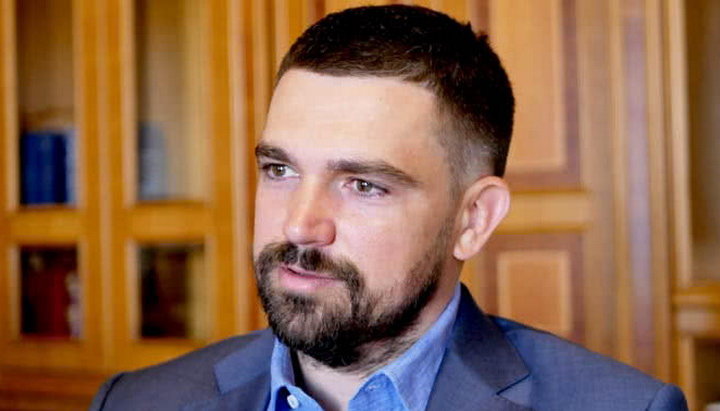
First Deputy Head of the Office of the President Sergey Trofimov. Photo: pravda.com.ua
On April 10, 2020, the First Deputy Head of the Presidential Office, Sergey Trofimov, commented on anti-church law No. 5309, which obliges the Ukrainian Orthodox Church to change its name as the Church “whose administrative center is located in the aggressor country” to become the “Russian Orthodox Church in Ukraine,” in an nterview to Glavcom.
Asked “why the process of transition of religious communities to the OCU has stopped”, Sergey Trofimov answered that this process, “unfortunately, was very politically-biased. People decide for themselves what faith to choose and what religion to profess. But politically, these manipulations about the Moscow Church (UOC – Ed.) and others are fictitious, spun and launched.”
“There is the Ukrainian Orthodox Church, where Ukrainian priests, Ukrainian monks, and parishioners are citizens of Ukraine. I mean, nobody has brought anyone here from Tajikistan, actually. While at my post, I do not give orders in someone’s favor and do not deal with these processes in my line of work. But as a believer and a citizen I, of course, will uphold the rule of law in resolving church-related issues. I receive many letters and complaints about illegal re-registration coupled with local pressure. Therefore, the heads of the RSA are tasked with monitoring the legality of these processes,” explained the First Deputy Head of the Presidential Office.
According to Sergey Trofimov, the position of President Vladimir Zelensky is that "the Church is separated from the state, and the state from the Church, the Church does not affect politics, and the state does not affect the life of the Church."
“I share the same position,” he added. “But I receive the appeals of a different content. The Ukrainian Orthodox Church addresses us and says that it does not need any preferences or special treatment. All it needs is not to be put under pressure as in previous years. That’s all they ask for.”
Sergey Trofimov emphasized that Law No. 5309 on the forced renaming of the UOC is pressure on the Church and recalled that it is disputed in court.
As reported by the UOJ, on December 20, 2018, the Verkhovna Rada adopted a law obliging the UOC to indicate affiliation with the Russian Orthodox Church in its name. On December 22, this law was signed by Petro Poroshenko. The UOC began to defend its rights in court.
In March 2019, the Kiev District Administrative Court opened proceedings in the case on the suit of the UOC on invalidating the decision of the Ministry of Culture, obliging it to indicate its affiliation with the Russian Orthodox Church in its name. On April 22, the Constitutional Court stopped the process of forcible renaming of the Ukrainian Orthodox Church. The Ministry of Culture challenged the decision, but the Court dismissed it.
Read also
Lionel Messi thanks God for his achievements as he ends international career
Argentine football star Lionel Messi credited God for his success as he brought his international career to a close, saying he could never have achieved so much without God's will.
Odesa’s St. Elijah Monastery honors memory of its founder
Metropolitan Agafangel led celebrations at St. Elijah Monastery in Odesa on the feast day of St. Gabriel of Mount Athos.
OCU cleric rejects suspension, accuses ruling bishop of usurping power
An OCU cleric called the decree suspending him "canonically null and void" and accused "Bishop" Semanchuk of attempting to seize parishes and using mobilization threats as blackmail.
Supreme Court: Religious beliefs do not exempt citizens from mobilization
The Supreme Court has clarified that Ukrainian law does not provide for alternative civilian service under martial law.
Ukraine birth rate drops 17%, demographer says
The head of a department at Ukraine’s Institute of Demography has reported a sharp decline in the country's birth rate.
Khust Eparchy honors memory of St. Job of Uholka
A Liturgy is served in Mala Uholka, a birthplace of St. Job of Uholka, on the saint's feast day.