State Ethnopolitics expertise calls UOC "a structural subdivision of ROC"
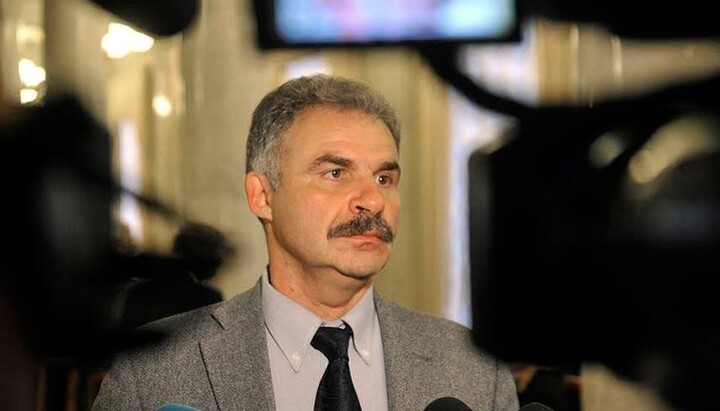
Head of the State Ethnopolitics Service Viktor Yelensky. Photo: risu.ua
The State Service of Ukraine for Ethnopolitics and Freedom of Conscience stated that as a result of the religious expertise of the Statute on the governance of the Ukrainian Orthodox Church for the presence of church-canonical connection with the Moscow Patriarchate, the experts concluded that the UOC remains part of the Russian Orthodox Church and does not even have the status of an autonomous Church.
The examination was carried out in accordance with the decision of the National Security and Defence Council of December 1, 2022 “On Certain Aspects of the Activities of Religious Organisations in Ukraine and the Application of Personal Special Economic and Other Restrictive Measures (Sanctions)”, put into effect by the Decree of the President.
“The adoption of a new version of the Statute on the management of the UOC (dated May 27, 2022) and the Resolution of the Council of the UOC did not lead to a rupture of the church-canonical connection of the Ukrainian Orthodox Church with the Russian Orthodox Church,” reports the State Ethnopolitics Service. “The status of the UOC as a structural subdivision of the ROC, enjoying certain rights of independence, but not forming an autocephalous Church, remains unchanged.”
According to the conclusion, "the UOC in relation to the ROC has an ecclesiastical-canonical connection of the part with the whole, the relations of the UOC with the ROC are not the relations of one independent (autocephalous) Сhurch with another independent autocephalous Сhurch."
According to the expert group of the State Ethnopolitics Service, the UOC also does not have the status of an autonomous Church, which would be recognized by other Churches, and "from the point of view of ecclesiology and canon law, it is a structural subdivision of the ROC, having separate rights of independent formation without its own canonical subjectivity".
“The current activity or inaction of the highest bodies of church authority and administration of the UOC indicates that the UOC continues to be in relation of subordination to the ROC. It does not act as an independent (autocephalous) Church and does not proclaim its own independence (autocephaly). No documents or actions that would testify to the transformation of the UOC into a religious organization independent of the ROC were found by the members of the expert group,” the State Ethnopolitics Service said.
As reported, President Volodymyr Zelenskyy, by his decree, put into effect the NSDC decision, by which he ordered the State Service for Ethnopolitics and Freedom of Conscience to conduct religious expertise of the Statute on the management of the UOC within two months for the existence of a church-canonical connection with the Moscow Patriarchate and, if necessary, "apply measures provided by law".
Read also
Upper Lavra court hearing postponed
The next court hearing in the Upper Lavra case has been scheduled for November 3.
UOC priest blesses ambulances at Kamianske medical center
A UOC priest in Kamianske blessed ambulances for a medical facility and wished its doctors God's help in their work.
Dumenko to German ambassador: Law targeting UOC also applies to other groups
Epifaniy Dumenko sought to defend Ukraine’s law restricting religious organizations during a meeting with the German ambassador.
Activists bused to court hearings in UOC cases, media say
A minibus has been spotted transporting protesters to and from courthouses where UOC cases are being heard.
Firefighters save historic UOC church from fire in Zakarpattia
A fire broke out at a UOC church in the Tiachiv district, damaging the altar and church furnishings.
Volyn Eparchy faithful collect six tons of aid for Sviatohirsk Lavra
Believers in Volyn collected food and warm clothing for people displaced by the war who have found shelter at Sviatohirsk Lavra.