Public opinion on affiliation of UGCC with OCU to be studied in Ukraine
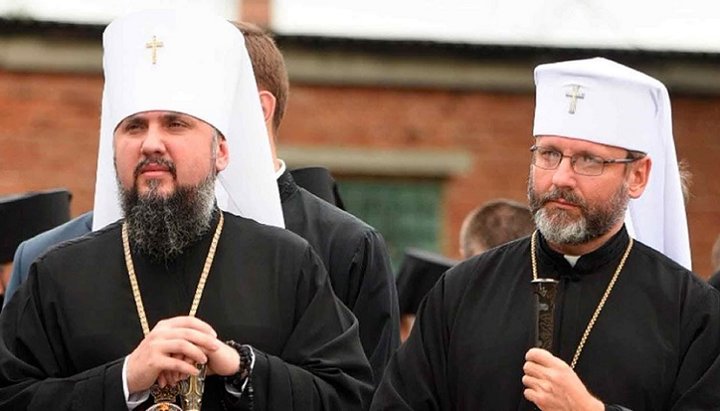
Heads of the OCU and UGCC Epiphany Dumenko and Sviatoslav Shevchuk. Photo: UGCC
The Institute for Foreign Policy Studies has announced a new comprehensive study, the full name of which is “Studying the public opinion of citizens and providing the most effective ways for the Ukrainian and Ruthenian Greek Catholic Churches to join the Orthodox Church of Ukraine, as well as creating a roadmap based on the Ukrainian experience for the ecumenical reunion of Orthodox and Greek Catholic Churches of the Byzantine rite." This was announced on June 3, 2020, on the organization’s website.
“In the framework of cooperation with the All-Ukrainian Council of Churches and Religious Organizations under the auspices of the Ecumenical Patriarchate, a decision was made to allocate us a research grant in the amount of 145 thousand Euros from the EU for the international platform program Global Exchange on Religion in Society,” the Institute said.
The grant provides for a comprehensive study in 2020-2021 and "the creation of a roadmap for the unification of Ukrainian Churches of various faiths with the subsequent use of Ukrainian experience for ecumenical reunification and the return of the Orthodox and Greek Catholic Churches of the Byzantine rite to the fold of the Ecumenical Patriarchate." Among the referred churches that are supposed to "return" under the jurisdiction of Constantinople, the Institute indicated Albanian, Belorussian, Bulgarian, Hungarian, Greek, Macedonian, Romanian, Slovak, Croatian and other Greek Catholic Churches, as well as "separate parishes in other countries EU, USA and Canada.”
The aim of the project is “to achieve mutual understanding between hierarchs and flocks in the process of ecumenical unification of the OCU, UGCC and RGCC, including the voluntary transfer of parishes and property under the control of the Local Church of Ukraine for Christian unity,” and the use of this experience “to facilitate the reunification of the Orthodox and Greek Catholic Churches of the Byzantine rite under the leadership of the Ecumenical Patriarchate."
The problem addressed, among other things, is “Russian hybression ('hybrid agression' with respect to Ukraine”.
“Moscow continues to destabilize the situation in the state, provoking violent and sectarian conflicts. Only a strong single local church can oppose this aggression. The eucharistic unity of churches will help to strengthen harmony not only within Ukrainian society, but also to unite the numerous branches of the Ukrainian communities worldwide and the peoples of Eastern, Central and Southern Europe. The experience of creating a single Ukrainian Local Church is only the beginning in the matter of religious unity. The next steps should be the development of a “road map” for the return of the Eastern Catholic Churches, which operate on the basis of the Byzantine rite, to the jurisdiction of the Ecumenical Patriarchate,” the report emphasizes.
As reported by the UOJ, in the territory of the Higher Theological Seminary of the Roman Catholic Church in Ukraine, a “maple of unity” of the RCC, the OCU, and the UGCC was planted.
Read also
Upper Lavra court hearing postponed
The next court hearing in the Upper Lavra case has been scheduled for November 3.
UOC priest blesses ambulances at Kamianske medical center
A UOC priest in Kamianske blessed ambulances for a medical facility and wished its doctors God's help in their work.
Dumenko to German ambassador: Law targeting UOC also applies to other groups
Epifaniy Dumenko sought to defend Ukraine’s law restricting religious organizations during a meeting with the German ambassador.
Activists bused to court hearings in UOC cases, media say
A minibus has been spotted transporting protesters to and from courthouses where UOC cases are being heard.
Firefighters save historic UOC church from fire in Zakarpattia
A fire broke out at a UOC church in the Tiachiv district, damaging the altar and church furnishings.
Volyn Eparchy faithful collect six tons of aid for Sviatohirsk Lavra
Believers in Volyn collected food and warm clothing for people displaced by the war who have found shelter at Sviatohirsk Lavra.