ROC hierarch: Changing Hagia Sophia status is a blow to global Orthodoxy
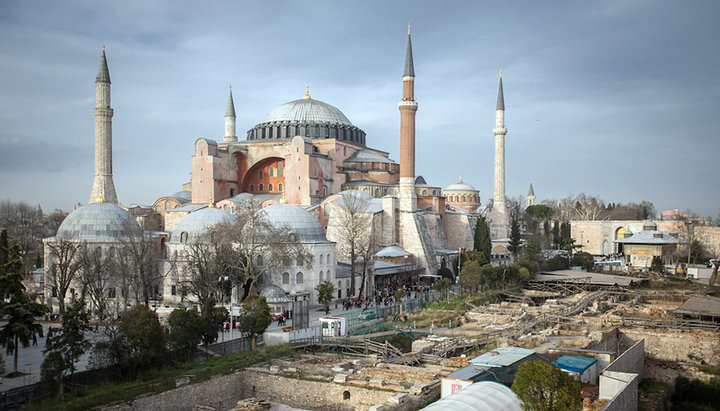
Hagia Sophia Cathedral in Istanbul. Photo: macos.livejournal.com
On July 10, 2020, the Head of the Department for External Church Relations of the Moscow Patriarchate, Metropolitan Hilarion (Alfeyev), said that changing the status of Hagia Sophia from a museum to a mosque is a serous blow to global Orthodoxy, reports Interfax Religion.
“With great regret and with great pain we take the today’s decision. This is a blow to the whole world Orthodoxy, because, Hagia Sophia is the same symbol for all Orthodox Christians worldwide as the St. Peter Cathedral in Rome for Catholics,” Vladyka said on Friday on the Russia-24 television channel.
Metropolitan Hilarion underscored that for the Russian Orthodox Church, Hagia Sophia "remains a temple dedicated to Christ the Savior."
The hierarch noted that the decision of the Turkish authorities to change the status of the shrine “was expected and repeatedly announced, but there was a hope until the last moment that the Turkish authorities would reconsider it.”
According to Metropolitan Hilarion, “this decision will certainly have negative implications for Turkey’s relations with the global Christian community”, especially since the Turkish authorities do not want to compromise and have repeatedly shown this with their actions.
He recalled that “it was repeatedly stated that the status of Hagia Sophia is an internal matter of Turkey, and Turkey itself decides what to do with this temple. Therefore, it is now obvious that Turkey did not want to compromise, nor did it want to hear the voices of those Christian leaders and the voices of those political leaders who called for this decision not to be adopted.”
Vladyka noted that Hagia Sophia Cathedral played a huge role in the history of the Russian Orthodox Church: “The historical choice made by the Holy Prince Vladimir was predetermined by the visit (of the Prince’s ambassadors – Ed.) to the shrine, and this was a choice that, in turn, preordained the whole history of Russia, that is, Christianity in Russia is directly connected with Hagia Sophia. And this temple is an unquestionable symbol for us.”
The Metropolitan also spoke about the mosaic images preserved on the walls of Hagia Sophia: “When this temple was first converted into a mosque, most of the mosaic images were simply knocked down with hammers, and only a small part was preserved under the stucco. What will happen to these murals – will they be knocked down with hammers, or smeared with plaster, or will they somehow be hidden from the eyes of those Muslims who will pray in this place? These and many questions are now being asked by Orthodox Christians around the world,” Vladyka Hilarion summed up.
Earlier, the UOJ wrote that, in the opinion of Metropolitan Anthony (Pakanich), the UOC Chancellor, an Orthodox prayer may sound again in Hagia Sophia Cathedral.
Read also
Volodymyr-Volynskyi Eparchy marks 30 years since restoration
The Pantanassa Icon and relics of Prince Volodymyr have arrived in Kovel and will visit churches across the Volodymyr-Volynskyi Eparchy to mark the 30th anniversary of the restoration of the episcopal see.
Bukovyna faithful bring humanitarian aid to Kherson region residents
The UOC’s Chernivtsi Eparchy delivered food to Holy Spirit Cathedral in Kherson.
Ukraine must have its own faith: Poroshenko's party lays out peace terms
Poroshenko’s party European Solidarity described church policy as a matter of national sovereignty and said there can be no compromises in this area.
432 UOC churches damaged in Ukraine during war, report says
According to the Religion on Fire project, 807 religious buildings in Ukraine have been damaged or destroyed as a result of hostilities.
DESS official gives number of clergy exempt from mobilization in Ukraine
A DESS representative said the actual number of clergy exempt from mobilization is significantly lower than the number of religious organizations designated as critical.
Cabinet keeps gas prices unchanged for religious organizations
The Cabinet has fixed gas prices for religious organizations through the end of the 2026–2027 heating season.