UOC-KP to challenge in court SBI resolution on closing case over its claim
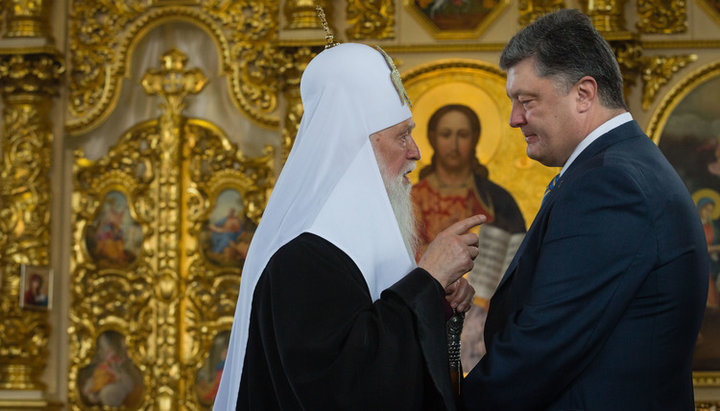
Head of the liquidated UOC-KP Filaret and ex-president of Ukraine Petro Poroshenko. Photo: president.gov.ua
In connection with the statement by the leadership of the State Bureau of Investigation on the closure of criminal proceedings on the claim of the UOC-KP, the Legal Department of the liquidated religious organization announced it would appeal this SBI resolution in court.
The official statement of the Legal Department of the UOC-KP, published on the religious organization's FB page, noted in particular that "as of July 31, 2020, the Kyiv Patriarchate has not received a resolution to close the criminal proceedings."
“Simultaneously with this, the Legal Department of the UOC-Kyiv Patriarchate initiated 21 court cases, the purpose of which is to protect the rights and freedoms of conscience of the Kyiv Patriarchate and its property,” the statement says. "Work in these directions will continue until the registration of the Kyiv Patriarchate as a legal entity has been renewed in accordance with its actual state."
The UOC-KP stressed that, taking into account the elements of criminal offences in the actions of state officials, “in order to comply with the principle of irreversibility of criminal responsibility for the crimes overtly committed, the decision to close criminal proceedings (if any) will be appealed in court, in accordance with Art. Art. 303-304 of the Criminal Procedure Code of Ukraine".
"We also express our gratitude to the SBI investigators for their principled position, the evidence provided and procedural initiatives that will be used in further work," the statement summarizes.
In a comment to the Pavlovsky news Telegram channel, the head of the Legal Department of the UOC-KP, Neonila Tkachenko, clarified that the criminal case was opened under Article 161 of the Criminal Code of Ukraine – violation of the equality of citizens based on their nationality or religious preferences, and the investigation should have identified specific culprits.
We will remind, earlier the State Bureau of Investigation reported about the closure of the criminal proceedings, referred to by Petro Poroshenko publicly as the "Tomos case", which in fact concerned the liquidation of the UOC-KP. Acting Director of the Bureau Alexander Sokolov explained that the case had been closed due to the absence of elements of a criminal offense and, in his opinion, the cancellation of the registration of the UOC-KP should be considered within the framework of administrative or civil proceedings.
According to Archpriest Alexander Bakhov, head of the Legal Department of the UOC, the SBI investigators closed the case prematurely, since it is, first and foremost, a violation of Ukrainian legislation and should be properly inquired.
Read also
Khust Eparchy honors memory of St. Job of Uholka
A Liturgy is served in Mala Uholka, a birthplace of St. Job of Uholka, on the saint's feast day.
UOC parish in Cologne donates ultrasound machine to Kharkiv region hospital
In Cologne, UOC believers raised funds for an ultrasound machine for the Kehychivka district hospital in the Kharkiv region.
Shevchuk tells Pope Leo of Ukraine's preparations for "another harsh winter"
The head of the UGCC expressed "special gratitude" to the Pope for his phone calls with Putin and Zelensky.
Berlin hierarch comments on Phanar document published by UOJ-USA
Metropolitan Mark called the information about the 2018 "Unification Council" alarming if confirmed, and expressed hope that Patriarch Bartholomew will reconsider his position.
UOC marks Synaxis of All Saints of Volyn Land at Lutsk cathedral
Metropolitan Serhiy of Ternopil and Kremenets led the Liturgy on the feast day of the Lutsk cathedral of All Saints of the Volyn Land.
SBU detains OCU cleric who organized draft evader's escape for money
In Transcarpathia, law enforcement officers detained a clergyman of the OCU who arranged for a draft evader to be smuggled into Slovakia for $15,000.