Idleness: an imperceptible sin dangerous to life
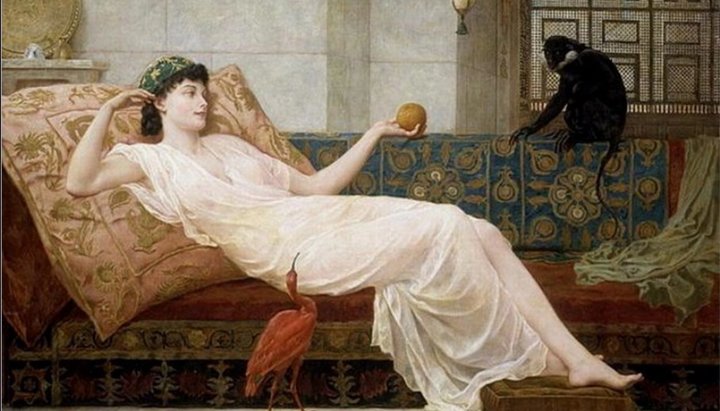
Idleness. Frederick Goodall. Photo: rceliamendonca.com
Such a sin as idleness is lucky if I may say so. In our strange time, it has not lost its face. It is in lies, fornication, anger, and many other sins that the modern world has long seen if not the norm then the inevitability, whereas idleness, despite everything, has always been considered a vice. Moreover, this viciousness is undoubted even for those for whom the very concept of viciousness if not the atavism of the distant past, it is certainly a convention.
Judge for yourself, will a non-believing boss be less demanding to a lazy employee than, for example, a believer? A non-believing wife will surely be “nagging” a good-for-nothing husband with the same ardour as a believer would. And gossipmongers whiling away the days of their good old time on a bench on the porch, undoubtedly will not show more indulgence towards a chronically unemployed neighbour than those who’re chatting during a service, sitting on a bench in the far corner of the church.
And yet, it is hardly possible to say that nothing has changed around idleness over time.
Not being able to idle for days on end, the modern man, nevertheless, spends many hours in idleness, often without even noticing it. The best opportunity for this is provided by such a benefit of civilization as the Internet.
To begin with, the "classic" idle pastime is not such a frequent occurrence. To spend time idly, you must at least have this time. Meanwhile, with the modern rhythm of life, such an opportunity is not available to everyone. Under the current conditions, even a non-family person must work more than eight hours a day, five days a week, to ensure a normal standard of living. And those who have a family, children, a host of relatives and, in addition, take care of elderly parents, are almost entirely chronically short of time as such. There seems to be no time to idle here.
However, this sin is still alive today.
Not being able to idle for days on end, the modern man, nevertheless, spends many hours in idleness, often without even noticing it. The best opportunity for this is provided by such a benefit of civilization as the Internet. Take social media. By themselves, they are certainly not dangerous. But this is provided that a person knows how to use them not to harm themselves. However, there are much more directly opposite examples around us.
Social media users spend long hours posting selfies, restaurant food photos, and pets from different angles. Here they communicate and have irreconcilable disputes in the comments, here they while away their working hours and sit out all night long. It is no exaggeration to say that they live here, and sometimes even more than in reality. And of course, all these streams of photos and videos, endless online battles and just thoughtless time-consuming scrolling of the news feed cannot be called otherwise than an idle pastime. After all, why spend hours doing nothing when you can pick up a smartphone every free minute?
Though TV, which is actively being replaced by the Internet, is gradually losing ground, in its current form it also provides many opportunities for wasting time. The same-like reality shows, nationwide discussions of the ups and downs of the personal life of celebrities, hours-long programmes about politics, the viewing of which instills in the viewer a firm belief in their own political literacy and social significance, plotless long-running series ... The price of watching such shows is about the same as if the time spent on them could be thrown into the trash.
Though TV, which is actively being replaced by the Internet, is gradually losing ground, in its current form it also provides many opportunities for wasting time.
If any of us do not surf the net for long or are not TV-addicted, do not relax and breathe a sigh of relief. Apart from the Internet and television, there are plenty of opportunities to waste time. For example, the fashionable pastime today is shopping.
Shopping usually takes place over a long period of time, sometimes with a clear shopping plan, sometimes without it, and sometimes it is pointless, but always accompanied by a desire to plunge into the intricate process of walking, looking around and purchasing. Of course, such pastime has a result in the form of purchases, but no matter how many of them there are and how much they are needed in the house, if it takes a lot more time than is actually necessary to make a purchase, then there is no more idle business than the case.
Of course, there is not the slightest doubt that all the above-mentioned keeps you busy for a while. Doing something like that, for example, all day long is at least difficult. However, the skill is developed by regular action rather than duration. And in this respect, even a couple of wasted hours a day is enough to form a vicious habit of idleness.
Over time, the desire to spend time in an idle way will only grow, and the strength and desire to counter this desire will become less and less. The result will be naturally deplorable: a person accustomed to idleness will no longer appreciate time. Going on the Internet for five minutes, he/she will easily spend half a day viewing unnecessary messages or texting in a messenger, any serious work will seem impossible for a person, and looseness, lack of self-discipline, irresponsibility and unreliability will become the key qualities. We can hardly talk about the life prospects of such a person because of their unenviable obviousness. But spiritual life is not worth talking about because it requires much more determination, focus, consistency and action than worldly life.
Therefore, the conclusion is simple: you need to learn not to waste an hour or a minute because the first step is the hardest, and each wasted hour offers a sad prospect of life lived in vain.
Read also
A lesson from a speechless donkey
The famous seer struck his donkey three times for refusing to go forward. All the while, she was saving his life – and seeing what he could not.
The time when the soul ripens
Modern society has turned youth into a cult and old age into a period of merely “living out one’s days.” The Christian perspective reveals the profound spiritual meaning of our later years.
Faith is not a checker piece in a spectator sport
Arguments about faith on social media increasingly resemble no-holds-barred fights. We turn to a saint who, sixteen centuries ago, knew how to speak to those interested only in turning theology into a combat arena.
The metropolitan who fought with a pen
St. Cyprian of Kyiv was robbed, expelled, and barred from his see. He answered with letters, books, and canons – and before his death, forgave everyone.
Loneliness under one roof
Spouses can share a home for years, raise children, and faithfully attend church – yet remain strangers to each other.
The cross – the deepest healing of the human soul
Emotional exhaustion and anxiety have become a way of life. Ancient Christian tradition offers an unexpected way out – embracing one's own cross.