Cherkasy bishop: The case against me is fabricated, it is a political order
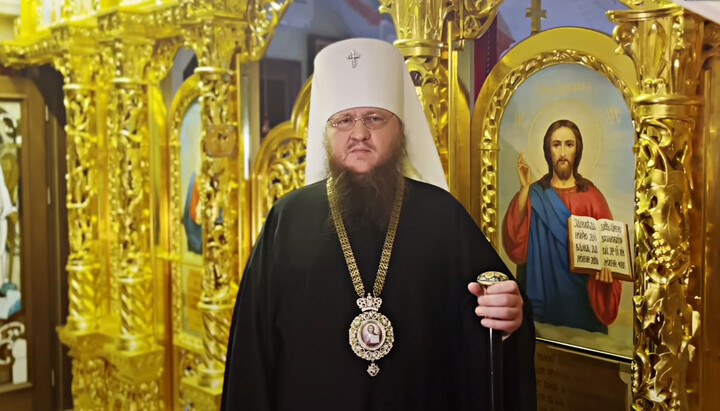
Metropolitan Theodosy (Snigirev) of Cherkasy and Kaniv. Photo: a video screenshot of the YouTube channel "Cherkaskyi Blagovisnik".
Metropolitan Theodosy, the head of the Cherkasy Eparchy of the Ukrainian Orthodox Church (UOC), claims that the criminal case against him is completely fabricated and is the result of a political order. This was stated in a video address by the hierarch, who is currently under round-the-clock house arrest.
"The whole case is fabricated; there is nothing there for which a person could actually be held accountable," said the metropolitan. "It is undoubtedly a political order, without any doubt."
The bishop explained that the criminal case was initiated based on reports from former clergy members of the Cherkasy Eparchy, whom he prohibited from ministry either due to involvement in schism or due to immoral behaviour.
"They acted as instruments in the hands of the persecutors of the Church, as executors of a political order," the metropolitan noted.
According to him, the case materials consist of seven volumes, which include, among other things, his interviews from the past 10 years.
"Naturally, there is a lot of criticism of the Kyiv Patriarchate and subsequently the Orthodox Church of Ukraine (OCU), a lot of criticism of the events and phenomena that have led to the persecution of the Church that we are experiencing now," the bishop said. "I have not admitted and do not admit any guilt because everything I have said in defence of the Church of Christ in these interviews, in my words, sermons, and speeches, I said not as a politician, not for any personal gain, but as a clergyman. I spoke the truth, and the Truth with a capital 'T.' And if they are going to judge me for this Truth and even sentence me to imprisonment, I will have to accept it as coming from the hand of God."
Metropolitan Theodosy emphasized that the opponents of the Church, who hoped to paralyze the Cherkasy Eparchy by isolating its ruling hierarch, were mistaken: "During the investigative actions – interrogations by the Security Service of Ukraine (SBU), initial court hearings – I repeatedly quoted a phrase from the Prophet Zechariah, which was also said by the Savior in the Gospel of Matthew: Strike the shepherd, and the sheep will be scattered.' Apparently, our ill-wishers thought that it had a literal meaning for the Cherkasy Eparchy. But, of course, it is not so. The Cherkasy Eparchy continues to live a full spiritual life."
As reported, the Cherkasy Regional Prosecutor's Office sent to court an indictment against Metropolitan Theodosy. The investigation charged him with inciting inter-faith hatred (part 1 of Article 161 of the Ukrainian Criminal Code) and justification of the Russian aggression (part 2 and part 3 of Article 436-2).
Read also
OCU activist admits breaking into UOC church in Sloviansk
Oleksandr Onyshchenko said that the OCU held its first "service" at the Seraphim Church, which had previously been broken into by forcing the locks and doors.
Archimandrite Ioustinos, longtime keeper of Jacob's Well, dies in Jordan
Archimandrite Ioustinos (Mamallos), the keeper of Jacob's Well in Nablus, has died after a prolonged illness.
Pilgrim group from Kyiv Theological Seminary visits Mount Athos
KTS students are making a pilgrimage to the holy sites of Romania, Greece, Mount Athos and Italy.
UOC cathedral celebrates its patronal feast in Ternopil
The service in the cathedral of the Holy Martyrs Faith, Hope, Love and their mother Sophia was led by Metropolitan Serhii of Ternopil, concelebrated by four hierarchs.
MinCulture marks centenary of Soviet-era reserve at Lavra's Refectory Church
Representatives of the Ministry of Culture presented awards to the Reserve's employees on the occasion of the anniversary at the Refectory Church of the Lavra.
Conference to mark 1700th anniversary of Christianity adoption held in Georgia
In Georgia, representatives of the Church and the state noted the defining role of Christianity in the country's cultural development.