Phanar head calls Ukrainians his "beloved people"
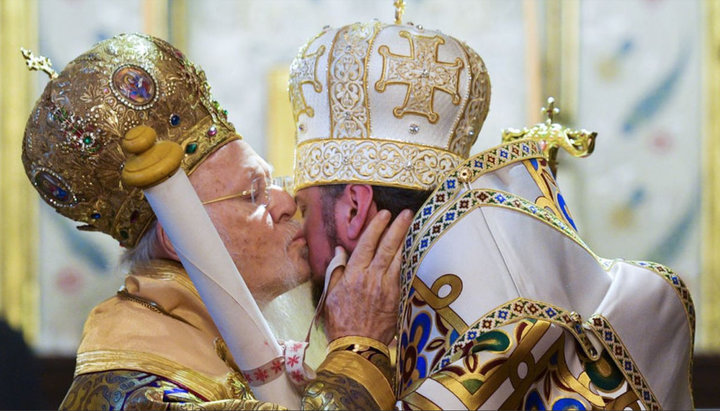
Patriarch Bartholomew and Epiphany Dumenko. Photo: chelyabinsk.bezformata.com
On August 22, 2020, Patriarch Bartholomew of Constantinople congratulated Ukrainians on Independence Day, calling them "beloved people." The full text of the message of the Phanar’s head was published by the "Vysokyi Zamok" resource.
“History has bound Ukraine and the Ecumenical Patriarchate since the times of Kyivan Rus'. Indeed, at the end of the 10th century, the Holy Prince Vladimir, Equal to the Apostles, was searching for a faith that could unite his people and give them peace and justice, as well as hope for eternal life,” writes Patriarch Bartholomew. “Saint Vladimir took then the decision to Christianize his people, receiving the holy baptism from hierarchs and clergy of the Holy and Great Church of Christ who came from Constantinople. Thus, the Ecumenical Throne became the Mother Church of the Ukrainian people, and its Christianization brought Christian values to the society and elevated its civilization through letters, art and education.”
The Ecumenical Patriarch believes that for a millennium of “a rich, but sometimes dreadful, history”, “the Mother Church has always accompanied the God-loving Ukrainian people, appointing her hierarchs, blessing her leaders, educating her masters, and praying for her faithful”.
“By the end of the particularly tragic 20th century, having celebrated the millennium of Christianization of Kyivan Rus, the Ukrainian people were blessed to recover their so-desired independence from the Soviet atheistic state, from which they had suffered so much. And after more than a quarter of century of political independence, the pious Orthodox faithful of Ukraine were granted by the Ecumenical Throne to have their own autocephalous Church,” the Patriarch of Constantinople noted.
The Phanar’s head wished that “the God-loving Ukrainian people eternally remember the faith of their forefathers, as suggested by the Epistle to the Hebrews, where it is said: «Remember your leaders, who spoke the word of God to you; consider the outcome of their way of life and imitate their faith», so that the Ukrainian state may flourish in peace and justice, in love and unity, thus anticipating the Kingdom of Heaven”.
At the end of his message, Patriarch Bartholomew “bestowed” on civil and ecclesiastical authorities, Christ-loving armed forces, members of the medical team, educators, and all citizens of good will” his patriarchal blessing, wishing all “’every good thing given and every perfect gift from above, coming down from the Father of lights’ (James 1:17) for the prosperity and salvation of our beloved Ukrainian people”.
As reported, on August 9, 2020, the head of the Phanar, Patriarch Bartholomew, called himself the father of the Russian people and stated that all Russians are "children of the Patriarchate of Constantinople".
Read also
Volodymyr-Volynskyi Eparchy marks 30 years since restoration
The Pantanassa Icon and relics of Prince Volodymyr have arrived in Kovel and will visit churches across the Volodymyr-Volynskyi Eparchy to mark the 30th anniversary of the restoration of the episcopal see.
Bukovyna faithful bring humanitarian aid to Kherson region residents
The UOC’s Chernivtsi Eparchy delivered food to Holy Spirit Cathedral in Kherson.
Ukraine must have its own faith: Poroshenko's party lays out peace terms
Poroshenko’s party European Solidarity described church policy as a matter of national sovereignty and said there can be no compromises in this area.
432 UOC churches damaged in Ukraine during war, report says
According to the Religion on Fire project, 807 religious buildings in Ukraine have been damaged or destroyed as a result of hostilities.
DESS official gives number of clergy exempt from mobilization in Ukraine
A DESS representative said the actual number of clergy exempt from mobilization is significantly lower than the number of religious organizations designated as critical.
Cabinet keeps gas prices unchanged for religious organizations
The Cabinet has fixed gas prices for religious organizations through the end of the 2026–2027 heating season.