Volunteer: There were no torture chambers in Borodianka temple
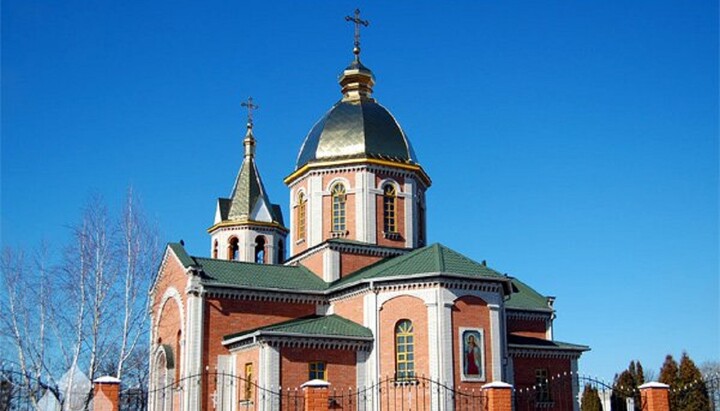
The Borodianka church. Photo: church-site.kiev.ua
Volunteer Pavlo, who was in Borodianka in February 2022, said that there were no torture rooms in the St Michael’s Church, reports the Telegram channel DOZOR on "Kozal 1".
Pavlo said that in February 2022 he, together with nine volunteers, was taking food to Borodianka. At that time there was no food at all in the settlement, on the approach to Borodianka they were met by Russian troops and brought to the church to the rector Archpriest Victor Talko.
"They gave us shelter on the first floor. There were rooms there, we were put there. The military ordered us to close the windows and forbade us to go outside. For almost four days, we were on the territory of the temple. The sisters fed us, we had food and everything. They took away our documents, mobile phones too. Thank God, we were not tortured, nothing like that happened. Everyone went about his business. I dug the vegetable garden and helped nuns in the greenhouse – they were growing tomatoes," said Pavlo.
According to him, Father Victor almost never communicate with the Russian military, the military almost never entered the territory of the church.
"Maybe only to draw water, that's all. They were mostly around the perimeter. I didn't see them taking food there, or any conversations. There was no such thing between Father Victor and them. People who had died were brought in. They asked where to bury them. The bodies were decomposing, it was pitiful to look at it all. As a Baptist I didn't go to church, I prayed. Frankly speaking, I had my father's little Bible with me, and I read it and the Psalms. I asked the Lord to keep us safe, and prayed for the boys, of course," he added.
Pavlo refuted the words of volunteers from Babintsi settlement that allegedly there were underground torture chambers in the Borodianka church.
"There were no underground rooms in the church. I did not see any violence. There were Babintsy residents, they were not with us. What they were telling... Well, I don't know. Perhaps they found some tunnels somewhere in there (smiles), but I doubt it. We were all pretty much together. It's a small area. There was a greenhouse. There was another room, there were products there. But they were not Russian rations – that's 100 %. They were usual products of the church. Maybe, the parishioners brought them. The store room was behind the room where we lived, but there was no basement anywhere. And in the temple, I doubt there are any such rooms at all. As for us being tortured and kept in the basement – there was no such thing, that's 100%. At least, the guys and I would have known that. We all came out together," he concluded.
As reported, Borodianka parishioners denied accusations against their rector.
Read also
Sumy Eparchy venerares miraculous Korsun-Shpylivka Theotokos Icon
Celebrations honoring the Mother of God’s icon known as the “Restorer of Sight” were held at Sumy Cathedral and concluded with a car procession around the city.
Receding Dniester in Khmelnytskyi region exposes foundation of flooded church
The foundation of St. John the Theologian Church, submerged during the construction of a hydroelectric power plant, has emerged for the first time in 45 years.
Medieval сhurch сrumbles as Culture Ministry сites missing agreement
The 14th–15th-century St. Nicholas Church in Chesnyky, Ivano-Frankivsk Region, is falling into disrepair.
Poland сondemns Lviv Regional Council's decision to declare 2007 year of UPA
Polish Prime Minister Donald Tusk says the Lviv Regional Council's decision to dedicate 2027 to the UPA and Roman Shukhevych is harmful to Ukraine.
OCU seeks court recognition of ownership of seized Cherkasy cathedral
The Cherkasy Regional Commercial Court will hear an OCU lawsuit seeking ownership of St. Michael's Cathedral, which was seized from UOC believers.
Lithuanian bishop: Ukraine is no model for believers' rights
Vicar of Vilnius Diocese voices concern over attempts to import Ukraine's religious conflict into Lithuania.