Federation of Constantinopolitans resents statement by Ukraine's advocates
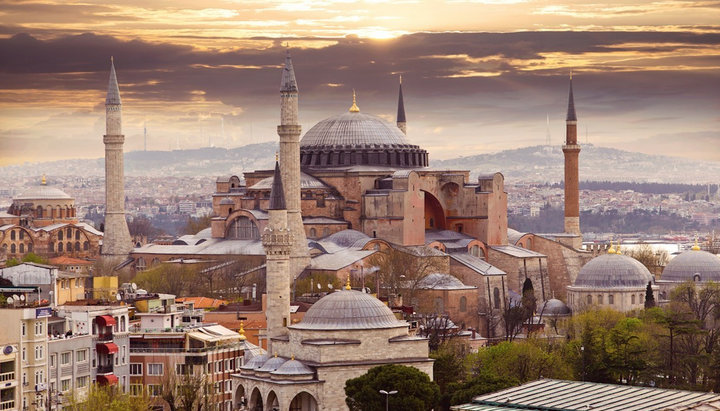
Hagia Sophia in Istanbul. Photo: romfea.gr
Representatives of the "Ecumenical Federation of Constantinopolitans" were unhappy with the statement of the NGO "Public Advocacy" regarding the announced petition of the Patriarchate of Constantinople on the issue of Hagia Sophia in the UN, reported the Romfea publication.
Addressing the Romfea editors, the Ecumenical Federation of Constantinopolitans considers it "necessary to indicate" that the resource "republished the text containing errors, inaccuracies and even malicious references"; therefore the editors are required to "take immediate action".
In its commentary, the NGO "Public Advocacy" wondered why the structures of Constantinople did not make a single statement about the problems of Hagia Sophia during the session of the UN HRC, which is going on these days in Geneva.
“Furthermore, on September 28, 2020, the UN HRC considered the State of Turkey in the UN Universal Periodic Review procedure, and the Patriarchate of Constantinople, having a permanent mission in Geneva, could have raised this issue in the right place and within the framework of the appropriate protection procedure, given that in this period, Turkey's actions have been assessed by diplomats all over the world. Consequently, it is easiest to attract the attention of the UN and advance the cause of protecting their rights via namely these procedures,” the the human rights activists believe.
In its commentary on the above publication, the "Ecumenical Federation of Constantinopolitans" emphasizes that "it is not an official body of the Ecumenical Patriarchate of Constantinople and does not officially represent the Mother Church, with which it only enjoys bonds of devotion, deep respect and love."
In addition, representatives of the organization claim that at the 45th meeting of the UN Human Rights Council (and not in the UN Human Rights Court, as mentioned in Romfea), they spoke three times: two speeches were recorded, while “the third one, oral, like many other speeches, was posted by the President of the Council on the UN website due to the lack of time for its presentation” (the texts of these speeches were attached to the letter as evidence– Ed.).
At the very end of their letter, representatives of the "Federation" indicate that allegedly "the use in this article (of NGO "Public Advocacy" – Ed.) of the term "Patriarchate of Constantinople" instead of the regular and precise term "Ecumenical Patriarchate of Constantinople" is a grievous mistake unless, of course, it is used intentionally for other purposes."
Earlier, the UOJ wrote that human rights activists commented on the Statement of the Archdiocese of Phanar in the United States on the preparation of a petition to the UN in order to bring Turkey to justice because of Hagia Sophia.
Read also
Khust Eparchy honors memory of St. Job of Uholka
A Liturgy is served in Mala Uholka, a birthplace of St. Job of Uholka, on the saint's feast day.
UOC parish in Cologne donates ultrasound machine to Kharkiv region hospital
In Cologne, UOC believers raised funds for an ultrasound machine for the Kehychivka district hospital in the Kharkiv region.
Shevchuk tells Pope Leo of Ukraine's preparations for "another harsh winter"
The head of the UGCC expressed "special gratitude" to the Pope for his phone calls with Putin and Zelensky.
Berlin hierarch comments on Phanar document published by UOJ-USA
Metropolitan Mark called the information about the 2018 "Unification Council" alarming if confirmed, and expressed hope that Patriarch Bartholomew will reconsider his position.
UOC marks Synaxis of All Saints of Volyn Land at Lutsk cathedral
Metropolitan Serhiy of Ternopil and Kremenets led the Liturgy on the feast day of the Lutsk cathedral of All Saints of the Volyn Land.
SBU detains OCU cleric who organized draft evader's escape for money
In Transcarpathia, law enforcement officers detained a clergyman of the OCU who arranged for a draft evader to be smuggled into Slovakia for $15,000.