Turkish authorities say Erdogan freed Hagia Sophia from shackles
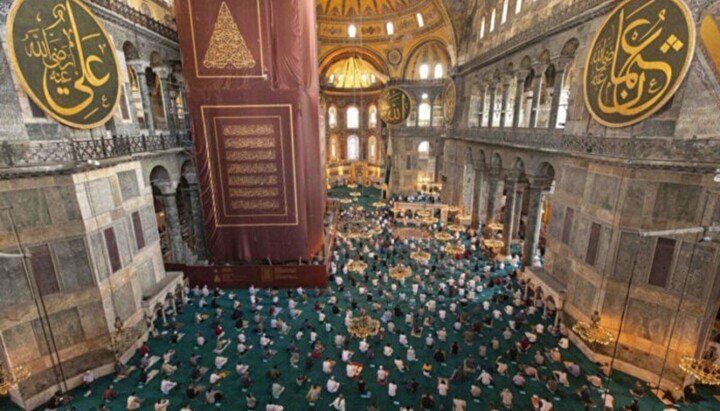
Hagia Sophia. Photo: orthodoxianewsagency.gr
Fahrettin Altun, the head of the Turkish Presidential Communications Directorate, stated that three years ago, Recep Tayyip Erdogan, by converting Hagia Sophia into a Muslim mosque, liberated it.
Altun mentioned the prophecy of Turkish symbolist poet Nedim Fazıl Kısakürek about the opening of Hagia Sophia.
"Our President Recep Tayyip Erdogan was blessed to fulfill the dream of this Teacher and liberate the Hagia Sophia from its shackles. Praise be to Allah," he wrote on Twitter.
On July 24, 2020, Turkey celebrated the anniversary when the Orthodox Hagia Sophia was converted into a mosque. Imam Bunyamin Topchuoglu stated that Hagia Sophia became a "symbol of Islam's victory" and also "symbolizes the unity" of the Turkish people.
As reported by the UOJ, earlier in the presidential election campaign, the President of Turkey recorded a video in which he portrayed himself as the rightful person who turned the Hagia Sophia into a mosque.
Read also
Metropolitan Onuphry congratulates Georgia on 1,700 years of Christianity
The Primate of the UOC sent a message to Patriarch Shio III on the anniversary of Christianity becoming the state religion in Georgia.
Zakarpattia marks 25th anniversary of Alexis of Carpatho-Russia's glorification
An all-night vigil was served at St. Nicholas Monastery in the village of Iza-Karputlash to celebrate the 25th anniversary of the glorification of St. Alexis of Carpatho-Russia.
DESS finds Balta Eparchy of UOC affiliated with ROC
Yelensky-headed state service said it found signs of affiliation of the Balta Eparchy Administration of the UOC with the ROC.
Upper Lavra court hearing postponed
The next court hearing in the Upper Lavra case has been scheduled for November 3.
UOC priest blesses ambulances at Kamianske medical center
A UOC priest in Kamianske blessed ambulances for a medical facility and wished its doctors God's help in their work.
Dumenko to German ambassador: Law targeting UOC also applies to other groups
Epifaniy Dumenko sought to defend Ukraine’s law restricting religious organizations during a meeting with the German ambassador.