“We don’t want you quoting Christ to us”
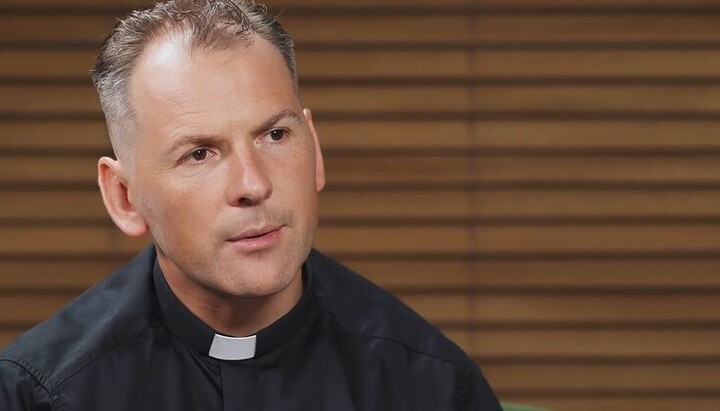
UGCC Priest Roman Kurakh. Photo: UOJ
“That these two peoples may cease destroying and killing one another. That these two beautiful nations may begin building the Kingdom of Heaven here on earth – and that one day they may enter into heaven together, embracing one another and glorifying the Lord for all eternity unto many and blessed years,” said the priest.
These words, broadcast over loudspeakers, were accidentally overheard in a public square by activist Sipyhina, who, just before Communion, stormed into the altar of the cathedral with two young male companions (wearing shorts and baseball caps) and confronted the priest. Their exchange speaks volumes about the state of contemporary Ukraine.
“Are you blessing our enemies?” Sipyhina exclaimed in outrage.
“I am blessing them – Jesus said so,” replied the priest, and asked what she expected him to say.
“I’d like you not to say that,” the activist responded. One of her companions then demanded that Kurakh stop saying he blessed Russians.
“Jesus said, ‘Bless your enemies.’ Do you want me to say it’s acceptable to kill people? I will not say that to you,” answered the priest.
The video of the incident was widely published by national media and major Telegram channels. The predominant reaction? Anger and indignation. For instance, UGCC priest Yurii Boiko called Kurakh a “traitor” and an agent of the “Russian world.” Religious scholar and head of “Athos Heritage” Serhii Shumylo labeled the priest “scum.” The reactions of “ordinary” Ukrainians are, frankly, unrepeatable in polite discourse.
And yet Kurakh is no “Moscow priest.” He is a “super-patriotic” Greek Catholic, whose own brother is currently serving at the front. Moreover, he does not belong to the official UGCC structure – his Mukachevo Eparchy is directly subordinate to Rome.
What conclusions can be drawn?
1. In present-day Ukraine, one can easily become an outcast simply for quoting Christ.
2. Even among the Greek Catholics, there are those unafraid to speak the truth today. And that means there is still hope for the Ukrainian people.
Read also
Ternopil post on Feast of Intercession: Has calendar reformn failed?
A significant number of believers have rejected the new church calendar introduced by the OCU and UGCC with government support.
Shoulder straps or a cassock: who writes the script for UOC "fighters"?
Everything indicates that both Veliar and Pshenychny are ordinary performers of someone else's script. There is only one question – does the scriptwriter wear shoulder straps or a cassock?
Why is it legal to kill a person before birth but not after?
Children are the most privileged members of society. Yet that same society officially permits children to be killed – and on a massive scale.
Honoring the Bolsheviks’ successors at Kyiv Lavra
It was under the Reserve that the relics of the saints were desecrated, Lavra churches were turned into an atheism museum, and toilets were installed in sanctuaries.
"Degenerates" and "stupid animals": anti-UOC activists turn on children
Future historians will wonder how a vast country’s information agenda could have been shaped for so long by people so petty, vicious, and utterly contemptible.
Zelensky sees murder of Polish priest but not of Sviatohirsk monk
Why does Zelensky react so emotionally and swiftly to the murder of a Catholic cleric while remaining completely silent about the murder of an Orthodox monk?