Tsikhanouskaya calls on Belarusian religious communities to join strike
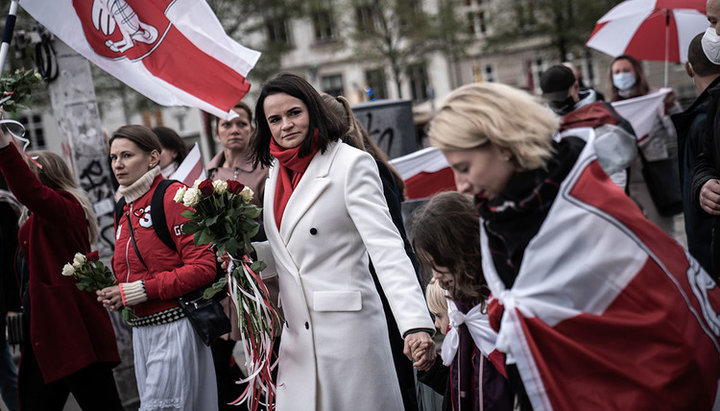
Tsikhanouskaya believes religious communities should support the opposition. Photo: Emil Helms / Ritzau Scanpix / AFP
On October 26, 2020, Svetlana Tsikhanouskaya announced the expiration of the “people’s ultimatum” she had issued to Belarusian President Alexander Lukashenko and declared the beginning of a “people’s strike.” At the same time, she expressed hope that, alongside state enterprises, religious communities would also join the strike.
“The main task is to show that no one will work for the regime. Workers at state factories and enterprises, transport workers and miners, teachers and students began striking from early morning. And I believe that private businesses, religious communities, cultural and sports figures, and IT specialists will support the strikers and suspend their work for a day,” Tsikhanouskaya wrote on her Telegram channel.
The situation was commented on by Bishop Savva (Tutunov) of Zelenograd, Deputy Chancellor of the Moscow Patriarchate and Vicar of the Patriarch of Moscow and All Russia, who recalled that history does know an example of a “strike by religious communities.”
“In 1890, the Sublime Porte undertook another wave of repression against the Greeks: it demanded restrictions on the rights of ecclesiastical courts in civil matters and sought to place Greek schools under Turkish authorities… though this was only the culmination of many other forms of oppression,” the hierarch wrote on his Telegram channel. “On October 4, 1890, the Constantinopolitan Synod and the Greek National Council declared that the Church was being persecuted and announced a quasi-interdict – closure of churches, cessation of bell ringing, and the performance of necessary services only at night. This triggered unrest and indignation against the Turkish authorities among the Greek population. On December 25 of the same year, the Sublime Porte backed down. The issue concerned the survival of the Orthodox ethnos in a hostile non-Christian environment.”
In Belarus, however, the situation is “obviously different,” the clergyman stressed.
“The fact that Mrs. Tsikhanouskaya is calling for such actions suggests either that she does not fully understand how a religious community differs in essence from a chess club, including in its ability to ‘suspend operations,’ or that she is deliberately trying to give her political struggle a religious dimension. Probably the former, considering the logical sequence in which she placed religious communities. But the latter would be quite tragic,” Bishop Savva of Zelenograd concluded.
As previously reported, the head of Russia’s Foreign Intelligence Service had earlier accused the United States of interfering in the religious situation in Belarus.
Read also
Upper Lavra court hearing postponed
The next court hearing in the Upper Lavra case has been scheduled for November 3.
UOC priest blesses ambulances at Kamianske medical center
A UOC priest in Kamianske blessed ambulances for a medical facility and wished its doctors God's help in their work.
Dumenko to German ambassador: Law targeting UOC also applies to other groups
Epifaniy Dumenko sought to defend Ukraine’s law restricting religious organizations during a meeting with the German ambassador.
Activists bused to court hearings in UOC cases, media say
A minibus has been spotted transporting protesters to and from courthouses where UOC cases are being heard.
Firefighters save historic UOC church from fire in Zakarpattia
A fire broke out at a UOC church in the Tiachiv district, damaging the altar and church furnishings.
Volyn Eparchy faithful collect six tons of aid for Sviatohirsk Lavra
Believers in Volyn collected food and warm clothing for people displaced by the war who have found shelter at Sviatohirsk Lavra.