In the trial of Metropolitan Theodosy, almost all "victims" are OCU clerics
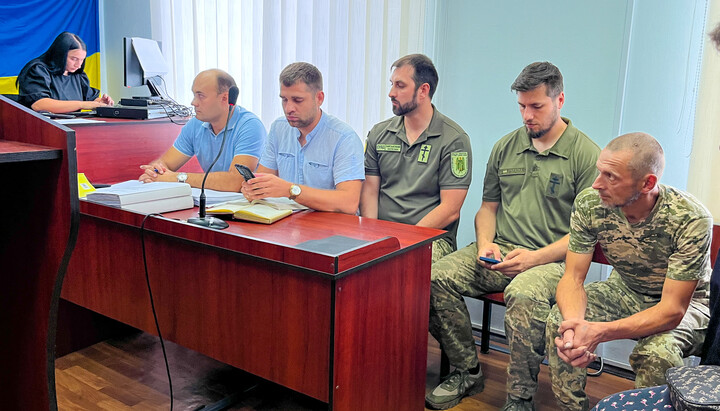
Representatives of the prosecution in the trial of Metropolitan Theodosy. Photo: the Faceboook page of the Cherkasy Eparchy of the UOC
As "victims" and "witnesses" of the prosecution in the trial against Metropolitan Theodosy, the head of the Cherkasy Eparchy of the UOC, are usually "clergymen" of the OCU, said the hierarch during his speech at the session of the Sosnivka District Court in Cherkasy.
"Charges against the Ukrainian Orthodox Church in the Cherkasy region are being brought forth today by the prosecutor's office and the Security Service of Ukraine in close cooperation with their loyal assistants from the religious sphere," the metropolitan said. "They do this with the hands of the so-called 'Orthodox Church of Ukraine,' represented by its 'clerics'. After all, practically all of the 'victims' and 'witnesses' in this process are the 'clergy' of the OCU."
The bishop drew the attention of those present to the fact that the OCU "clerics" came to the court session not in priestly garments, but in camouflage.
"They do not want to be publicly identified in court as 'clergy.' The 'clergy' of the OCU do not want their 'Judas sin' to be perceived as such by our society and the entire Orthodox world, which is following the process. Therefore, they do not wear the appropriate attire for their position in the OCU – cassocks and crosses – to the court hearings. They come to court sessions in military uniforms, disguised as chaplains. Why sit here in court wearing protective camouflage trousers and t-shirts? Are you really threatened by a sniper or enemy bullets? No, you are not threatened. But you really don't want the Christian world to see that the Orthodox metropolitan was brought to court by the 'clergy' of the OCU. And that is precisely what is happening. And this is taking place in the 21st century before the eyes of the entire Orthodox world," emphasized the metropolitan.
He noted that in the courtroom, there is also the priest Yevhen Burkatsky, whom these very representatives of the OCU "illegally expelled three weeks ago, along with the religious community, through manipulations with legal concepts and documents. They took over the Sretensky Church, which the Cherkasy Eparchy built at its own expense, and handed it over to the OCU."
"Father Yevhen, along with his wife and seven children, was expelled from the parish house precisely by these people who are now sitting before us in military uniform, pretending to be 'victims' in this trial," said Metropolitan Theodosy.
As reported, Metropolitan Theodosy said that the criminal case against him was artificially fabricated and was a manifestation of persecution of the Ukrainian Orthodox Church.
Read also
Reports to SBU of weapons in UOC churches were always false, Novynskyi says
The protodeacon said that under Maliuk, inspections began to be accompanied by public accusations against the Church without evidence.
Culture Ministry pledges to speed up seizure of Kyiv-Pechersk Lavra from UOC
Culture Minister Tetiana Berezhna has pledged to personally attend a court hearing in the Kyiv-Pechersk Lavra case.
Kamianske Eparchy honors Dnipro Icon of the Mother of God for first time
A festive service was held at a cathedral in Kamianske, where the Dnipro Icon of the Mother of God was brought out for veneration by the faithful for the first time.
Kyiv conscription officers abduct UOC priest
TRC officers reportedly abducted Maksym Kostiuchenko, a cleric of a UOC church in the Ukrainian capital.
Court grants DESS lawsuit to dissolve UOC’s Rovenky Eparchy
The appeals court partially granted the DESS lawsuit seeking to dissolve the Rovenky Eparchy but rejected the request to seize its property, citing a gap in Ukrainian legislation.
Met. Meletiy consecrates house of worship for UOC community in Dankivtsi
Members of the persecuted UOC Intercession parish in Dankivtsi have converted a house into a place for communal prayer and worship services.