After an attempted seizure in Luh, fresco of Mother of God streaming myrrh
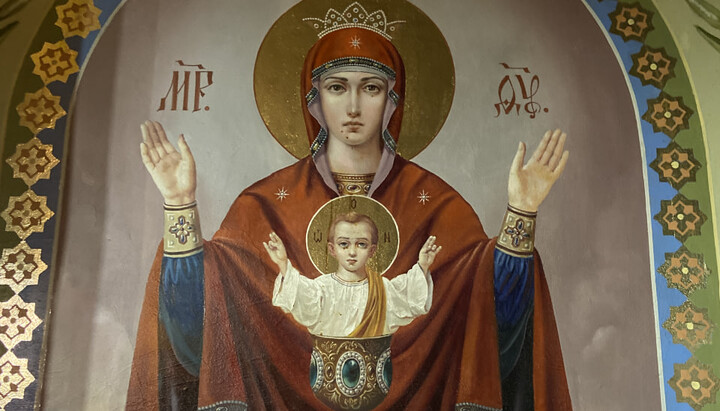
The fresco of the Mother of God "The Inexhaustible Chalice” in the Holy Spirit Church of the UOC in vlg. Luh, Transcarpathia. Photo: spzh.news
In the Holy Spirit Church of the UOC in vlg. Luh, Transcarpathia, which activists of the OCU and Greek Catholics attempted to seize, the fresco of the Mother of God "The Inexhaustible Chalice" began to stream myrrh, reports Fr Volodymyr Lehach, the rector of the church.
According to Fr Volodymyr Lehach, myrrh of red colour appeared on the fresco painted on the church wall.
He also mentioned that the first drops on the icon were noticed by parishioners and clergy of the UOC on September 2, 2023, during the attempted seizure of the church.
Photographs show that myrrh appeared on the faces of the Mother of God and the Infant Jesus Christ.
According to Fr Vladimir, pilgrims from neighbouring villages have already started coming to the church to pray before the myrrh-streaming image.
As reported, the UOC parishioners in Luh successfully defended their church from raiders.
Read also
Ukrainians help restore Serbian Orthodox church in Paris
Orthodox Ukrainians have become regular parishioners of St. Sava Church in Paris and have taken part in its restoration.
Bulgarian Church clergy and laity oppose Phanar head’s visit
More than 2,000 clergy and laity have called for the Ecumenical Patriarch’s visit to be canceled, citing disagreement with his actions and concerns that the visit could legitimize schism.
Unknown intruders break down doors at two UOC churches in Sloviansk
Archbishop Paisiy said OCU activists are suspected of breaking into the churches in Sloviansk, and police have launched an investigation.
Sviatohirsk Lavra prays for murdered monk on 40th day after death
The brethren of the Sviatohirsk Lavra held a memorial service for murdered Monk Varsonofiy, calling on the faithful to pray for the newly departed monk.
Polish Culture Ministry funds restoration of Armenian cathedral in Lviv
An international project supported by Poland aims to preserve the unique artistic heritage of the Armenian Cathedral in Lviv.
Persecuted UOC parish in Rakiv Lis celebrates patronal feast in new church
The faithful marked the fifth anniversary of the consecration of the church built to replace the one that was seized, as well as its patronal feast, in the Volyn village of Rakiv Lis.