"Myriany" releases a video about OCU’s church raid technology
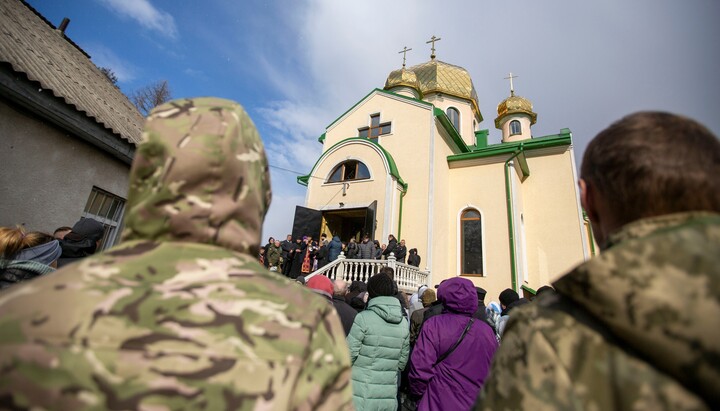
Forcible seizure of the Cathedral of the Nativity of Christ of the UOC in Ivano-Frankivsk. Photo: facebook.com/ruslan.martsinkiv
The public initiative "Myriany" (Laity – Trans. Note) published a film that provides a detailed account of the methodology employed by the OCU for the takeover of UOC temples. The corresponding video is available on the organization's YouTube channel.
According to the film, the technique embraced by adherents of the OCU for the seizure of UOC shrines involves several stages. The initial phase in the process of taking over a temple involves gathering people for a vote on transitioning the community. These gatherings are typically organized by representatives of the authorities, "clergy," or OCU activists.
"These gatherings take place anywhere but not in the church: village councils, clubs, schools, stadiums. Why not in the church? Because people who have nothing to do with the religious community are assembled here," the video explains.
The second stage of a church raid entails the transmission of protocols from the unlawful voting of OCU activists in favor of the community's "transition" under the jurisdiction of the OCU. Simultaneously, the "Myriany" pointed out that the authorities disregard actual religious community meetings, where faithful UOC members vote to remain within the UOC. Instead, officials are re-registering communities from the UOC to the OCU, contrary to the will of genuine parishioners.
"In some instances, authorities do not even conduct gatherings for transitioning to the OCU; they simply re-register the communities. For example, in Ivano-Frankivsk. The UOC community filed complaints with the police and the prosecutor's office against such actions by the authorities and even sought protection from the president, all to no avail," they added.
The "Myriany" designates the third stage as the actual seizure process, which occurs with the support of the police and individuals in camouflage.
"They force their way onto the territory, break doors, and take over the church. The church community tries to resist, but the odds are uneven... Often, the doors are forcibly broken by the OCU 'clergy' themselves. For example, several clerics led by the OCU spokesperson, Archbishop Yevstratiy Zoria, immediately broke the doors to the Transfiguration Cathedral of the UOC in Bila Tserkva," the public initiative reported.
As a result, UOC believers are compelled to pray in homes, barns, and even outdoors, while the seized temples are either empty or have few people present.
"The faithful do not stay in the church together with the OCU. They remain with their priest. The Shepetivka Cathedral community prays in a building. The expelled community in Trebukhiv currently prays in the woods in tents. Meanwhile, the seized churches are either empty or have hardly any people inside," added the public union.
As previously reported by the UOJ, OCU activists in Radomyshl attacked a wounded soldier and UOC believers.
Read also
OCU activist admits breaking into UOC church in Sloviansk
Oleksandr Onyshchenko said that the OCU held its first "service" at the Seraphim Church, which had previously been broken into by forcing the locks and doors.
Archimandrite Ioustinos, longtime keeper of Jacob's Well, dies in Jordan
Archimandrite Ioustinos (Mamallos), the keeper of Jacob's Well in Nablus, has died after a prolonged illness.
Pilgrim group from Kyiv Theological Seminary visits Mount Athos
KTS students are making a pilgrimage to the holy sites of Romania, Greece, Mount Athos and Italy.
UOC cathedral celebrates its patronal feast in Ternopil
The service in the cathedral of the Holy Martyrs Faith, Hope, Love and their mother Sophia was led by Metropolitan Serhii of Ternopil, concelebrated by four hierarchs.
MinCulture marks centenary of Soviet-era reserve at Lavra's Refectory Church
Representatives of the Ministry of Culture presented awards to the Reserve's employees on the occasion of the anniversary at the Refectory Church of the Lavra.
Conference to mark 1700th anniversary of Christianity adoption held in Georgia
In Georgia, representatives of the Church and the state noted the defining role of Christianity in the country's cultural development.