Hierarch: SBU’s references to DESS examination in banning UOC are absurd
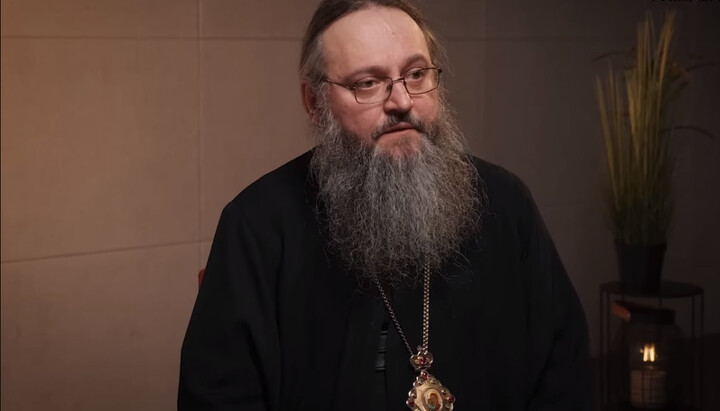
Metropolitan Clement (Vecheria). Photo: screenshot of a video from the YouTube channel “Ukrayinska Pravda”
The head of the Information Department of the UOC, Metropolitan Clement, commented on the letter from the head of the SBU Vasyl Maliuk to the MPs about the need to adopt a bill banning denominations based on the examination by the State Ethnopolitics' Commission, in which the UOC was recognized as “a structural unit of the Russian Orthodox Church, which is in a relationship of subordination relative to the Russian Orthodox Church.”
He argued that such references only highlight the absence of genuine claims by the state against the Church.
Metropolitan Clement drew a parallel between the SBU's appeal to the DESS expertise and the biblical portrayal of the trial of Jesus before the Sanhedrin. He suggested that both cases involved seeking false accusers to give a semblance of legitimacy to decisions based on hatred rather than law.
"Then they looked for false accusers against Christ in order to impart at least an imaginary image of legality to a verdict based on hatred rather than law. Now any unbiased person cannot help but be surprised by the attempt to justify government decisions with the text of the DESS examination. By the way, its authors wickedly took care to avoid legal responsibility for their text and said in advance that it does not carry legal consequences. Like Pilate, they washed their hands,” the hierarch said.
Furthermore, Metropolitan Clement expressed concern that the accusations against the UOC, based on the findings of criminal cases, do not align with European traditions of upholding the presumption of innocence.
"Today, sensationalism and unsupported claims are in trend, devoid of any legal basis. This is part of the technology used to substitute common sense with virtual reality. If a Christian lives according to the Commandments of God, they have nothing to fear – all accusations against them will either be untrue or compel them to violate their freedom of conscience and transgress their own religious beliefs, which is absolutely illegal according to the Constitution of Ukraine. However, the situation that has developed in our country requires us to take maximum responsibility for our Christian mission and the sense of life," said Metropolitan Clement.
He also called for officials to provide a broader statistical overview, disclosing the number of criminal proceedings initiated against representatives of other religious, social, professional, or political groups. This transparency, according to Metropolitan Clement, would lead to justified expectations for new legislative proposals that uphold the legal responsibility of all Ukrainian citizens, rather than appearing as selective justice.
As reported by the UOJ, the SBU initiated a bill aimed at liquidating religious denominations linked to Russia.
Read also
Volodymyr-Volynskyi Eparchy marks 30 years since restoration
The Pantanassa Icon and relics of Prince Volodymyr have arrived in Kovel and will visit churches across the Volodymyr-Volynskyi Eparchy to mark the 30th anniversary of the restoration of the episcopal see.
Bukovyna faithful bring humanitarian aid to Kherson region residents
The UOC’s Chernivtsi Eparchy delivered food to Holy Spirit Cathedral in Kherson.
Ukraine must have its own faith: Poroshenko's party lays out peace terms
Poroshenko’s party European Solidarity described church policy as a matter of national sovereignty and said there can be no compromises in this area.
432 UOC churches damaged in Ukraine during war, report says
According to the Religion on Fire project, 807 religious buildings in Ukraine have been damaged or destroyed as a result of hostilities.
DESS official gives number of clergy exempt from mobilization in Ukraine
A DESS representative said the actual number of clergy exempt from mobilization is significantly lower than the number of religious organizations designated as critical.
Cabinet keeps gas prices unchanged for religious organizations
The Cabinet has fixed gas prices for religious organizations through the end of the 2026–2027 heating season.