Pope allows women ex officio to be ministers of Word and Altar
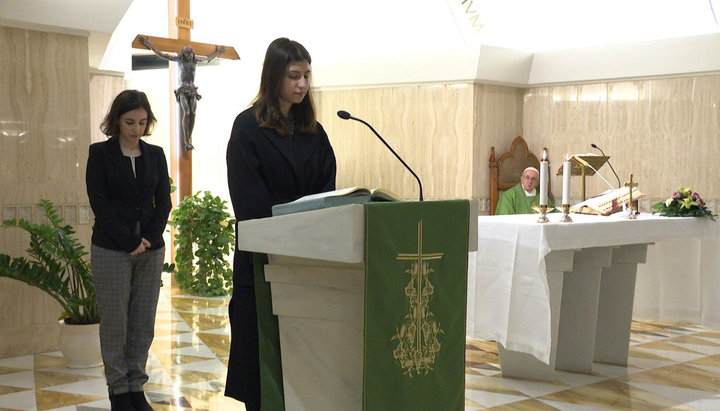
Pope Francis and women at the altar. Photo: vaticannews.va
On January 10, 2021, Pope Francis signed a decree, whereby the ministries of readers and acolytes are from now on open to women, the official website of the Vatican reports.
According to the press service of the papal throne, the pontiff institutionalized what had been practiced for decades in the Roman Catholic Church, where women in various churches had the access to the service of the Word and the Altar.
“There is nothing new about women proclaiming the Word of God during liturgical celebrations or carrying out a service at the altar as altar servers or as Eucharistic ministers. In many communities throughout the world these practices are already authorized by local bishops,” the pontiff noted.
At the same time, the Vatican website notes that “up to this point, this has occurred without a true and proper institutional mandate, as an exception to what Pope St Paul VI had established when, in 1972, even while abolishing the so-called ‘minor orders’, he decided to maintain that access to these ministries be granted only to men.”
Now, in the so-called "Apostolic Epistle" Spiritus Domini, the Pope changed the first paragraph of Canon 230 of the Code of Canon Law, where he establishes that "women can have access to these ministries and that this be recognized through a liturgical act formally instituting them as such."
The new wording of the canon reads, “Lay persons who possess the age and qualifications established by decree of the conference of bishops can be admitted on a stable basis through the prescribed liturgical rite to the ministries of lector and acolyte." Thus, the Pope has abolished the definition of "lay man" which existed until now.
According to the pontiff, “a doctrinal development has been arrived at in these last years" and "certain ministries instituted by the Church have as their basis the common condition of being baptized and the royal priesthood received in the Sacrament of Baptism.”
In a letter addressed to the Prefect of the Congregation for the Doctrine of the Doctrine, Cardinal Luis Francisco Ladaria Ferrer, the Pope attempted to explain the theological motivations behind this decision.
He connects them "with the renewal traced out by the Second Vatican Council, as well as with the urgent need to rediscover the co-responsibility of all of the baptized in the Church, and the mission of the laity in a particular way."
The head of the RCC reminded the cardinal of the words of Pope John Paul II, according to which "the Church does not have the faculty in any way to confer priestly ordination on women." However, according to Pope Francis, "regarding non-ordained ministries, it is possible, and today it seems appropriate, to surmount this reservation."
“To offer to lay persons of both sexes the possibility of accessing the ministries of Acolyte and Lector, in virtue of their participation in the priesthood of the baptized, the awareness will grow, through a liturgical act (of institution) as well, of the precious contribution that many lay persons, including women, have been offering for some time to the life and mission of the Church.” He adds that “the decision to confer these offices even on women, which entails stability, public recognition and a mandate on the part of the bishop, will make more effective everyone’s participation in the work of evangelization.”
Akolyte – originally a minor rank of the clergy – is an assistant to a bishop or presbyter and later a lay clergyman in the RCC who performs a certain service during Mass. The acolyte's duties include lighting and carrying candles, preparing bread and wine for Eucharistic consecration, and a number of other functions; with a special blessing, an acolyte can administer communion to believers in the RCC.
Earlier it was reported that according to the Catholic Bishop Carlos Eskribano, "female priests" can solve the crisis of shortage of clergy, while the Archbishop of Luxembourg Jean-Claude Hollerich said that he is "open" to women becoming priestesses.
Read also
Medieval сhurch сrumbles as Culture Ministry сites missing agreement
The 14th–15th-century St. Nicholas Church in Chesnyky, Ivano-Frankivsk Region, is falling into disrepair.
Poland сondemns Lviv Regional Council's decision to declare 2007 year of UPA
Polish Prime Minister Donald Tusk says the Lviv Regional Council's decision to dedicate 2027 to the UPA and Roman Shukhevych is harmful to Ukraine.
OCU seeks court recognition of ownership of seized Cherkasy cathedral
The Cherkasy Regional Commercial Court will hear an OCU lawsuit seeking ownership of St. Michael's Cathedral, which was seized from UOC believers.
Lithuanian bishop: Ukraine is no model for believers' rights
Vicar of Vilnius Diocese voices concern over attempts to import Ukraine's religious conflict into Lithuania.
Hundreds of believers honor St. Alexis of Carpatho-Russia in Khust Eparchy
At the St. Nicholas Monastery in the village of Iza-Karputlash, Metropolitan Mark of Khust led a festive liturgy, concelebrated by six metropolitans, five archbishops and three bishops.
Court upholds UOC parish appeal in Voloshky over OCU switch dispute
The Northern Commercial Court of Appeal has upheld the appeal of the St. Nicholas parish of the UOC in the village of Voloshky, Volyn region, in a dispute over a transfer to the OCU.