Drabinko: Words about Bukovyna being “non-Ukrainian” have no ethnic slant
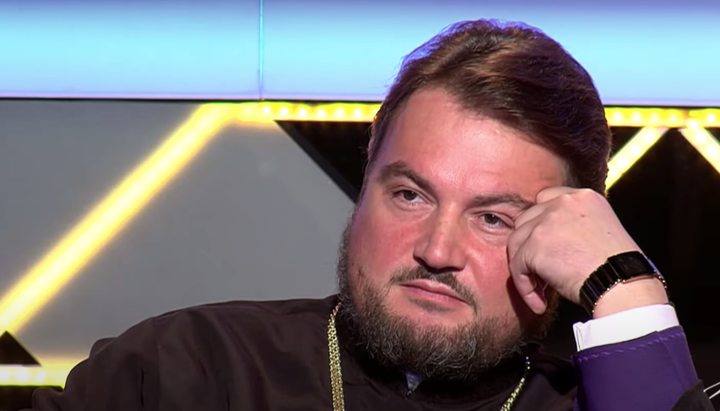
"Hierarch" of the OCU Alexander (Drabinko). Photo: screenshot of "Priamyi" YouTube channel
Ex-Metropolitan Alexander (Drabinko) commented profusely on the response of the Bukovyna residents to his words that "these people do not have special Ukrainian roots." On his Facebook page, Drabinko said, “The Union of Orthodox Journalists, these Muscovite-rootless people, had better not pit me against my Ukrainians-Bukovynians! Anyone who is misled by the so-called UOJ on the Day of Unity of Ukraine saying that ‘Bukovyna residents are allegedly non-Ukrainian’ and who, having read this disgusting provocation, were offended, I strongly recommend that you turn to the original source and watch and listen carefully to what was said."
Drabinko also added that “there is no national or ethnic connotation in what he said. There is only a subjective characteristic of an era and an individual person without generalizations."
Let us remind you that Alexander (Drabinko), in an interview with Ostap Drozdov, commented on his attitude towards His Beatitude Onuphry, in which, in particular, he said, “A native of the Trinity-Sergius Lavra, Metropolitan Onuphry is from Bukovyna himself. Bukovyna joined the Soviet Ukraine after Romania participated in the war with the Soviet Union. And we must not forget that these people have no special Ukrainian roots ... they are absent.”
Drabinko’s statement caused a backlash from Bukovyna residents.
Doctor of Historical Sciences, Professor of Chernivtsi National University Mykhailo Chuchko, in his commentary to the UOJ correspondent, said that “the former bishop, who left the canonical Church, does not know ethnic statistics, basic history and, accordingly, misleads people”: “There is a census of 1910, according to the population, the majority in the northern part of Bukovyna were Ukrainians, and in the southern part – Romanians," said the historian. Therefore, claims that Bukovynians are a kind of "non-Ukrainians", if we talk about Chernivtsi region, about those people who lived in the territory at that time (the birth of His Beatitude – Ed.) – this is a distortion of the facts and mere ignorance."
The UOC Diocese of Chernivtsi-Bukovyna stated that Drabinko's words about the Bukovyna residents and His Beatitude Metropolitan Onuphry as people without "Ukrainian roots" are insulting. Archimandrite Nikita (Storozhuk), secretary of the diocese, in a conversation with the UOJ correspondent said that representatives of many nationalities live in the Chernivtsi region, but Drabinko's assertion about the “non-Ukrainianness” of Bukovyna people “are offensive for those 70% of the region's residents who consider themselves Ukrainians and speak Ukrainian.”
The archimandrite said that there are villages in the region where the majority speak Romanian, but in the Vyzhnytsi district, where the Primate of the UOC was born and which is located in the Carpathian foothills, all villages are Ukrainian-speaking.
Read also
Rivne Eparchy of UOC marks 290th anniversary of Bilashiv church
Metropolitan Pimen led a festive Liturgy marking the 290th anniversary of the founding of the Church of the Nativity of Theotokos in Bilashiv.
UOC priest killed in war laid to rest in Kovel
The Volodymyr-Volynskyi Eparchy bid farewell to Archpriest Andriy Korinchuk, rector of several parishes, who was killed in the war.
Vyshhorod mayor accused of damaging monument to Sts. Boris and Gleb
The creators of the monument to Sts. Boris and Gleb accused the Vyshhorod mayor of damaging it and demanded that it be restored to its original appearance.
Bulgarian Primate responds to criticism of Bartholomew's visit (UPDATED)
Patriarch Daniel urged those unhappy with the Synod's decision to measure their views against the Church's conciliar judgment and warned against turning church gatherings into mere talk shops.
UOC faithful honor St. Filaret of Chernihiv
Archbishop Nikodym of Liubech celebrated the Divine Liturgy at the Church of All Saints of Chernihiv on the feast day of St. Filaret.
Two UOC churches damaged in Russian shelling of Kramatorsk
The UOC's Intercession and St. Nicholas churches were damaged in Russian attacks on Kramatorsk in the Donetsk region.