Lviv Council: Uniates' return to the Church or Stalin’s destruction of UGCC?
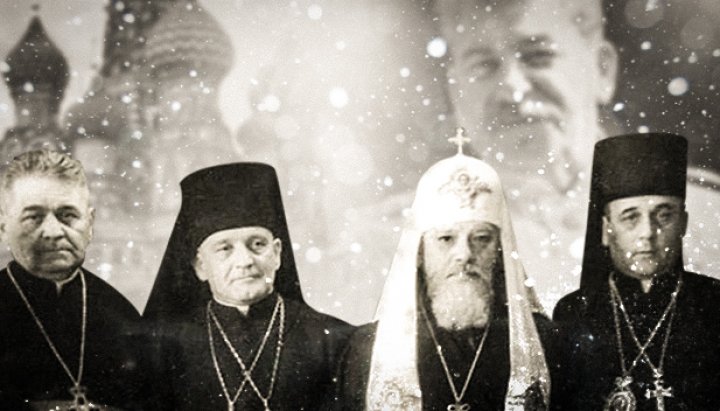
The delegation of the Lviv Council with Patriarch Alexy I. Collage: UOJ
In 2021, the 75th anniversary of the Lviv Council was marked – the council at which the Greek Catholics were returned to Orthodoxy. For many years, this event has remained the subject of controversy. The Uniates themselves call it nothing other than a “false council,” rightly noting that it was organized by the Soviet authorities and directing their accusations at the Russian Orthodox Church. In the 1990s, the Ukrainian Greek Catholic Church resumed its activity and has since become one of the largest confessions in the country. In other words, no actual return of the Uniates to Orthodoxy took place in the end. So what, in fact, happened in Western Ukraine in March 1946?
The preconditions for the liquidation of the UGCC
By the end of the summer of 1944, Galicia, liberated from the Nazis, had once again become part of Soviet Ukraine, but the situation there remained extremely difficult. With the German army departed, the mainly desk-bound leaders of the nationalist movement also left, while in the forests of Galicia, Volhynia, and the Carpathians they left behind around 50,000 armed and well-trained fighters of the OUN-UPA,[1] an organized nationalist underground, and a local population full of mistrust toward Soviet power. The Banderites embarked on a large-scale partisan war, inflicting serious losses on the army and Soviet authorities, while local residents either supported them or maintained a silent neutrality, fearing both sides alike.
The position of the Ukrainian Greek Catholic Church threatened to turn into a genuine catastrophe. Not only was it burdened by the weight of open collaboration with the Nazis during the war, but it also now had to maneuver between aiding its own offspring – militant nationalism – and accepting the rules of coexistence with Soviet power. Foreseeing the coming disaster, Metropolitan Andriy Sheptytsky feverishly sought a way out. On October 14, 1944, he addressed the Uniate clergy with a pastoral message: “I advise the parish priests that each parish should donate at least 500 rubles for the wounded and sick soldiers of the Red Army and deliver the money by October 1 to the metropolitan consistory, from where it will be passed on to the Red Cross.”[2]
Not stopping there, the head of the UGCC wrote personally to Stalin:
“To Joseph Vissarionovich Stalin, Leader and Great Marshal of the invincible Red Army – greetings and obeisance. As a result of your victorious march from the Volga to the San and beyond, you have once more united the western Ukrainian lands to Great Ukraine. For the fulfillment of these long-cherished desires... the entire Ukrainian people expresses to you its sincere gratitude... Promising you our sincere cooperation for the flourishing of the state now and in the future, we congratulate you and sincerely wish you the greatest good, namely eternity.”[3]
No reply from Stalin to this offer of sincere cooperation followed.
On November 1, 1944, Metropolitan Andrey Sheptytsky died at the age of seventy-nine and was buried with great honors in the crypt of St. George’s Cathedral. Yet the passions surrounding almost half a century of his activity have not subsided to this day. Soviet historians accused him of collaboration with Hitler, with the nationalist underground, and of organizational activity in the struggle against communism. The Ukrainian church diaspora accused him of neglecting the interests of the people. The Poles blamed Count Sheptytsky for apostasy. Greek Catholic researchers such as I. Nahaievsky, S. Baran, I. Hrynokh, and V. Laba sang of the great feats of the “spiritual guide” of the Ukrainian people. Contemporary UGCC figures created for Sheptytsky the image of a “Ukrainian Moses” worthy of beatification. Paradoxical though it may seem, each of them is right in his own way: the activity of Metropolitan Sheptytsky was as many-sided as it was contradictory.
- A political contradiction: the Central State Historical Archive in Lviv preserves Sheptytsky’s letters to Franz Joseph, Nicholas II, Symon Petliura, Pavlo Skoropadskyi, Joseph Stalin, and Adolf Hitler – and all of them contain assurances of the UGCC’s sincere cooperation with their policies.
- A national contradiction: in order to realize his Uniate-national ideas, Metropolitan Sheptytsky at various times played along with all the external forces that dominated Galicia – the Austrians, the Germans, the Poles. Yet every time, these games ended in the collapse of any manifestation of national independence.
- A theological contradiction: Sheptytsky did not create a single integral theological work, but “all his thoughts can be gathered together like little mosaic stones and from them a theological work can be created,”[4] mainly on one theme – the joining of the “schismatics” to the Roman See.
These principal aspects of Metropolitan Sheptytsky’s activity are precisely what account for the sharply polarized assessments of his legacy. The meaning of their combined totality was expressed rather accurately and fully by Pope Pius XII in his message on the occasion of the celebration of the 1,000th anniversary of the baptism of Princess Olga: “Metropolitan Andrey Sheptytsky undertook great labors and endured many sufferings for the conversion of the non-united brethren into the one flock, and in his life desired nothing more than to testify to his deepest devotion to the Apostolic See.”[5]
After the death of Metropolitan Sheptytsky, the UGCC was headed by his closest associate, Iosyf (Kobernytskyi-Dychkovskyi-Slipyi). Formerly rector of the Lviv Seminary and later of the Theological Academy, he was a highly educated theologian and, from 1939, due to Sheptytsky’s illness, had in effect directed all the initiatives of the UGCC during the war. He solemnly greeted the Hitlerite forces in Lviv on June 30, 1941, took personal part in the collection of contingents, and was involved in staffing mobilization commissions.[6] On April 20, 1942, he presided over a solemn service in honor of Hitler’s birthday, and that same year traveled to Berlin, where he met with Vandesleben, head of the Third Reich’s department for church affairs. On April 29, 1943, he served a solemn service marking the creation of the SS Division “Galicia.”[7]
Iosyf Slipyi presided over a solemn service in honor of Hitler’s birthday, traveled to Berlin, where he met with the head of the Third Reich’s department for church affairs, Vandesleben, and served a solemn service on the occasion of the formation of the SS Division “Galicia.”
These actions did nothing to facilitate peaceful coexistence with the new authorities. Yet despite this, Bishop Iosyf Slipyi wrote a letter to the Soviet government offering assurances of the UGCC’s loyalty to the new regime. That was far too little. At the end of November 1944, a delegation of the Galicia Uniates – consisting of priests H. Kostelnyk, I. Kotov, and V. Buchynskyi under the leadership of Klyment Sheptytsky, brother of the deceased metropolitan and hegumen of the Studites – set out for Moscow, attempting to determine a mode of coexistence with Soviet power. Their intentions were reinforced by a substantial gift – 100,000 rubles for aid to war invalids.
The delegation was warmly received in the Moscow Patriarchate. At the Council for Religious Affairs, they were assured that there would be no difficulties with the registration of UGCC communities. But soon the delegates were summoned to the General Staff, where they were informed that Soviet recognition of the Galicia Uniates depended entirely on a single factor – their attitude toward the OUN-UPA. From the Soviet side, this demand made logical sense and was relatively moderate: beyond the enormous losses on the front, large numbers of soldiers were dying at the hands of the Banderites in Western Ukraine. And the Soviet authorities, without yet charging the Ukrainian Uniates with the full spectrum of their political activities, demanded that they help facilitate the peaceful disarmament of the OUN-UPA formations – whose very conception and concrete military actions had been blessed and strongly supported by the Greek Catholic clergy.
The UGCC delegation was informed that Soviet recognition of the Galicia Uniates depended entirely on one factor – their attitude toward the OUN-UPA.
The delegation refused even to consider this demand, and the chaplain of Nachtigall, Ivan Hrynokh, later wrote resentfully: “The delegation was required to take part in the struggle against the Ukrainian insurgents. Our explanations were of no help – that the Church cannot directly and actively involve itself in an altogether politicized internal struggle. The government was not satisfied with the metropolitan’s appeals to Christian love and mercy, to respect for the Fifth Commandment of God, ‘Thou shalt not kill!’”[8]
So it turns out that participating in the formation and activity of OUN-UPA structures – even to the point of serving as their chaplains – was supposedly outside politics, while helping to end armed resistance was deemed a political act. In essence, by that refusal the UGCC confirmed precisely its political creed. Soon afterward, the authorities initiated yet another round of negotiations with representatives of the UGCC and the UPA, this time in Lviv. The terms were the same: full disarmament of the UPA partisans in exchange for complete amnesty and the legalization of the Uniates. These talks also ended without result.
The UGCC’s refusal to participate in ending the armed resistance of the OUN-UPA can be seen as the turning point in the Soviet authorities’ changing attitude toward it. Even had it agreed to the proposal, there could have been no question of extending the Union to all of Ukraine, as Sheptytsky and Slipyi had requested, but the legal existence of the UGCC within Western Ukraine might well have become a reality. After all, during the prewar year and a half, from September 1939 to June 1941, Soviet authorities in Galicia discriminated against the UGCC, but did not destroy it. When they returned from the autumn of 1944 onward, they did not immediately move to crush the Uniates but only tried to compel them to participate in solving the greatest problem – one largely inspired by the Uniates themselves – the armed resistance of the OUN-UPA. By its refusal, the UGCC largely determined its own subsequent fate. In any case, even Uniate historians themselves, including one of the most authoritative researchers of that period, B. Bociurkiw, are forced to admit that the liquidation of the UGCC was not a pre-planned act of collaboration between Soviet power and the Russian Orthodox Church: “The Kremlin’s decision to proceed with the liquidation of the UGCC was taken sometime between December 1944 and March 1945, and the Moscow Patriarchate was drawn in later.”[9]
The UGCC’s refusal to participate in the process of ending the OUN-UPA’s armed resistance can be regarded as the decisive turning point in the Soviet authorities’ changed attitude toward it.
In December 1944, the republican party conference in Kyiv adopted a resolution “On shortcomings in party work in Lviv,” after which several Uniate priests were arrested for deviation from the “ideological instruction for religious workers.” In early April 1945, the authorities launched a systematic persecution of the Uniates. On April 8, 1945, the newspaper Vilna Ukraina published an article titled “With the Cross and a Pistol,”[10] in which the Uniates were accused of treason during the war, collaboration with the occupiers, cooperation with the UPA, and anti-Soviet activity. Three days later, from April 11 to 15, 1945, all the bishops of the UGCC’s Lviv Metropolia were arrested: Metropolitan Iosyf Slipyi, Nykyta Budka, Mykola Charnetskyi, Hryhorii Khomyshyn and his vicar Ivan Liatyshevskyi, as well as Iosafat Kotsylovskyi and his vicar Hryhorii Lakota. Then came the arrests of priests.
On April 22, 1945, Macarius (Oksiuk) was consecrated Bishop of Lviv and Ternopil. The diocese he headed at that time consisted of about ten Orthodox communities.
It was not the inner ecclesiastical liturgical-theological activity of the Uniates – nor even its opposition to the militant atheism of the Soviet state – but precisely the socio-political activity of the Western Ukrainian Uniates during the years 1941–1945 that became the precondition for the Soviet liquidation of the Ukrainian Greek Catholic Church.
The preparation and conduct of the Lviv Church Council
On May 28, 1945, an Initiative Group for the Reunification of the UGCC with the Orthodox Church was created. Its members were representatives of the three Uniate dioceses of Galicia:
Archpriest Havriil Kostelnyk, rector of the Transfiguration Cathedral in Lviv, head of the group;
Archpriest Mykhailo Melnyk – from the Peremyshl Diocese;
Archpriest Antonii Pelvetskyi – from the Stanislaviv Diocese, now Ivano-Frankivsk.
The central figure among them was Havriil Kostelnyk. It should be noted that the attempts of contemporary Uniate historiography to portray Protopresbyter Havriil Kostelnyk as a passive victim of NKVD intrigues and a meek executor of the authorities’ will are entirely groundless. His participation in the Lviv Church Council would not be the result of state security manipulation, but an expression of his inner conviction – a profound disagreement with the ecclesiological nature and institutional forms of the Union. These convictions had taken shape long before the war and entirely apart from any influence of Soviet authorities.
A Bačka Rusyn by origin, a graduate of Freiburg University with a doctorate in philosophy, he became perhaps the most outstanding theologian of the Uniate Church in the first half of the twentieth century. Among Uniate theologians, he stood out for his critical attitude both to the very nature of the Union and to the forms of its implementation. By the end of the 1920s, he had openly assumed the role of a principled critic of Vatican Uniate policy and the leading representative of the Eastern Orthodox orientation among the Greek Catholic clergy.[11]
In 1929, his work The Dispute Over the Epiclesis was published, in which he explained the reasons for the rise of the papacy and pointed to Rome’s liturgical deviations. The Vatican reacted sharply: Fr. Havriil was removed from his position as editor of Nyva and deprived of the right to teach at the Academy. From 1930 onward, he wrote a number of articles examining the problem of the Union, as well as the fundamental work Apostle Peter and the Roman Popes, which was published after the war. In 1936, at the Uniate congress in Lviv, Professor Kostelnyk dared to deliver the astonishingly seditious paper “The Ideology of the Union,” in which, after analyzing various aspects of the UGCC’s activity, he devoted particular attention to dismantling the favorite myth of the Galician Uniates – namely, that only the Union could save Ukraine, its language, and its culture:
“The Union has always denationalized Eastern peoples in favor of their Latin neighbors. In Poland it denationalized Ukrainians and Belarusians in favor of the Poles, in Hungary – Ukrainians in favor of the Magyars, in Croatia – Serbs in favor of the Croats... Nowhere in the world have the Uniates succeeded in drawing the Latins to their side; rather, the Latins everywhere bend the Union to their own pattern... Thus, there is something distorted in the Union, something that levels and directs its creative forces into nothingness, as cancer does in an organism.”[12]
At the diocesan synod in 1943, Fr. Havriil directly called on those present to enter Orthodoxy.
“There is something distorted in the Union, something that levels and directs its creative forces into nothingness, as cancer does in an organism.”
Uniate theologian Havriil Kostelnyk, “The Ideology of the Union,” 1936
And so, on May 28, 1945, he became head of the Initiative Group for the Reunification of the UGCC with the Russian Orthodox Church. That same day, the group’s appeal “To the Reverend Greek Catholic Clergy in the Western Regions of Ukraine” appeared,[13] announcing the creation of the Initiative Group, its legitimacy, authority, and purpose, and describing the process by which Uniate priests would join it and sign their names. One phrase in the text is alarming: “The state authority will recognize only our Initiative Group, and there will be no other administrative authority in the Greek Catholic Church,”[14] which clearly indicates a conscious expectation of state support.
The members of the Initiative Group petitioned the government of the Ukrainian SSR to register its activity.[15] In response, P. Khodchenko, commissioner for religious affairs under the Council of People’s Commissars of the Ukrainian SSR, by decree No. 625 of June 18, 1945, fully sanctioned its activity.
On July 1, 1945, around 300 Uniate priests addressed a letter to Soviet Foreign Minister V. Molotov, in which they protested the activity of the Initiative Group and declared their loyalty to the new government. No reply to this appeal followed.
On July 27, 1945, Havriil Kostelnyk wrote directly to Patriarch Alexy I, informing him of the creation of the Initiative Group and its plans for action.[16]
Meanwhile, the Initiative Group launched extensive activity. Clergy conferences were held in all deaneries, usually following the same pattern: the appeal of the Initiative Group was read, then a report on the history of the Union, after which Uniate priests were invited to submit petitions for entry into the Russian Orthodox Church. Kostelnyk personally took part in most of these conferences, and it was there, incidentally, that delegates to the future council were elected. By the end of February 1946, 986 Uniate priests of Galicia had submitted applications to join the Russian Orthodox Church, while 281 refused.[17]
Today, the objectivity of this process is judged differently depending on one’s convictions, but it is clearly necessary to take into account the historical factors of the time:
- many of those who agreed to transfer to the Russian Orthodox Church were sincere in their decision, as evidenced by the existence in Galicia of strong currents of Russophilism and anti-Latinism, as well as numerous cases of conversion to Orthodoxy even before the war and the entirely independent move of 32 Uniate priests with their parishes in the Drohobych region into Orthodoxy, separate from Kostelnyk’s Initiative Group;[18]
- in the conditions of mounting terror, priests signed out of fear of repression – by that time around a thousand Uniate priests of Galicia had already been arrested.[19]
Because of a whole series of difficult religious and national circumstances, by the beginning of the winter of 1945 the authorities were pressing for the council to be convened quickly. Kostelnyk, on the contrary, seeking to achieve the greatest benefit for the Church, argued for the need to do serious work even among the laity – and that required time. The date of the unification council – the Sunday of Orthodoxy in 1946 – was first indicated in an appeal of December 4, 1945, by Metropolitan Ioann (Sokolov) of Kyiv and Galicia.
On February 16, 1946, Havriil Kostelnyk asked Kozirev, chairman of the Lviv regional council, for permission to hold the council in St. George’s Cathedral and requested accommodations for the delegates in Lviv hotels from March 8 to 10. By order of the regional council, the hotels “Europe” and “Narodna” were allocated for their lodging.
On February 18, 1946, at a meeting of the Initiative Group, the numerical composition of the council was finally approved.[20]
On February 22, 1946, in the Small Exaltation Church of the Kyiv Caves Lavra, the rite of reception into Orthodoxy was performed for the members of the Initiative Group – priests Havriil Kostelnyk, Antonii Pelvetskyi, and Mykhailo Melnyk. That same day, Antonii Pelvetskyi and Mykhailo Melnyk were tonsured as monks. On February 24, Antonii Pelvetskyi was consecrated bishop, and the next day Mykhailo Melnyk was likewise consecrated bishop. The first was appointed to head the Stanislaviv Diocese of the Russian Orthodox Church, the second the eastern, Soviet-held part of the Peremyshl Diocese under the name Drohobych-Sambir.
On March 1, 1946, the newspaper Lvivska Pravda published an official notice from the Prosecutor’s Office of the USSR about the arrest in April 1945 of the UGCC episcopate “for active treasonous and collaborationist activity in favor of the German occupiers,” adding that the case against them had been transferred to a military tribunal.[21]
On March 6, 1946, at a pre-conciliar meeting consisting of 18 priests and two bishops, held under the chairmanship of Havriil Kostelnyk in his apartment, the final plan for the council was approved, the composition of the presidium was discussed, and draft council resolutions were prepared.[22]
From March 8 to 10, 1946, the UGCC Council was held in Lviv. Its proceedings were attended by 216 clerical delegates, 19 laymen, and 4 Orthodox bishops.[23]
The course of the council is described in detail in the Documents and Materials of the Lviv Church Council.[24] The basis for the official account was the original text by Havriil Kostelnyk, now preserved in the “Kostelnyk Archive.”[25]
On March 8, 1946, Friday of the first week of Great Lent, at 10:30 a.m., the council opened with a moleben “For the Descent of the Holy Spirit.” Archpriest Havriil Kostelnyk took the chair as president of the council and, declaring it officially open, addressed the participants with a welcoming speech, announced the order of business, and then gave the floor to Bishop Antonii Pelvetskyi. Pelvetskyi’s report was an account of the Initiative Group’s activity from its creation until the opening of the council. An analysis of the original text of this report,[26] preserved in typescript in the “Kostelnyk Archive,” suggests that its author was Havriil Kostelnyk himself.
During Bishop Antonii’s report, representatives of the Orthodox hierarchy entered the session hall in St. George’s Cathedral – Bishop Macarius (Oksiuk) of Lviv and Ternopil, Bishop Nestor (Sydoruk) of Mukachevo and Uzhhorod, and Protopriest Konstantin Ruzhytskyi, administrator of the Patriarchal Exarch, later rector of the Moscow Theological Academy and Seminary from 1951 to 1964.
After Pelvetskyi’s report, Havriil Kostelnyk delivered his address “On the Motives for the Reunification of the Greek Catholic Church with the Russian Orthodox Church,” concluding with these programmatic proposals:
“I propose that our Council abolish the resolutions of the Brest Council of 1596, renounce Rome and the union with Rome, and return to the Holy Orthodox Church. I propose that we ask His Holiness Alexy, Patriarch of Moscow and All Rus’, to receive us into the body of the All-Russian Orthodox Church.”[27]
In the discussion on these proposals initiated by Kostelnyk, 12 speakers took the floor, after which Kostelnyk read the draft resolution of the council. Since no other draft or amendments were proposed, the text was adopted by a show of hands and was proclaimed the “Resolution of the Council of the Greek Catholic Uniate Church,” declaring:
“to abolish the resolution of the Brest Council of 1596, liquidate the union, annul dependence on Rome, and return to the Orthodox faith.”[28]
At 4:30 p.m., the first day of the council concluded with the singing of “It Is Truly Meet.”
The second day of the council, March 9, was devoted to the church-canonical formalization of the decision on reunification. Before the Liturgy, all the delegates went to confession. At the Divine Liturgy, Metropolitan Macarius (Oksiuk) performed the rite of reception into the Russian Orthodox Church for the council delegates. He read aloud the renunciation of the dogmas of the Catholic Church and then administered the oath of fidelity to Orthodoxy to the 204 Greek Catholic priest-delegates. The participants repeated the words of the oath aloud. After the Cherubic Hymn, the prayer of absolution was read, and the priest-delegates took full part in the celebration of the Divine Liturgy. A characteristic sign of the completed act of reunification was the memorial service for Metropolitan Andriy Sheptytsky, served by all the participants after the Liturgy.
At the Divine Liturgy, Metropolitan Macarius (Oksiuk) performed the rite of reception into the Russian Orthodox Church for the council delegates. He read aloud the renunciation of the dogmas of the Catholic Church and then administered the oath of fidelity to Orthodoxy to the 204 Greek Catholic priest-delegates.
After the service, the council resumed its proceedings in the session hall, first sending an appeal to Patriarch Alexy I requesting that the Ukrainian Greek Catholics be received into canonical communion with the Russian Orthodox Church.[29] After that, by unanimous decision, the council approved the texts of greeting telegrams to Patriarch Maximos of Constantinople,[30] to Metropolitan Ioann of Kyiv, to Generalissimo I. Stalin, to N. Khrushchev, chairman of the Council of People’s Commissars of the Ukrainian SSR,[31] and to M. Hrechukha, chairman of the Supreme Soviet of the Ukrainian SSR.[32]
To inform the Greek Catholics of Western Ukraine of the accomplished act of the liquidation of the Union and entry into the Russian Orthodox Church, a text composed by Kostelnyk was adopted – the “Appeal to the Clergy and Faithful of the Western Regions of the Ukrainian SSR.”[33] Kostelnyk then read another report on the dogmatic and disciplinary changes entailed by the incorporation of the UGCC into the Russian Orthodox Church.
At about three o’clock in the afternoon, the Patriarchal Exarch of Ukraine, Metropolitan Ioann of Kyiv and Galicia, arrived at the session. Taking the chair of the council, he read the Patriarchal Gramota of Patriarch Alexy I, in which the Patriarch announced the reception of the pastors and flock of the Greek Catholic Church in the western regions of Ukraine into the Russian Orthodox Church.[34] Metropolitan Macarius (Oksiuk) then repeated the Patriarch’s gramota in Ukrainian.
The address by the Moscow Patriarchate’s delegate, Protopriest Konstantin Ruzhytskyi, was devoted to the centuries-long struggle of Ukrainian Orthodoxy against forced Latinization and to the contemporary condition of the Russian Orthodox Church.
A brief sermon by Bishop Nestor (Sydoruk), calling on all to embody in life the decisions of the council, followed by a solemn many years, brought the second day of the council to a close.
The third day of the council, March 10 – the Sunday of Orthodoxy – saw the Divine Liturgy led by Metropolitan Ioann, which became the conciliar celebration of the reunification of the Greek Catholics of Western Ukraine with the Orthodox Church.
Yet the bitterness of grievance darkens this conciliar triumph when one reads the newly uncovered documents from the Archive of the Security Service of Ukraine. Six days after the close of the council, the deputy people’s commissar for state security of the Ukrainian SSR, P. Drozdetsky, reporting to the NKGB of the USSR on the liquidation of the UGCC, wrote:[35]
“Analyzing the outcome of the Council, we consider that the plans approved by the NKGB for the liquidation of the Greek Catholic Church by way of its reunification with the Russian Orthodox Church have, in essence, been carried out.”
But on the next page he gives a characterization of Kostelnyk that leaves no room to doubt either the sincerity of the chief actor of the council or the absence of any self-serving, obsequious collaboration between Fr. Havriil and the security organs:
“Though by his convictions he was unquestionably anti-Soviet, yet in church matters equally unquestionably an opponent of Rome, Kostelnyk sincerely embarked on the path of a realistic church policy, the only one possible in Western Ukraine after the expulsion of the occupiers.”
The results and evaluation of the Lviv Church Council
The Union was proclaimed liquidated and non-existent. In early April 1946, a delegation of the council visited Moscow, where on April 5 it was received by Patriarch Alexy I.
In Western Ukraine, the transfer of Uniate priests into Orthodoxy continued, though at a slow pace. By 1950, their number had reached 532 in the Lviv Diocese, 302 in Peremyshl, and 227 in Stanislaviv.[36] At the same time, arrests of Greek Catholic clergy continued. On June 3, 1946, the military tribunal pronounced its sentence in the case of the arrested UGCC bishops – all of them received terms of 8 to 10 years. Even before that, on December 28, 1945, Bishop Hryhorii Khomyshyn died in a Kyiv prison; on November 17, 1947, Bishop Iosafat Kotsylovskyi died as well. On September 20, 1948, Protopresbyter Havriil Kostelnyk was murdered.
In general, those five postwar years were sheer nightmare for Western Ukraine: Banderite terror and state repression, collectivization and the deportation of prosperous peasants that accompanied it, mass arrests and population expulsions – all of this created an extremely unfavorable environment for the development of Orthodoxy, while the remnants of the UGCC, now outlawed, automatically found themselves in the same camp as the nationalist underground.
Neither by the resolution of the council nor by a series of other measures was it possible to liquidate the Union in Western Ukraine. The Greek Catholics themselves, supported by Rome, did not recognize the canonical legitimacy of the council and viewed it as an act of external violence against them. The Orthodox, for their part, defended its canonical validity. A thorough account of this is found, for example, in the report of Metropolitan Filaret of Kyiv and Galicia at the ceremonial gathering in Lviv on May 16, 1981.[37]
Neither by the resolution of the council nor by a series of other measures was it possible to liquidate the Union in Western Ukraine. The Greek Catholics themselves, supported by Rome, did not recognize the canonical legitimacy of the Lviv Church Council and viewed it as an act of external violence against them.
But beyond canon law, whose particular provisions are interpreted quite differently by Orthodox and Catholics, substantial clarity in assessing the Lviv Council can be provided by an analysis based on historical documents. On the basis of its Resolution,[38] the significance of the council may be formulated as follows: in 1946, the Lviv Council attempted to abolish what the Brest Council of 1596 had created. Therefore, to evaluate it properly, it is not enough – as contemporary Greek Catholic scholars do – merely to draw out selective recollections of “Orthodox-communist violence.” It is necessary to compare the historical realities of both councils – that is, what forces, in what way, and to what end created the Union at Brest, and correspondingly, who, what, and how destroyed it at Lviv.
The Brest and Lviv Councils: Is there a parallel?
Catholic researchers at the official level of the Pontifical Institute of Ecclesiastical Studies acknowledge:
“Rome treated the Union as the first step in the Catholicization of Russia. In the opinion of the Poles, the creation of a Uniate church in the eastern territories was to become an important element in integrating those lands into the Polish state. For the Orthodox hierarchs inclined toward accepting the Union, the principal reason was the elevation of their status to the level of Latin bishops.”[39]
According to this official formulation, among the operative factors of the Brest Council there was not even a shadow of the will of the Orthodox people.
The methods by which the Union was created are well known: from the prolonged deception of their own people by renegade hierarchs to total political patronage and outright violence by the authorities of the Polish-Lithuanian Commonwealth. On February 17, 1595, Sigismund III himself established a commission composed of the Latin bishops Jan Solikowski and Bernard Maciejowski to formulate the conditions of the Union. On July 1, 1595, Bishops Hypatius (Potii) and Cyril (Terletskyi) presented their documents personally to Sigismund III and discussed them with the royal commission. On July 28, 1595, the king issued an order forbidding any envoys from the Patriarch of Constantinople to enter Poland from Turkey. On July 30, 1595, he issued another decree concerning the rights and privileges of the future Uniate bishops, guaranteeing them protection by the force of royal authority. The Brest Council itself was held under the protection of Polish troops.[40] The act of Union, on December 15, 1595, was ratified by King Sigismund III – and from that moment the Union acquired official status in the Commonwealth. What followed was the centuries-long genocide of Orthodox Ukrainians and Belarusians.
The methods by which the Union was created are well known – from the prolonged deception of their own people by renegade hierarchs to complete political patronage and outright violence by the authorities of the Polish-Lithuanian Commonwealth.
As for the methods of the Orthodox initiators of the Union, Metropolitan Sheptytsky himself asserted that the renegade bishops first broke with Orthodoxy, then accepted the Union, and only afterward drew the Orthodox people into it.[41]
And finally, the most important question – what was actually produced by the Brest Council?
According to Metropolitan Iosyf Slipyi:
“Such a rite today represents no value either for Orthodoxy or for the Western Latins. They say that it is neither fish nor meat (ne carne, ne pesne). And indeed, our rite, with its innovations, adds neither value nor greatness. The motives that compelled our ancestors to assimilate with the Latins are no longer relevant today...”[42]
Metropolitan Andriy Sheptytsky:
“In general, the experience of the Catholic Church’s Uniate activity is rather lamentable. Everything we do is perceived by our Orthodox brethren in such a way that not only do they not draw nearer to us, they do not even wish to know us better.”[43]
And Metropolitan Iosyf Slipyi again, in his History of the Universal Church in Ukraine:
“The conclusion of the Union was a barrier to heretical propaganda, restrained the actions of the non-united Moscow and Tsargrad, and strengthened the state position of Poland.”[44]
Thus, the Uniate leaders themselves acknowledge that, in ecclesiological terms, the Brest Council created nothing genuinely new. What emerged was only a religious-political alliance which, “being born to a significant extent of non-religious causes, proved doomed to failure.”[45]
The Lviv Council of the years 1944–1950 radically differed from the time and realities of the Brest Council of 1596 precisely in the relation of forces and aims. If in Brest Rome, and the head of the Catholic Church personally, Pope Clement VIII, created the Union for the purpose of Catholicizing the Slavs, using the power of the Polish state to achieve it, then in 1946 the communist regime tried to destroy the Union as a religious organization, accusing it – to a considerable extent with justification – of anti-Soviet activity, while sheltering behind the Orthodox Church, which it had itself almost destroyed earlier.
The canonical legitimacy of Havriil Kostelnyk’s group was no less than that of the initiators of the Union – Bishops Cyril (Terletskyi) and Hypatius (Potii). The methods of liquidating the Union were, perhaps, milder than the methods by which it had been introduced.
The result of the Lviv Church Council, however, proved tragic. The activity of the council of March 8–10, 1946, having been placed by the crude politics of Soviet power on the same platform as the violence of an atheistic state, was monstrously distorted in the course of its realization. In Western Ukraine, Orthodoxy came to be identified with state lawlessness and Russification, while the Union, fashioning for itself the image of an inspirer of the national liberation idea, moved steadily toward its revival.
[1] Hunchak T. Ukraine. The First Half of the Twentieth Century. Kyiv, 1993, p. 241.
[2] Little-known letters of Metropolitan Sheptytsky. Vilna Ukraina. Lviv, October 31, 1983.
[3] Ibid.
[4] Kulchytskyi O. The Unknown Metropolitan // Suchasnist. Munich, July 1962, p. 107.
[5] Message of His Holiness Pope Pius XII to the Greek Catholics on the occasion of the celebration of the 1,000th anniversary of the baptism of St. Olga // Svitlo. Toronto, June 1956.
[6] Central State Historical Archive in Lviv. F. 201. Op. 1. File No. 6124. L. 1.
[7] Lvivski Visti. Lviv, April 24, 1942.
[8] The Lamp of Truth. Toronto, 1976. Part 3, p. 340.
[9] Bociurkiw B. The Suppression of the Ukrainian Catholic Church in the USSR and Poland in the Postwar Years // Suchasnist. Munich, 1990. No. 7–8, p. 130.
[10] With a Cross or a Pistol? // Vilna Ukraina. Lviv, April 8, 1945.
[11] Bociurkiw B. The Suppression of the Ukrainian Catholic Church in the USSR and Poland in the Postwar Years // Suchasnist. Munich, 1990. No. 7–8, p. 137.
[12] Nikolaev K. The Eastern Rite..., p. 100.
[13] Lviv Church Council. Documents and Materials. Kyiv, 1984, pp. 43–45.
[14] Lviv Church Council. Documents and Materials. Kyiv, 1984, p. 45.
[15] “Kostelnyk Archive.” Vol. I. File No. 014. To the Council of People’s Commissars in Kyiv. The Matter of the Greek Catholic Church in Western Ukraine. May 28, 1945.
[16] “Kostelnyk Archive.” Vol. I. File 012. Letter to His Holiness Alexy, Patriarch of Moscow and All Rus’. July 27, 1945.
[17] Lviv Church Council. Documents and Materials. Kyiv, 1984, p. 72.
[18] By the Way of the Cross. Collection of Documents and Materials. Lviv, 2006. Doc. No. 93, p. 307.
[19] Cywiński B. I was prześladować będą. KUL-Lublin, 1990. Vol. 2, p. 195.
[20] “Kostelnyk Archive.” Vol. I. File 025. Minutes of the Meeting of the Initiative Group of the Greek Catholic Church for Reunification with the Orthodox Church. February 18, 1946.
[21] Lvivska Pravda. Lviv, March 1, 1946.
[22] “Kostelnyk Archive.” Vol. VI. File 041. Pre-conciliar Meeting Held on March 6, 1946, Under the Chairmanship of Fr. Dr. H. Kostelnyk and the Most Reverend Bishops Antonii and Mykhailo. March 6, 1946.
[23] “Kostelnyk Archive.” Vol. VI. File 060. Nominal List of Priest-Delegates to the Council of the Greek Catholic Church in Lviv, March 8, 9, and 10, 1946.
[24] Lviv Church Council. Documents and Materials. Kyiv, 1984, pp. 52–61.
[25] “Kostelnyk Archive.” Vol. VI. File 051. Council of the Greek Catholic Church for Reunification with the All-Russian Orthodox Church (Proceedings). March 10, 1946.
[26] “Kostelnyk Archive.” Vol. VI. File 054. Report on the Activity of the Initiative Group for the Reunification of the Greek Catholic Church with the Orthodox.
[27] Lviv Church Council. Documents and Materials. Kyiv, 1984, p. 85.
[28] Lviv Church Council. Documents and Materials. Kyiv, 1984, p. 94.
[29] “Kostelnyk Archive.” Vol. VI. File 072. To His Holiness Alexy, Patriarch of Moscow and All Rus’.
[30] “Kostelnyk Archive.” Vol. VI. File 065. Turkey, Istanbul. To His Holiness Patriarch Maximos of Constantinople.
[31] “Kostelnyk Archive.” Vol. VI. File 066. Moscow. To Generalissimo Stalin. Moscow. To His Holiness Alexy, Patriarch of Moscow and All Rus’. Kyiv. To Chairman of the Council of People’s Commissars Khrushchev.
[32] “Kostelnyk Archive.” Vol. VI. File 064. To the Chairman of the Supreme Soviet of the Ukrainian SSR in Kyiv, Mykhailo Serhiiovych Hrechukha.
[33] “Kostelnyk Archive.” Vol. VI. File 074. Appeal to the Clergy and Faithful.
[34] Lviv Church Council. Documents and Materials. Kyiv, 1994, p. 75.
[35] Archive of the Security Service of Ukraine. F. 16. Op. 7 (1848). File 4. Vol. 7. Fol. 223–253. Memorandum on the liquidation of the Greek Catholic Church in the western regions of the Ukrainian SSR. March 16, 1946. Quoted from: The Liquidation of the UGCC (1939–1946). Documents of the Soviet State Security Organs. Kyiv: Serhiichuk M. I., 2006. Vol. II, pp. 617–644.
[36] Cywiński B. I was prześladować będą. KUL-Lublin, 1990. Vol. 2, pp. 196–200.
[37] Lviv Church Council. Documents and Materials. Kyiv, 1984, pp. 168–182.
[38] Ibid., p. 94.
[39] B. Cywiński, Ogniem próbowane. Tom 1. Korzenie tożsamości. Rome: Pontifical Institute of Ecclesiastical Studies, 1982, pp. 50–51.
[40] Documenta Unionis Brestensis eiusque auctorum (1590–1600). Rome, 1970, no. 49, pp. 89–90; no. 53, pp. 92–94.
[41] Metropolitan Andrey Sheptytsky. To the Clergy // LAIEV. Lviv, 1943, no. 3–4, p. 18.
[42] The Lamp of Truth. Toronto, 1973. Part 1, p. 277.
[43] Hrynokh I. Servant of God..., p. 123.
[44] Archive of the Security Service of Ukraine. Judicial File No. 63258, vol. 6, p. 100.
[45] B. Cywiński, Ogniem próbowane. Tom 1. Korzenie tożsamości. Rome: Pontifical Institute of Ecclesiastical Studies, 1982, p. 51.
Read also
Golgotha in the midst of a pogrom
In the autumn of 1938, the Jewish artist Marc Chagall painted the crucified Christ. Synagogues burn and refugees flee around the cross, while the Crucified One Himself is wrapped in a prayer shawl.
Stories of the Early Church. Level of governance: patriarch
How did several episcopal sees rise above the rest, why did the Church’s administrative map come to mirror that of the empire, and is the patriarchate a sacred form of Church governance?
A Chronicle without an author
We are accustomed to calling The Tale of Bygone Years the work of St. Nestor. Yet another monk left his signature on it, while the chronicle itself passed from one generation of scribes to the next.
How a wedding stopped a war
The young princess of Slutsk was married off to keep two powerful noble families from drowning the city in blood. Soon afterward, a Uniate metropolitan complained that Orthodoxy had been reborn in Slutsk.
Man before the forces of nature
A solitary figure on the shore seems insignificant before the immense power of the sea, yet it is he who stands before the Creator.
The mysteries of Golgotha in the light of archaeology
The veil of centuries obscures what really happened in the fourth century. Archaeology and ancient texts shed light on the true history of one of Christianity’s greatest sacred sites.