Rector on storming Ladyzhyn church: Received a blow to the head and fell
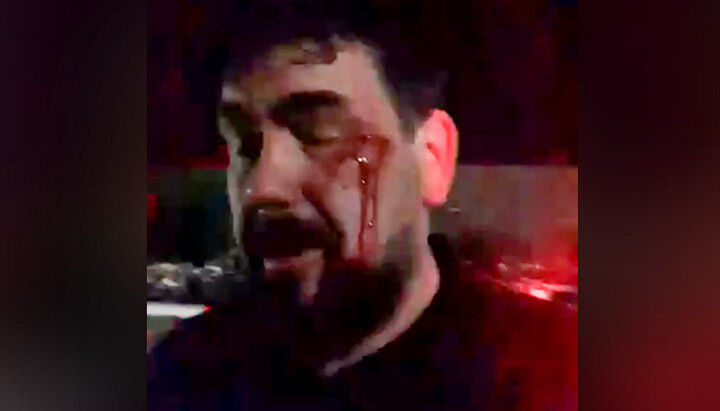
The rector of the Kazan Church in Ladyzhyn, Fr Yevheniy Vorobiov, after the seizure. Photo: UOJ
Archpriest Yevheniy Vorobiov, the rector of the Kazan Church in Ladyzhyn, detailed in an interview with the UOJ how the seizure of his temple took place on January 9, 2024.
According to the priest, after a previous attempt on December 28, parishioners decided on night watch in the church. At 5 a.m., they were awakened by severe blows to the doors of the sacristy.
"They climbed over the fence, cut the lock on the gate, and two loaders entered the temple grounds. One started to 'work on' the northern door, and the other – the entrance to the sacristy. Initially, the outer door was torn off (they broke it by hand), then the loader pulled away the blocks that were in its way and started to break down the inner door with a pitchfork. The fourth blow knocked it out," said the rector.
According to him, the bandits rushed inside and immediately began dispersing tear gas.
"After a dose of gas, I received a blow to the head – didn't even realise with what and how. I fell. They dragged me by my jacket, kicked me, and eventually pushed me outside. I remember shouts: ‘Everyone outside the perimeter!’. They were organised and very fast. Literally within five minutes, everything was over," the priest said.
He says there were about 20 attackers who acted with the support of a hundred military men.
"Then another group arrived in a large jeep, with automatic weapons. When the 'activists' barricaded themselves in the temple, all the servicemen, at the command of their leader, lined up and left in three columns," Fr Yevhen said.
He said that the local Ladyzhyn police, upon arriving at the temple, acted professionally, blocking the road to the loader ramming the temple. However, the soon-to-arrive special forces from the "Vinnytsia" battalion behaved differently.
"When we tried to enter the temple grounds on the day of the seizure, the 'activists' didn't let me in, and a clash occurred. After that, Vinnytsia policemen took me to their bus and ordered me to stand there. I asked: 'Am I detained?' – 'No.' – 'So, can I go?' – 'Stay here.' One of them said, 'Take a step – we'll shoot you in the head. In general, you need to be beaten, beaten, and beaten; you haven't been beaten yet.' He said it in other words; I just can't use them," the priest said.
"This person then came to the temple every day to bring 'fresh' fighters on a bus," the priest added.
As earlier reported, the rector of the Kazan Church in Ladyzhyn was brutally beaten, and the temple was seized.
Read also
BOC Patriarch: Bartholomew cannot be anathematized without conciliar decision
Patriarch Daniel said that no Local Orthodox Church has anathematized the Patriarch of Constantinople, warning that misguided zeal can lead people to place themselves above the Church.
Bulgarian Patriarch: Athos monasteries do not admit OCU clergy
The Bulgarian Primate noted that the monasteries of Iviron, Vatopedi, Hilandar, and Zograf do not admit OCU clergy but remain in communion with Patriarch Bartholomew.
Rivne Eparchy of UOC marks 290th anniversary of Bilashiv church
Metropolitan Pimen led a festive Liturgy marking the 290th anniversary of the founding of the Church of the Nativity of Theotokos in Bilashiv.
UOC priest killed in war laid to rest in Kovel
The Volodymyr-Volynskyi Eparchy bid farewell to Archpriest Andriy Korinchuk, rector of several parishes, who was killed in the war.
Vyshhorod mayor accused of damaging monument to Sts. Boris and Gleb
The creators of the monument to Sts. Boris and Gleb accused the Vyshhorod mayor of damaging it and demanded that it be restored to its original appearance.
Bulgarian Primate responds to criticism of Bartholomew's visit (UPDATED)
Patriarch Daniel urged those unhappy with the Synod's decision to measure their views against the Church's conciliar judgment and warned against turning church gatherings into mere talk shops.