Berlin Consultation notes violations of Ukrainian authorities against UOC
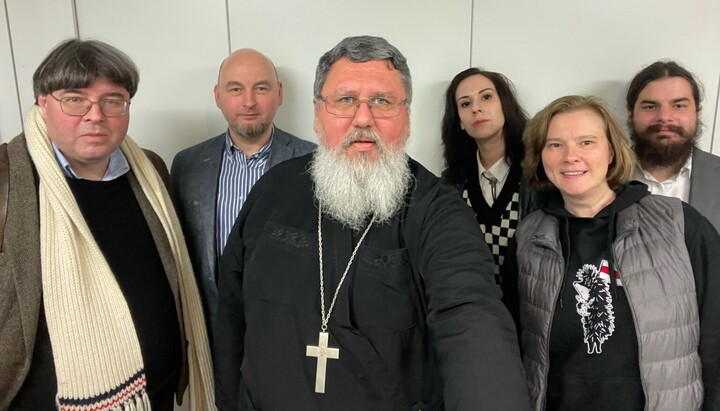
Participants of the UN Theological Consultation in Berlin. Photo: baznica.info
On 5 February 2024, at the beginning of the UN week dedicated to harmonious interfaith relations, a theological consultation on state-confessional relations in Ukraine was held in Berlin. The event, organised by the Latvian resource Baznica.info and the St. Maynard Foundation, was attended by theologians and experts from Germany, Switzerland, France and Latvia.
Starting the consultation, the participants condemned the war against Ukraine. At the same time, they stated that military aggression "cannot serve as a justification for violations on the part of democratic Ukraine".
The moderator said, "This war is what many call the war of authoritarianism against democracy. And it is important that it should end with the victory of democracy.'"
Natalia Vasilevich, a Belarusian Orthodox human rights defender currently residing in Germany, noted in her speech that restrictions on freedom of conscience cannot be discriminatory.
"Regarding freedom of religion, state security is not such a legitimate goal – this is specifically stated in General Comment No. 22 of the Human Rights Committee on Article 18 of the International Covenant on Civil and Political Rights," Vasilevich remarked.
According to her, freedom of speech allows for critical expression regarding any denomination. However, if hate speech is used by officials, if it is done systematically and leads to acts of violence, the state must respond to such statements.
Vasilevich noted that Ukrainian authorities are at an impasse regarding the UOC, as there are concerns about repression against this denomination from Western partners, upon whose support Ukraine depends in a complex situation of war.
Master of Theology, member of the Administrative Council of Vicariate of the Metropolis of Gaul of the Ecumenical Patriarchate, Justina Panina (France), commenting on conflicts in Ukraine, drew attention to the experience of Orthodox communities in France. She mentioned that "fixed membership with mandatory membership fees does not eliminate all possible problems but provides a much more transparent system when voting on jurisdictional changes."
According to Panina, at least a partial introduction of such a system could provide greater security for UOC Orthodox communities from raiders.
Sociologist and publicist Nikolai Mitrokhin (Germany) pointed out that there is no independent monitoring of the religious situation in Ukraine. According to him, there are many examples of manipulation to distort voting results during transfers.
"There are certainly cases of the majority of community members moving from one church to another, but they are an absolute minority and are not challenged by their former church. However, the majority of 'transitions' either mean a division in former communities, often accompanied by disputes over who will receive the church, or active pressure from external forces on communities (primarily local administrations and activists of socio-political organisations previously not involved in active religious practice and membership in the community), or direct seizure of churches and parish property from the 'wrong' church in favour of the 'national' one by administrative or blatantly illegal methods, using direct violence. Moreover, this property is not always subsequently used for religious purposes. Or all of this together," Mitrokhin said.
At the same time, he noted that for "society" and "abroad," supporters of the national church in all cases describe such situations as "transition", completely discrediting this term. In fact, many (if not the majority) of the "converted" communities remain and conduct regular services because the vast majority of the clergy refuse to "move".
Meeting participants stated that a change in religious policy is in the interests of Ukraine’s leadership as it removes a number of issues from the European Christian community and deprives Moscow of the opportunity to use the religious factor for its interests, including weakening Ukraine's support from Europe and the United States.
As earlier reported, according to Natalia Vasilevich, the Ukrainian authorities have cornered themselves in the situation with the UOC.
Read also
Medieval сhurch сrumbles as Culture Ministry сites missing agreement
The 14th–15th-century St. Nicholas Church in Chesnyky, Ivano-Frankivsk Region, is falling into disrepair.
Poland сondemns Lviv Regional Council's decision to declare 2007 year of UPA
Polish Prime Minister Donald Tusk says the Lviv Regional Council's decision to dedicate 2027 to the UPA and Roman Shukhevych is harmful to Ukraine.
OCU seeks court recognition of ownership of seized Cherkasy cathedral
The Cherkasy Regional Commercial Court will hear an OCU lawsuit seeking ownership of St. Michael's Cathedral, which was seized from UOC believers.
Lithuanian bishop: Ukraine is no model for believers' rights
Vicar of Vilnius Diocese voices concern over attempts to import Ukraine's religious conflict into Lithuania.
Hundreds of believers honor St. Alexis of Carpatho-Russia in Khust Eparchy
At the St. Nicholas Monastery in the village of Iza-Karputlash, Metropolitan Mark of Khust led a festive liturgy, concelebrated by six metropolitans, five archbishops and three bishops.
Court upholds UOC parish appeal in Voloshky over OCU switch dispute
The Northern Commercial Court of Appeal has upheld the appeal of the St. Nicholas parish of the UOC in the village of Voloshky, Volyn region, in a dispute over a transfer to the OCU.