Archbishop Victor: Prodigal Son Parable is a revelation about God himself
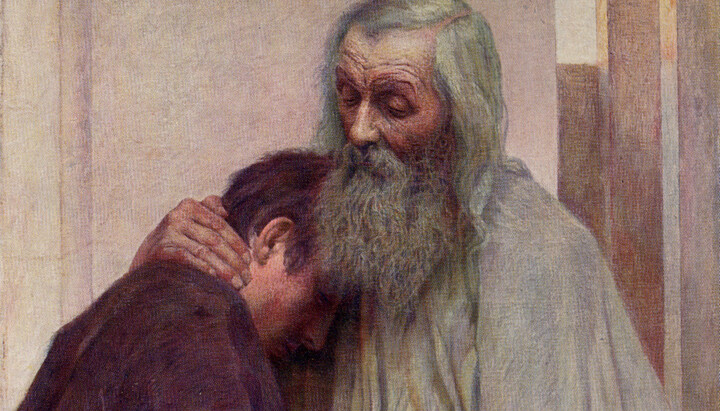
Eugene Bernan. "Prodigal Son". Photo: fineartphotographyvideoart
Archbishop Victor of Khmelnytsky shared insights into the Gospel parable of the prodigal son in his UOJ blog.
"The greatest revelation of Sacred Scripture is that God is a person, and man is also a person. Between these personalities, each of which possesses freedom (God by nature, man by God's gift), certain relationships are established. What these relationships will be depends not only on God but also on man," wrote the hierarch.
He underscored that the son's demand to his father to give him his share of the inheritance is "a striking description of how God loves man and respects his freedom."
"The son's request itself is an undisguised and cynical insult to the father. The son demands the part of the inheritance that would be due to him in the event of the father's death. In other words, he says to the father, 'For me, you are as good as dead'," the hierarch wrote, adding that "humanly speaking, any father in such a case would not only not give his son a share of the inheritance but would also punish him for his insolence."
"But God has a completely different view of these things. 'My thoughts are not your thoughts, nor are your ways My ways,' says the Lord... The father's consent demonstrates how much he respects his son's freedom. Despite all his paternal authority, despite the opportunity not to let his son make the mistake he has already decided to make in his heart, the father allows him to carry out his plan. This means that the father is, in a way, saying to his son, 'You are a person. Not a slave, not a subordinate, but a person, and I respect your decisions, although they make me feel hurt'," Archbishop Victor emphasized.
Commenting on the son's return to the father, he wrote that his repentance was sincere. "And most importantly, the father became alive for him again. If the initial request for a share of the inheritance sounded like 'you are dead to me,' now it's 'you are alive to me, and I'm coming to you.' And the son's repentance was not in vain (as often happens with us); he rose and went to the father," the hierarch wrote.
Moreover, how the father received the son, according to him, is "a description of complete, unaccountable, and boundless love. Love that can only exist between two persons."
"From a logical point of view, this parable is absolutely absurd. It could not have been told by any 'founder of religion' but only by the Son of God, who proclaimed to people, 'God is love...' (1 John 4:16). The absurdity of this parable is that it seems to refute all teachings about virtue, obedience to commandments, asceticism, and so on. As if to say, 'Don't bother, don't fast, don't pray, don't work, you can sin and live for your pleasure, and then come to God and just say 'forgive'. The same message is heard in the Gospel narrative of the wise thief crucified to the right of Christ. He committed terrible deeds, robbed, killed, raped, and then simply asked to be remembered in the Kingdom of Christ. Can there be anything more absurd than this?! But the love of God is exactly like this—it forgives everything, as long as a person turns to Him, and does not remember anything sinful that a person has done," the hierarch wrote, emphasizing that those who think they can consciously sin and then rely on forgiveness are mistaken, that such deceit and hypocrisy in relations with God is impossible, and we must be sincere.
At the same time, he said that the elder son, although he remained with his father all the time, did not acquire love.
"The elder son, who always obeyed all his father's commandments, worked for him, and did what pleased him, of his own free will refused to enter the Heavenly Kingdom. Why? Because he did not have love. God is a person, and man is a person, and the relationship between them is love. Without having learned to love, a person cannot enter the Kingdom of Heaven. The most important commandment about love for God and neighbor is given, among other things, because, without love, a person himself will refuse to enter the Kingdom of Heaven, where love reigns," Archbishop Victor concluded.
Earlier, the UOJ reported that, according to His Beatitude Onuphry, whoever wants to see Christ must climb the tree of fasting.
Read also
Met. Meletiy consecrates house of worship for UOC community in Dankivtsi
Members of the persecuted UOC Intercession parish in Dankivtsi have converted a house into a place for communal prayer and worship services.
OCU eparchy sells church center site to developer for housing
The OCU’s Volyn Eparchy sold land intended for a spiritual center to a private developer planning to build townhouses and residential buildings.
SBU names UOC priest’s wife a suspect in Cherkasy region
The SBU accused Matushka Kateryna Prykotenko of “spreading enemy propaganda” through correspondence with parishioners.
UGCC cleric calls Russian Orthodox literature dangerous for clergy
While examining the causes of divisions within the UGCC, Yustyn Boiko concluded that Russian Orthodox literature had influenced Greek Catholic clergy.
UOC will play major role in achieving peace, says Vadym Novynskyi
UOC Protodeacon Vadym Novynskyi believes the Church will help bring about reconciliation within Ukrainian society after the war ends.
Catholic media outraged by forcible conscription of Uniate cleric
The Vatican’s Apostolic Nunciature has demanded the return of a forcibly mobilized Greek Catholic cleric.