Bill 8371 does not comply with Ukraine's international obligations
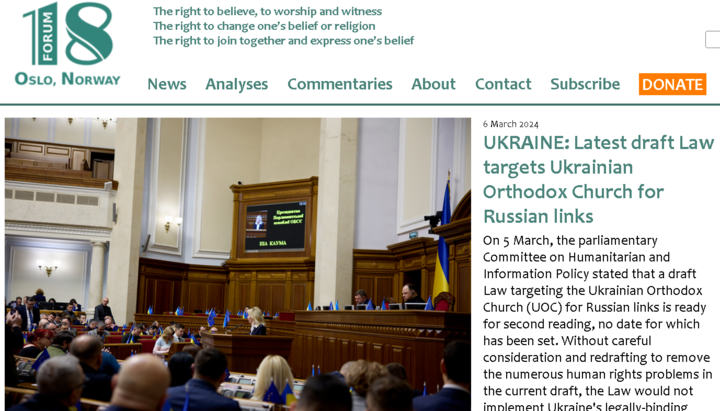
Photo: a screenshot from the website forum18.org
Bill 8371 on banning the UOC does not meet Ukraine's international human rights obligations to respect and protect the freedoms of religion or belief, expression, and association, says the article published on the website of the Norwegian human rights organisation Forum 18 on 6 March 2024.
The author of the article, Dmytro Vovk, a visiting professor at the Benjamin N. Cardozo School of Law and managing director of the Centre for the Rule of Law and Religion Studies at the Yaroslav the Wise National Law University in Ukraine, and a lecturer in law at the Ukrainian Catholic University gives a thorough legal analysis of the bill.
"The adoption of the bill in its current wording indicates that the Ukrainian state has decided to deal harshly with the UOC," the author emphasises. “In addition to prosecuting clerics, believers and communities involved in security offences, the state will prosecute all UOC communities for ecclesiastical and historical ties with the Russian Orthodox Church."
In his opinion, this will legitimise the large-scale and relatively quick stripping of the legal status of all UOC communities.
"This will both legitimise past decisions by local councils in some regions to strip UOC communities of the right to lease land or property and will force UOC organisations to abandon several state-owned historically significant places of worship, such as Pochaiv Lavra in Ternopil region," he concludes.
According to Professor D. Vovk's analysis, the draft law will also significantly increase the state's role in inter-religious relations and expand the powers of the DESS to monitor and control religious communities and the expression of religious ideas. Such an expansion of powers, the author is sure, will not have sufficient legal protection against their arbitrary use.
"Without carefully addressing these issues, the draft law will not be able to implement Ukraine's legally binding international obligations to respect and protect freedom of religion or belief, freedom of expression and association," the expert stresses.
The Norwegian publication Forum 18 informs that several international organisations are ready to draw up their expert opinion on the draft law but they have not received any requests from the Ukrainian authorities.
"The OSCE Office for Democratic Institutions and Human Rights (ODIHR) has not received a request from the Ukrainian authorities to review the Bill, ODIHR spokesperson Katja Andrusz told Forum 18 that it had not received a request to review the draft law."
As previously reported, the UOC could be banned based on Russian documents
Read also
Metropolitan Onuphry congratulates Georgia on 1,700 years of Christianity
The Primate of the UOC sent a message to Patriarch Shio III on the anniversary of Christianity becoming the state religion in Georgia.
Zakarpattia marks 25th anniversary of Alexis of Carpatho-Russia's glorification
An all-night vigil was served at St. Nicholas Monastery in the village of Iza-Karputlash to celebrate the 25th anniversary of the glorification of St. Alexis of Carpatho-Russia.
DESS finds Balta Eparchy of UOC affiliated with ROC
Yelensky-headed state service said it found signs of affiliation of the Balta Eparchy Administration of the UOC with the ROC.
Upper Lavra court hearing postponed
The next court hearing in the Upper Lavra case has been scheduled for November 3.
UOC priest blesses ambulances at Kamianske medical center
A UOC priest in Kamianske blessed ambulances for a medical facility and wished its doctors God's help in their work.
Dumenko to German ambassador: Law targeting UOC also applies to other groups
Epifaniy Dumenko sought to defend Ukraine’s law restricting religious organizations during a meeting with the German ambassador.