Violation of UOC communities' rights due to anti-church law broached at UN
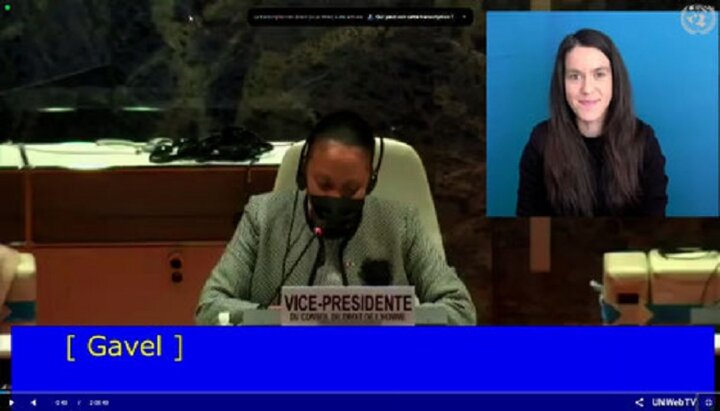
Intersessional meeting of the UN Human Rights Council. Photo: protiktor.com
On May 11, 2021, Oleg Denisov, President of the Human Rights Organization NGO Public Advocacy, took part in an intersessional meeting of the UN Human Rights Council, where he spoke about the formation of a negative image of believers of the Ukrainian Orthodox Church in the socio-political sphere of Ukraine and the violation of the rights of the UOC communities due to the adoption by the Verkhovna Rada of the so-called law on renaming, according to the Public Advocacy website.
He noted that now there is a tendency of some states to interfere in the affairs of religious confessions, violating fundamental human rights, which undermines the foundations of social stability and in some cases, poses a threat to religious peace. “In particular, in Ukraine, North Macedonia, and, until recently, Montenegro, central government bodies at the level of bills, as well as laws that have come into force, encourage inequality between religious confessions, and in some cases, openly discriminate by giving advantages to certain confessions and restricting the legal rights of others,” said the human rights activist at he UN meeting.
Denisov's statement says that with the entry into force of the so-called Law on renaming, more than 12 thousand religious organizations in Ukraine are actually deprived of the right to freely dispose of their property, open bank accounts, amend their statutes, since according to the law, their constituent documents are invalidated in terms of the name. “Therefore, the communities, although they have not lost their status of a legal entity, they are actually affected in their civil rights, deprived of the opportunity to be full-fledged participants in civil involvement,” the human rights activist said.
He stated at the UN that the obligation to change the name of a religious organization against the free will of its members violates the canonical, historical and religious identity of believers, as well as the right to freedom of religion, which is guaranteed by international law. “Undoubtedly, believers should be retained the right to preserve the historical names of their religious communities, and the state cannot interfere in this area of church life,” Denisov said.
The human rights activist drew the attention of diplomats to the fact that in a number of international documents, in particular in the Guidelines for the Analysis and Prevention of Genocide, developed by the Office of the UN Secretary General, targeting and labeling a certain part of the population as a potential victim or target, based on racial, ethnic or religious signs, indicates a high risk of mass violations of human rights in the country.
“In this regard, the formation in the socio-political sphere of Ukraine of a negative image of the believers of the Ukrainian Orthodox Church as supporters of the Russian Federation, recognized in Ukraine as an aggressor state, combined with the hate speech in the media and rhetoric by officials and politicians of different levels, testifies to the incitement of religious enmity towards this group of believers, which causes extreme concern and requires a response from the international community, ”summed up the head of the NGO Public Advocacy.
As the UOJ reported, the Head of the Representation of the UOC to European International Organizations told the OSCE meeting participants about the anti-church laws adopted in Ukraine.
Read also
OCU activist admits breaking into UOC church in Sloviansk
Oleksandr Onyshchenko said that the OCU held its first "service" at the Seraphim Church, which had previously been broken into by forcing the locks and doors.
Archimandrite Ioustinos, longtime keeper of Jacob's Well, dies in Jordan
Archimandrite Ioustinos (Mamallos), the keeper of Jacob's Well in Nablus, has died after a prolonged illness.
Pilgrim group from Kyiv Theological Seminary visits Mount Athos
KTS students are making a pilgrimage to the holy sites of Romania, Greece, Mount Athos and Italy.
UOC cathedral celebrates its patronal feast in Ternopil
The service in the cathedral of the Holy Martyrs Faith, Hope, Love and their mother Sophia was led by Metropolitan Serhii of Ternopil, concelebrated by four hierarchs.
MinCulture marks centenary of Soviet-era reserve at Lavra's Refectory Church
Representatives of the Ministry of Culture presented awards to the Reserve's employees on the occasion of the anniversary at the Refectory Church of the Lavra.
Conference to mark 1700th anniversary of Christianity adoption held in Georgia
In Georgia, representatives of the Church and the state noted the defining role of Christianity in the country's cultural development.