Church сelebrates the Dormition of the Most Holy Theotokos
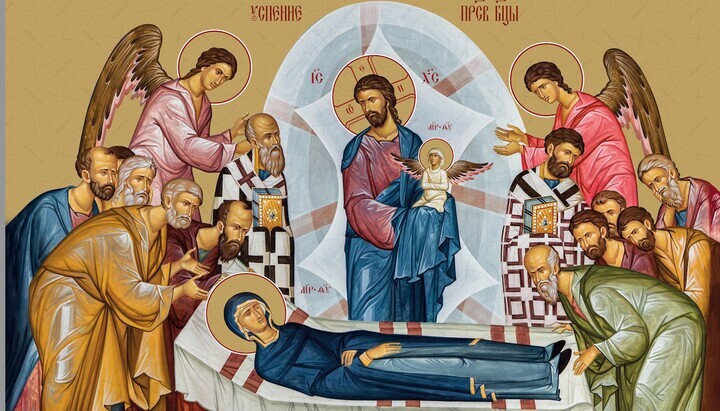
Icon of the Dormition of the Mother of God. Photo: psdsale.com
On August 28, the Holy Church celebrates the great feast of the Dormition of our Most Holy Lady, the Theotokos and Ever-Virgin Mary.
The term "dormition," related to the word "deceased," can be translated as "sleep" or "death" – this is how the Church refers to the day of the repose of the Theotokos. This event is not described in the Bible, but we know about it through the Tradition of the Church.
Before her dormition, the Mother of God lived in Jerusalem, preaching the Lord alongside the apostles. One day during prayer, the Virgin Mary saw the Archangel Gabriel, who had once announced to her the great joy – that she was destined to become the Mother of the Savior of the world. This time, the Archangel informed her that her earthly life would end in three days and that the Lord would take her to Himself.
Before her death, the Most Holy Virgin wished to see all the apostles, who had by then scattered to various places to preach the Gospel. Her desire was fulfilled – the Holy Spirit miraculously gathered the apostles at the bedside of the Most Holy Theotokos, where she prayed and awaited her end, and only the apostle Thomas arrived in Jerusalem on the third day after her burial.
The apostles witnessed the blessed end of the Holy Virgin. Christ Himself, surrounded by angels, appeared to receive the soul of His Pure Mother and to take her up to heaven.
Her body was buried in Gethsemane, where the Lord's Tomb was located and where the parents of the Virgin Mary and her betrothed husband, the righteous Joseph the Betrothed, were also buried.
On the third day, the apostle Thomas arrived at the tomb of the Mother of God. The tomb was opened, but the body of the Theotokos was no longer there – only her burial linens remained.
In the evening of the same day, after a communal meal, during prayer, the apostles heard the singing of angels. Looking up, they saw the Most Holy Virgin, surrounded by angels, ascending through the air in a heavenly light. She addressed them with the words: “Rejoice! Now I am always with you.”
According to Church teaching, Christ took the Most Holy Theotokos in the flesh to His Heavenly Kingdom and placed her above all angelic powers.
The Dormition of the Theotokos is the final major feast of the Church year. The Church New Year is celebrated on September 14 (according to the old calendar, September 1), so the first feast of the year is the Nativity of the Theotokos, and the last is her Dormition. Thus, the entire year is organized around the events of the life of the Mother of God. The feast of the Dormition is preceded by a two-week fast, comparable in strictness to the Great Lent.
On August 25, 2024, on the eve of the patronal feast of the Holy Dormition Pochaev Lavra, a large many-thousand cross procession from Kamianets-Podilskyi arrived at the monastery.
Read also
Metropolitan Onuphry calls for prayers to Mother of God for peace in Ukraine
On the feast day of the “She Who Is Quick to Hear” icon, the UOC Primate spoke of the Mother of God’s maternal care and urged the faithful to live by the laws of holiness and love.
OCU holds evening of wedding rituals at seized Cherkasy cathedral
An event featuring participants dressing in traditional wedding attire and reenacting folk rituals to bandura accompaniment was held at St. Michael’s Cathedral in Cherkasy.
Volodymyr-Volynskyi Eparchy marks 30 years since restoration
The Pantanassa Icon and relics of Prince Volodymyr have arrived in Kovel and will visit churches across the Volodymyr-Volynskyi Eparchy to mark the 30th anniversary of the restoration of the episcopal see.
Bukovyna faithful bring humanitarian aid to Kherson region residents
The UOC’s Chernivtsi Eparchy delivered food to Holy Spirit Cathedral in Kherson.
Ukraine must have its own faith: Poroshenko's party lays out peace terms
Poroshenko’s party European Solidarity described church policy as a matter of national sovereignty and said there can be no compromises in this area.
432 UOC churches damaged in Ukraine during war, report says
According to the Religion on Fire project, 807 religious buildings in Ukraine have been damaged or destroyed as a result of hostilities.