Norwegian organization Forum 18 criticizes Ukrainian law No. 3894
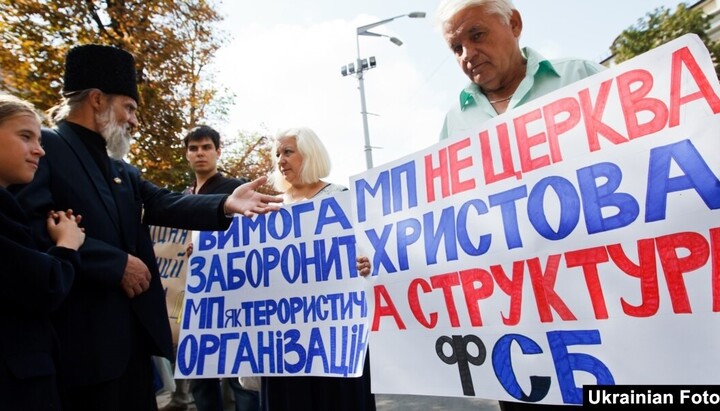
A rally against the UOC. Photo: Ukrainian photo
The Norwegian organization Forum 18 has criticized Ukrainian law No. 3894-IX, which bans the activities of the Russian Orthodox Church and its affiliated religious organizations in Ukraine, including the Ukrainian Orthodox Church (UOC). In its analysis, Forum 18, which aims to defend religious freedom, highlighted several key points of concern about the law. The analysis was cited by "Christians Against War."
The main points of criticism are as follows:
- Lack of necessity for proof of illegal activity: The law allows for the prohibition of any religious organization associated in any form with the Russian Orthodox Church (ROC) without the need for evidence of illegal behavior. This approach violates international human rights standards to the effect that punishments should be imposed only for specific illegal actions, not based on presumed affiliations.
- Vagueness of terminology: Forum 18 emphasizes that the law contains vague terms such as "influence" and "blessing", allowing the state to interpret and apply it arbitrarily. This poses a risk to many religious communities that could be banned without clear justification.
- Complications for the UOC to prove independence: Despite the UOC declaring its independence from the ROC in May 2022, the law makes this independence legally unrecognized. Any action by Moscow Patriarch Kirill, interpreted as a "blessing", could be used to ban a community, even if it claims autocephaly.
- Inability of the UOC to avoid liquidation: The organization notes that even if the UOC officially declares its autocephaly, it may not be enough to prevent its communities from being banned.
- Leeway for abuse: The law contains too many vague provisions, which could lead to arbitrary decisions to ban religious organizations.
Thus, Forum 18 argues that law No. 3894-IX excessively expands the state's control over religious communities, violating international principles of freedom of religion and posing a threat to Ukrainian religious organizations, which may be unjustly banned.
As previously reported by the Union of Orthodox Journalists, a national audit of UOC property was initiated by the State Service of Ukraine for Ethnopolitcs and Freedom of Conscience (DESS).
Read also
Lionel Messi thanks God for his achievements as he ends international career
Argentine football star Lionel Messi credited God for his success as he brought his international career to a close, saying he could never have achieved so much without God's will.
Odesa’s St. Elijah Monastery honors memory of its founder
Metropolitan Agafangel led celebrations at St. Elijah Monastery in Odesa on the feast day of St. Gabriel of Mount Athos.
OCU cleric rejects suspension, accuses ruling bishop of usurping power
An OCU cleric called the decree suspending him "canonically null and void" and accused "Bishop" Semanchuk of attempting to seize parishes and using mobilization threats as blackmail.
Supreme Court: Religious beliefs do not exempt citizens from mobilization
The Supreme Court has clarified that Ukrainian law does not provide for alternative civilian service under martial law.
Ukraine birth rate drops 17%, demographer says
The head of a department at Ukraine’s Institute of Demography has reported a sharp decline in the country's birth rate.
Khust Eparchy honors memory of St. Job of Uholka
A Liturgy is served in Mala Uholka, a birthplace of St. Job of Uholka, on the saint's feast day.