Satanism gains ground in Chile as traditional religions decline
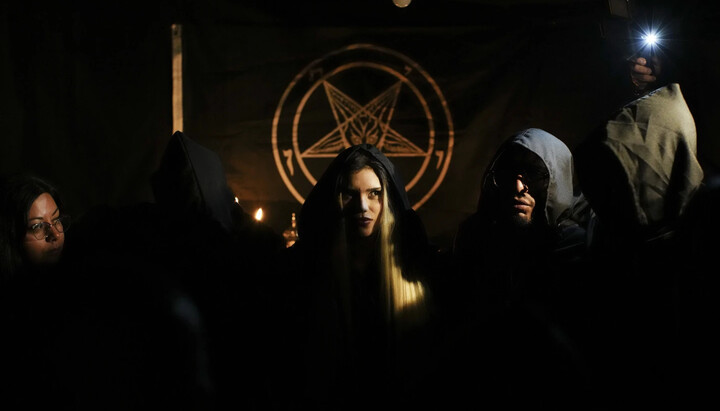
Satanists and Luciferians in Chile take part in a Celtic pagan festival in Santiago, October 31, 2024. Photo: ASP
According to Associated Press, five years after controversy and public alarm over the recognition of the The Satanic Temple in the United States, a similar movement has emerged in conservative Chile, where roughly half of the country’s 18 million people still identify as Catholic.
Luis Bahamondes, a professor at the Center for Judaic Studies at the University of Chile, told AP that “these types of organizations now feel that they have greater support to challenge what was virtually impossible before."
He noted that until recently, the Catholic Church exercised unprecedented influence, shaping views on politics, economics, geopolitics, sexuality, and education.
Founded in 2021, the Chilean “Temple of Satan” has around 100 members and more than 400 applications pending. Prospective members undergo background checks, interviews with a special committee, and psychological evaluation. Interest surged in late July, when the group formally applied to the Ministry of Justice for legal recognition as a religious organization.
Members include writers, firefighters, police officers, lawyers, and psychologists who see the group as a way to challenge moral norms, dogmas, and what they describe as religious imposition. Rather than worshiping gods, they emphasize humanity.
One member told AP: “You are the owner of your present and your future, there is no God that makes decisions for you.” The adherent added that Satan is purely symbolic, and that their rituals are intended “to bring out the emotions and leave the intellect aside.”
Representatives of Chile’s Catholic, Anglican, Evangelical, and Jewish communities said in a joint statement that “the history of Satanism is well known, and it has often led to tragedies.”
Followers of Satanism in Chile, drawing on the tradition of the Church of Satan established by Anton Szandor LaVey, emphasize skepticism and logic over belief in heavenly or supernatural beings. Their adherents are free to formulate their own beliefs, rituals, and spiritual practices.
Néstor da Costa, an expert on secularism and religion at the Catholic University of Uruguay, said the influx of people seeking answers through different perspectives might be linked to the search for less dogmatic approaches
“It may be a readjustment of the religious side of people who leave Catholicism but continue to believe in something,” he added.
Whether the Chilean government will grant the “Temple of Satan” official religious status remains unclear, but its emergence points to deeper shifts within what was until recently a strongly conservative society.
Earlier, the UOJ reported that a large-scale satanic show titled “Gates of Darkness” was held in the streets of Toulouse, France.
Read also
UOC priest’s father killed in AFU military service laid to rest in Sumy
UOC clergy held a funeral service for Ukrainian serviceman Serhii Taptunov at Holy Trinity Cathedral in Sumy. He was buried at a city cemetery with military honors.
Patriarch Bartholomew says his see ensures unity in Christ’s Body
Speaking at the Bulgarian Church's Holy Synod, Patriarch Bartholomew declared that the Archbishop of Constantinople serves as the unifying link and guarantor of Orthodox unity.
Patriarch Daniel calls for preserving Church unity
In a sermon at St. Alexander Nevsky Cathedral in Sofia, the Bulgarian Primate emphasized humility, repentance, and fidelity to the Orthodox faith as the path to overcoming divisions.
Bulgarian and Constantinople Patriarchs attend Liturgy at Sofia Cathedral
Metropolitan Barnabas presided over the Liturgy at St. Alexander Nevsky Cathedral in Sofia as part of celebrations marking two anniversaries of St. John of Rila.
Prosecutors seek to seize Dormition Church from UOC community in Pisky
Prosecutors are seeking to transfer a wooden church in Poltava Region, handed over to believers in 1992, to state ownership under the regional administration.
Metropolitan Onuphry: Love for enemies destroys evil, revenge multiplies it
The UOC Primate urged believers to forgive those who wrong them and do good without expecting gratitude or reward.