On "Priestly" War
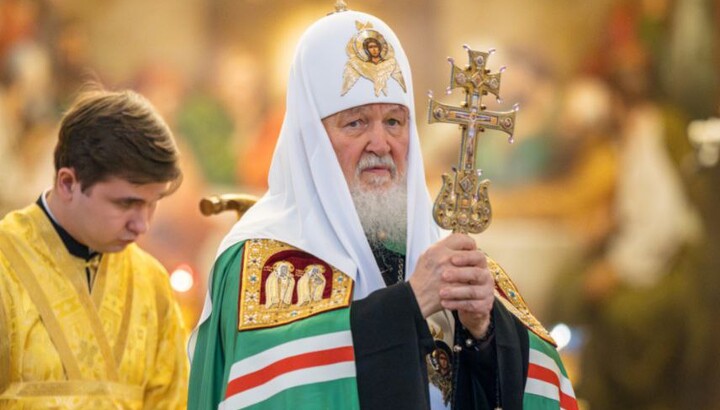
Patriarch Kirill of the Russian Orthodox Church. Photo: ROC Military Department
Now, let’s look at some statistics.
On February 6, it was reported that almost a year ago, on the frontlines, the son of a priest from the Ovruch Diocese, Andriy Lenko, was killed. He had been missing in action. Despite his illness, he was drafted into the army. At the time of his enlistment, Andriy was studying at the Kyiv Seminary and dreamed of becoming a priest.
His death brings to mind many others.
- July 24, 2024 – Vadym Mironin, son of a nun from the Tikhvin Convent, was killed.
- July 3, 2024 – Oleksandr Maksymiuk, son of a priest from the Rivne Diocese, was killed on the frontlines.
- December 24, 2024 – Dmytro Yakonovych, son of Metropolitan Longin, was killed in combat.
- September 2024 – Serhiy Riabets, son of a priest from the Alexandria Diocese, was killed.
- May 2023 – Oleksandr Prokopchuk, son of a priest from the Sarny Diocese, was killed in battle.
- Autumn 2023 – Andriy Demchyk, brother of a priest from the Chernivtsi-Bukovyna Diocese, was killed.
- Autumn 2023 – Ioann Markevych, nephew of Metropolitan Augustyn of Bila Tserkva and son of a priest from the Bila Tserkva Diocese, was killed.
- August 18, 2023 – Oleksandr Margita, son of a priest from the Volyn Diocese, was killed on the frontlines.
- Spring 2023 – Vasyl Fechko, son of a priest from the Mukachevo Diocese, was killed.
- August 2022 – Vasyl Nahai, son of a priest from the Bila Tserkva Diocese, was killed.
- December 26, 2022 – Vasyl Korobeinyk, son of a priest from the Sumy Diocese, was killed in combat.
- May 2022 – Mykola Yakovliuk, son of a priest from the Volyn Diocese, was killed.
- May 2022 – Nazarii Pryimak, brother of a priest from the Volyn Diocese, was killed.
- April 2022 – Oleksandr Kovalenko, brother of Metropolitan Luke of Zaporizhzhia, was killed in battle.
And this is far from a complete list. There are dozens of UOC priests who have died because of the war and hundreds of churches destroyed.
It is unclear why Russia calls this war "holy". UOC believers are suffering. Priests are suffering. Perhaps it would be more relevant to call it the "priestly war".
Read also
Why is Jerusalem “wrong” about OCU, but Constantinople isn’t?
In the eight years since the OCU was established, we have never once heard its leader suggest that the Patriarch of Constantinople is capable of error.
Who destroyed and restored Kyiv Lavra? MinCulture's video reveals the truth
The Culture Ministry’s propaganda about the Kyiv-Pechersk Lavra has inadvertently revealed the truth.
Ternopil post on Feast of Intercession: Has calendar reformn failed?
A significant number of believers have rejected the new church calendar introduced by the OCU and UGCC with government support.
Shoulder straps or a cassock: who writes the script for UOC "fighters"?
Everything indicates that both Veliar and Pshenychny are ordinary performers of someone else's script. There is only one question – does the scriptwriter wear shoulder straps or a cassock?
Why is it legal to kill a person before birth but not after?
Children are the most privileged members of society. Yet that same society officially permits children to be killed – and on a massive scale.
Honoring the Bolsheviks’ successors at Kyiv Lavra
It was under the Reserve that the relics of the saints were desecrated, Lavra churches were turned into an atheism museum, and toilets were installed in sanctuaries.