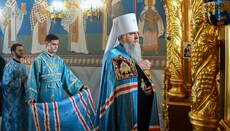

Prayer for Zelensky
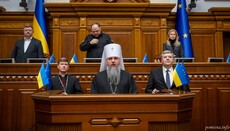
If Dumenko composes a “prayer” for a visit to parliament in which the president, the Rada, and the government are each listed separately, we understand that these words are addressed not to God, but to the people who invited him into the Rada.
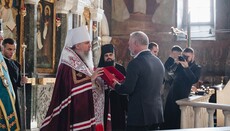
Dumenko read a prayer for Ukraine from the rostrum of the Verkhovna Rada. As usual, from a sheet of paper. It contained the following words:
“Strengthen our warriors, the president, the Verkhovna Rada, the authorities, the government, and all our Ukrainian people, who are resisting the treacherous Russian aggressor on land, at sea, and in the air. Grant us victory in Thy name and establish a just peace.”
Why are we writing about this? Because the entire “prayer” rhetoric of today’s patriotic confessions, in its pathos, is becoming more and more caricature-like and is sliding into frankly grotesque forms.
How do we pray for our country in the Church services? “For its authorities and armed forces.” That is enough. We do not spell things out to God: help the missile troops separately, or the Ministry of Economy, or the Committee on Humanitarian Policy. God is the Knower of hearts. He knows all our thoughts before they are even spoken.
But if a “metropolitan” composes, for a trip to the Rada, a prayer in which the president is listed separately, the Rada separately, the government separately, then we understand – these words are not addressed to God at all, but to the people who invited him into the Rada: Zelensky, Stefanchuk, the MPs, and so on.
And one more thing. Is it really necessary, in a prayer, to tell God that the aggressor is “treacherous”? That we are asking for help “on land, at sea, and in the air”? That our defenders are “courageous,” while the aggressor’s designs are “devilish”? One would think Christ knows far better than we do where the struggle is taking place, and who is treacherous and who is brave. And Serhiy Dumenko cannot fail to understand this. Yet he says it anyway. Why?
Because that is what they want to hear in the hall. That is the language normally used from the parliamentary rostrum. If you remove Dumenko’s final “amen” from the text, you are left with a typical speech by the average MP, complete with “a just peace,” “the treacherous Russian aggressor,” and other political clichés.
Still, one has to admit: speeches from the Rada’s rostrum are usually delivered with more inspiration. In acting skills, Epifaniy is clearly outmatched by the politicians.