Greek Prime Minister to discuss vaccination at Synod of Greek Church
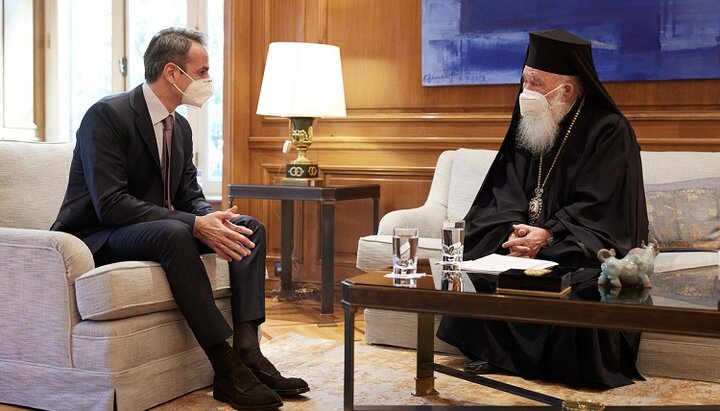
Prime Minister of Greece Kyriakos Mitsotakis and Primate of the Church of Greece, Archbishop Jerome. Photo: orthodoxia.info
Greek Prime Minister Kyriakos Mitsotakis will be present at the extraordinary meeting of the Permanent Holy Synod on Monday, December 13, in Athens, reports orthodoxia.info.
The presence of a state official at the Synod was approved by the Primate of the Greek Orthodox Church, Archbishop Jerome of Athens and All Greece. Mitsotakis will tell the hierarchs of the GOC about the progress of vaccination against coronavirus in the country, as well as about the celebration of the Nativity of Christ in a pandemic.
Also, the members of the Synod will discuss with the official what restrictions will apply to the work of the temples of the Greek Church during the Christmas and New Year holidays. The meeting will begin in the Synodal Hall of the GOC at 11:00.
As reported, the Greek authorities banned unvaccinated people from visiting temples without a PCR test.
Read also
SBU told Phanar many UOC bishops would join OCU in 2018, report says
According to a Phanar representative’s account, Ukrainian security services told the Constantinople delegation that many UOC representatives were prepared to attend the OCU’s “Unification Council.” In the end, only two did.
Catholic cardinal visits Ukrainian POWs during trip to Russia
During three days of consultations in Moscow, Cardinal Matteo Zuppi discussed prospects for ending the war in Ukraine.
Ukrainians help restore Serbian Orthodox church in Paris
Orthodox Ukrainians have become regular parishioners of St. Sava Church in Paris and have taken part in its restoration.
Bulgarian Church clergy and laity oppose Phanar head’s visit
More than 2,000 clergy and laity have called for the Ecumenical Patriarch’s visit to be canceled, citing disagreement with his actions and concerns that the visit could legitimize schism.
Unknown intruders break down doors at two UOC churches in Sloviansk
Archbishop Paisiy said OCU activists are suspected of breaking into the churches in Sloviansk, and police have launched an investigation.
Sviatohirsk Lavra prays for murdered monk on 40th day after death
The brethren of the Sviatohirsk Lavra held a memorial service for murdered Monk Varsonofiy, calling on the faithful to pray for the newly departed monk.