Foundation of church ruined by Bolsheviks discovered by accident in Poltava
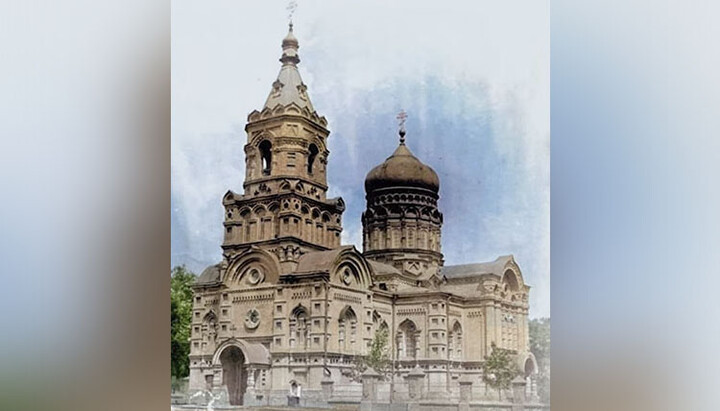
The Intercession Church in Poltava, blown up by the Bolsheviks. Photo: Suspilne
In Poltava, during a spring planting of maple trees in Pavlenko Park, municipal workers discovered stone masonry in the ground, Suspilne reports. It turned out to be the edge of the foundation of the old Intercession Church, which stood on that site from 1903 until 1935. The building was destroyed by an explosion in 1935. Several fragments of the old church will be handed over to the local history museum.
In two pits where trees were planned to be planted, the edge of the Intercession Church’s foundation was uncovered. According to local historian Leonid Bulava, the structure had been built of red brick together with a bell tower.
“It was a very long church, stretching, as per tradition, from east to west. It had three entrances. The church was surrounded by a stone fence, and its height reached 36 meters – about the height of a ten-story building. It was built by an architect following a design by architect Nosov, the same one who designed the current SBU building, the Kozelshchyna Church, and the church in Nyzhni Mlyny. The church was built in the pseudo-Russian style, which was popular in the early 20th century. Services were held there until at least 1934, and in 1935 it was closed and demolished by explosion,” said historian Leonid Bulava.
According to archaeologists, the foundation site of the Pokrova Church would be well-suited for the creation of an open-air museum, which could become a point of interest for tourists.
“There are two options for what to do with these remains, these finds, and the foundation. One is to leave it as is, plant a tree, cover it with soil, and pretend nothing was ever there. That’s the simple option. The other option is to conduct proper research in a small area – really a very small section – to expose the foundation as much as possible, determine where it lies, where the wall and corner are, and turn it into a museum exhibit. To create here a part of an open-air museum. The area could be covered with colored gravel, with informational boards installed. The city council should be interested in conducting research here,” said archaeologist Yurii Pugolovok.
Restoration of the church is not being considered by experts.
Earlier, it was reported that the Exaltation of the Cross Monastery in Poltava is collapsing due to a landslide.
Read also
Met. Meletiy consecrates house of worship for UOC community in Dankivtsi
Members of the persecuted UOC Intercession parish in Dankivtsi have converted a house into a place for communal prayer and worship services.
OCU eparchy sells church center site to developer for housing
The OCU’s Volyn Eparchy sold land intended for a spiritual center to a private developer planning to build townhouses and residential buildings.
SBU names UOC priest’s wife a suspect in Cherkasy region
The SBU accused Matushka Kateryna Prykotenko of “spreading enemy propaganda” through correspondence with parishioners.
UGCC cleric calls Russian Orthodox literature dangerous for clergy
While examining the causes of divisions within the UGCC, Yustyn Boiko concluded that Russian Orthodox literature had influenced Greek Catholic clergy.
UOC will play major role in achieving peace, says Vadym Novynskyi
UOC Protodeacon Vadym Novynskyi believes the Church will help bring about reconciliation within Ukrainian society after the war ends.
Catholic media outraged by forcible conscription of Uniate cleric
The Vatican’s Apostolic Nunciature has demanded the return of a forcibly mobilized Greek Catholic cleric.