Near Jerusalem, archaeologists discover monastery founded by Saint Sabbas
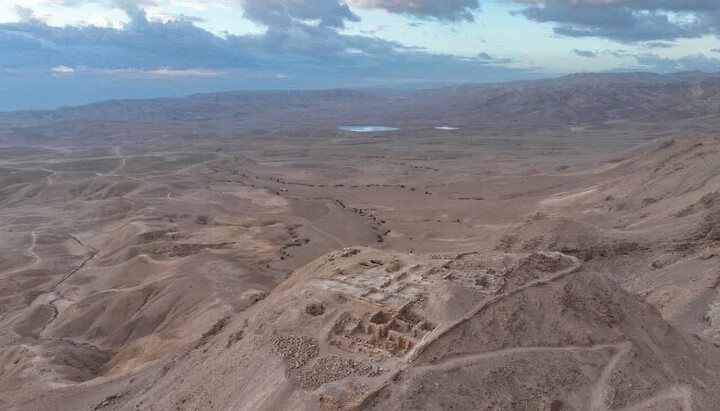
5th-century monastery in the Judean Desert. Photo: The Times of Israel
A significant discovery for Orthodox history has been made by archaeologists from the Hebrew University of Jerusalem. In January 2025, they concluded the second season of excavations in the Judean Desert, where they uncovered a well-preserved 5th-century Byzantine Orthodox monastery, reports The Times of Israel. The research was conducted at the Hyrcania fortress in the West Bank in cooperation with the Judea and Samaria archaeology department.
The excavations revealed a unique Christian complex adorned with richly decorated mosaics, frescoes, and liturgical objects – evidence of a flourishing Orthodox monastic community. The monastery was founded in 492 A.D. atop a hill that locals referred to as the “terrifying mountain.” Beneath the Byzantine structures, remains of buildings from the Second Temple period were also found, located about 17 kilometers southeast of Jerusalem.
“When we first excavated the site, we thought that we were dealing with a modest building since historical sources describe a small group of people establishing it,” said Michal Haber. “As we uncovered its decorative structures, mosaic floor, and other features, we understood the story was different. Now we can see how we are dealing with a prosperous monumental monastery.”
One of the most remarkable finds in 2023 was an inscription in red ochre, paraphrasing part of Psalm 86 in Koine Greek – the dialect used in the New Testament. The inscription was discovered beneath a depiction of an Orthodox cross, attesting to the deep liturgical life of the monastic community.
Of particular significance for Orthodox history is the fact that the monastery was founded in 492 A.D. by Saint Sabbas the Sanctified himself – one of the great pillars of Eastern monasticism. According to ancient sources, Saint Sabbas ascended the top of what he called the “terrifying mountain” and established the monastery as a dependence of the Great Laura of Saint Sabbas.
Notably, the Laura of Saint Sabbas the Sanctified, overlooking the Kidron Valley, still stands and functions to this day. It is one of the oldest continuously active monasteries in the world and belongs to the Jerusalem Orthodox Church.
“Archaeological findings confirm the information from hagiographies and historical chronicles about the ascetic life of Saint Sabbas in the Judean Desert,” noted Dr. Oren Gutfeld. “The monastery we discovered is an invaluable testimony to the spread of Orthodox monasticism in the Holy Land during the 5th and 6th centuries.”
Monastic life at the site flourished for nearly three centuries until the monastery fell into decline in the late 8th or early 9th century A.D., likely due to political changes in the region.
Archaeologists uncovered numerous artifacts that testify to the monastery’s rich liturgical life: fragments of oil lamps, censers, altar crosses, and church vessels. Particularly valuable are fragments of parchment with Greek texts, possibly from the Gospels or liturgical books.
“We discovered remnants of a scriptorium – a workshop for copying sacred texts – which indicates the monks’ high level of spiritual education and their contribution to preserving early Christian heritage,” Haber noted.
Fragments of wall paintings depicting saints and biblical scenes are of special interest to researchers of Orthodox iconography. Although most images were only partially preserved, they demonstrate the high quality of Byzantine-era iconographic art and contain unique examples of iconographic canons.
As excavations progressed, the archaeological team also explored deeper layers beneath the monastery. Remains of structures from the time of Herod the Great and even the Hasmonean period (2nd–1st centuries B.C.) were uncovered.
“We found a lovely example of a vaulted Jewish ritual bath, or mikveh, with the remains of columns,” Haber reported.
The archaeologists also unearthed a Byzantine mosaic floor and the remains of several rooms.
Haber said that the colorful fragments they found were probably painted under Herod as they are almost identical to those unearthed in a late Second Temple-period villa in the Jewish Quarter in Jerusalem, where people who belonged to the elites of the city lived.
Read also
UOC hierarch takes part in consecration of Serbian monastery in Germany
Bishop Veniamin of Boyarka took part in the consecration of the restored monastery of the Serbian Orthodox Church in Hildesheim.
International conference on theology and Church history held in Kharkiv
On October 9, the V International Conference on Theology and Church History, attended by guests from Europe, was held at the Kharkiv Theological Seminary of the UOC.
UOC Boryspil Eparchy priest's brother killed in war
In the village of Perevolochna, Chernihiv region, a funeral service was held for the soldier Roman Povkh, the brother of the rector of a UOC church in the village of Sadove.
TRC detains rector of UOC church in Mali Puzyrky village
A priest of the Khmelnytskyi Eparchy with a heart condition was forced to undergo a medical commission and taken away to an unknown destination.
OCA renews fundraising for Ukrainian refugees in Poland
The Primate of the OCA has called on the faithful to show Christian mercy in practice and support Ukrainian displaced persons in Poland.
Kyiv residents split over renaming alley after Filaret
Forty-six percent of respondents opposed renaming an alley in central Kyiv after Filaret Denysenko.