Shaping “future of monasticism in Ukraine” while expelling monks. Seriously?
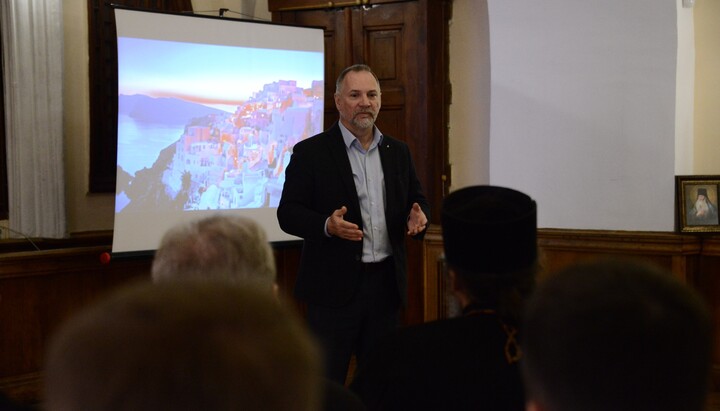
Head of the Reserve Ostapenko. Photo: Reserve's website
The Kyiv-Pechersk Lavra Reserve, in tandem with the OCU, held a "monastic forum" under the pompous title "Paisian Readings".
There, with utmost seriousness, they claimed to “reflect on the role of monasticism in the modern world,” to search for “new forms of ministry,” and even to “discuss the future of monastic life in Ukraine.”
Why do we say “claimed”?
Because the irony is so thick, you could cut it with a knife.
First, this very reserve has spent more than two years waging an aggressive campaign to evict 200 monks from the Lavra – monks who have lived, prayed, and served there for decades. Buildings have been seized, lawsuits filed, smear campaigns unleashed in the media. And now – suddenly – they're concerned about the future of monasticism? That’s not just cynical. It’s theatrical hypocrisy.
Second, the grand “forum” gathered a whopping 15 people. Of those, only three or four could even remotely be called monks. So when this tiny assembly presumes to chart the course for all monastic life in Ukraine, it’s less of a theological summit and more of a tragicomic performance.
Let’s recall some hard numbers. According to official 2021 statistics, the OCU has 233 monks. The UOC? Roughly 4,700. Without even touching on deeper questions of spiritual life, doctrine, or discipline – it begs the question: what exactly is the OCU discussing? And with whom?
But wait – there’s more.
One of the forum’s central “insights” was the claim that the Lavra had been “occupied by Muscovites” for 300 years. Yet not a word was said about the historical fact that most of the Lavra’s churches and buildings – which the Reserve and the OCU now actively use – were built during this supposed “occupation”. That part was conveniently swept under the rug.
And their stewardship of the so-called “liberated” Lavra? That was put on full display when the cross recently fell from the All Saints Church – yes, Mazepa’s church. And judging by the careless, politically driven management style we’ve seen so far, this may be only the first of many such “falls”.
In short, what we witnessed was not a forum on monastic renewal – it was a theatrical display staged by those who have little connection to real monastic life, but every intention of rewriting its legacy.
Read also
Ternopil post on Feast of Intercession: Has calendar reformn failed?
A significant number of believers have rejected the new church calendar introduced by the OCU and UGCC with government support.
Shoulder straps or a cassock: who writes the script for UOC "fighters"?
Everything indicates that both Veliar and Pshenychny are ordinary performers of someone else's script. There is only one question – does the scriptwriter wear shoulder straps or a cassock?
Why is it legal to kill a person before birth but not after?
Children are the most privileged members of society. Yet that same society officially permits children to be killed – and on a massive scale.
Honoring the Bolsheviks’ successors at Kyiv Lavra
It was under the Reserve that the relics of the saints were desecrated, Lavra churches were turned into an atheism museum, and toilets were installed in sanctuaries.
"Degenerates" and "stupid animals": anti-UOC activists turn on children
Future historians will wonder how a vast country’s information agenda could have been shaped for so long by people so petty, vicious, and utterly contemptible.
Zelensky sees murder of Polish priest but not of Sviatohirsk monk
Why does Zelensky react so emotionally and swiftly to the murder of a Catholic cleric while remaining completely silent about the murder of an Orthodox monk?