Mount Athos monks condemn desecration of relics in the Kyiv-Pechersk Lavra
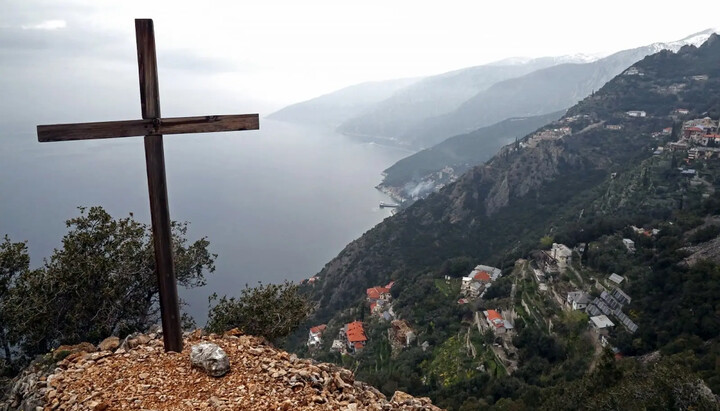
Mount Athos. Photo: Voria
A group of monks from Mount Athos has published a statement on the "UOJ on Athos" website, expressing their firm opposition to the actions of the Ukrainian authorities, who have initiated a scientific examination of the holy relics in the Kyiv-Pechersk Lavra.
The Athonite monks report that on 28 March 2025, a commission from the Ministry of Culture of Ukraine, comprising anatomists, biologists, and veterinarians, accompanied by law enforcement officers, entered the Caves of the Kyiv-Pechersk Lavra. The aim of the commission was “to determine the historical and scientific value of the relics of the Holy Fathers of the Caves by taking samples for DNA testing”.
“Regrettably, these actions by the Ukrainian authorities concerning the relics of the Venerable Fathers of the Caves remind us of the ‘deeds and days’ of the Soviet atheist regime,” the Athonite monks emphasize.
“Would it be acceptable for the heretical Vatican if the Italian authorities undertook similar measures to examine the relics of the Holy Apostles Peter, Andrew the First-Called, Saint John Chrysostom, and other saints? By analogy, would the Holy Community of Mount Athos tolerate intervention by the Greek state to study samples of holy relics from the sacred monasteries of the Athonite State?” the monks ask.
The statement includes a theological justification for the veneration of relics: “The Orthodox Church considers holy relics to be vessels of Divine Grace. St Gregory Palamas explains that just as Christ’s divinity did not abandon His human body during His three-day burial and Resurrection, so too the Grace of the Holy Spirit does not leave the bodies of the saints after their biological death. Therefore, we kiss the holy relics with reverence to receive the Grace of the Holy Spirit that dwells in them.”
The Athonite monks are demanding a response from senior Church authorities: “We especially await an assessment from the fourteen Orthodox Churches, beginning with the Ecumenical Patriarchate. It is no longer possible to pretend that nothing tragic is occurring in the Ukrainian Orthodox Church and its holy sites.”
They also call upon the Holy Kinot of Mount Athos – the highest administrative body of the Holy Mountain – to issue an official statement, as was done previously in response to a blasphemous art exhibition at the National Gallery of Greece.
“How, and more importantly, why should the scientific value of holy relics be determined? Are these actions not being carried out to test how Orthodox Christians around the world will react to yet another deliberate act of blasphemy?” the Athonite monks conclude.
Earlier, the UOJ reported that a metropolitan of the Bulgarian Church had condemned the desecration of Lavra relics.
Read also
Met. Meletiy consecrates house of worship for UOC community in Dankivtsi
Members of the persecuted UOC Intercession parish in Dankivtsi have converted a house into a place for communal prayer and worship services.
OCU eparchy sells church center site to developer for housing
The OCU’s Volyn Eparchy sold land intended for a spiritual center to a private developer planning to build townhouses and residential buildings.
SBU names UOC priest’s wife a suspect in Cherkasy region
The SBU accused Matushka Kateryna Prykotenko of “spreading enemy propaganda” through correspondence with parishioners.
UGCC cleric calls Russian Orthodox literature dangerous for clergy
While examining the causes of divisions within the UGCC, Yustyn Boiko concluded that Russian Orthodox literature had influenced Greek Catholic clergy.
UOC will play major role in achieving peace, says Vadym Novynskyi
UOC Protodeacon Vadym Novynskyi believes the Church will help bring about reconciliation within Ukrainian society after the war ends.
Catholic media outraged by forcible conscription of Uniate cleric
The Vatican’s Apostolic Nunciature has demanded the return of a forcibly mobilized Greek Catholic cleric.