Greek theologian: Denying the Holy Fire miracle is the devil's provocation
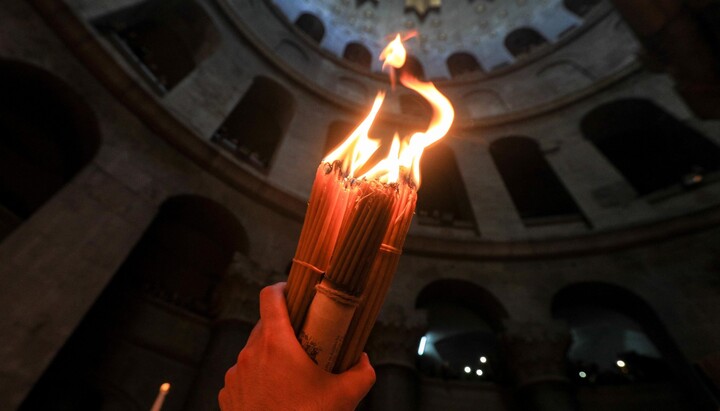
There is abundant evidence for the supernatural nature of the Holy Fire. Photo: open sources
In an article published on the Greek branch of the Union of Orthodox Journalists, well-known Orthodox priest and writer Fr. Anastasios Gotsopoulos addressed the recurring skepticism surrounding the descent of the Holy Fire. He firmly rejected such denial as spiritual provocation.
“Each year during Great Lent and Holy Week, the devil tries to tempt the faithful. One of his most monotonously repeated provocations is the denial of the great and unique miracle of the Holy Light, which shines forth from the Life-Giving Tomb of our Lord in Jerusalem,” the priest emphasized.
Fr. Anastasios noted that there are irrefutable historical testimonies to the miracle of the Holy Fire, dating from the 4th century to the present. He stressed that no matter what methods are used to disprove the event, its authenticity cannot be denied.
He references the research of engineer and architect Haris Skarlakidis, whose work "Holy Light: The Miracle of the Light of the Resurrection at Christ’s Tomb" (Athens, 7th edition, 2021) compiles and analyzes 85 historical accounts of the Holy Fire from the 4th to the 16th century.
“I call it multiform and diverse, because its manifestations are not one-dimensional: the central lamp of the Holy Sepulchre is lit miraculously, sometimes lamps in the Church of the Resurrection or even the candles in the hands of the faithful,” Fr. Anastasios writes, explaining the different ways the miracle has appeared.
The priest highlights the unique property of the Holy Fire in the first moments after it appears: “How can the laws of physics explain the fact that the Holy Light, in its first minutes, illuminates but does not burn? Every year we see how many believers touch the flame of the 33-candle bundle to their faces – some with thick beards – and they are not burned.”
Remarkably, historical testimonies confirming the miracle come from a wide range of religious backgrounds – not only Orthodox Christians, but also Catholics, Monophysites, and Muslims. Fr. Anastasios cites the diverse national origins of the 85 historical witnesses: French (17), English (9), Greek-Byzantines (8), Italians (7), Arab Muslims (7), Germans (6), Ethiopians (5), Armenians (5), Russians (4), Persians (4), Icelanders (3), Egyptian Copts (2), Iraqis (Chaldeans) (2), and individuals from Cyprus, Syria, Moldova, Flanders, Austria, and Switzerland.
Fr. Anastasios also recalls a famous historical event from 1579, when the Ottoman authorities barred the Orthodox Patriarch from entering the Church of the Holy Sepulchre and instead gave the right to conduct the ceremony to the Armenian (Monophysite) Patriarch.
“During the descent of the Holy Fire, it emerged from a column near the main entrance of the Church of the Resurrection and ignited the lamps of the Orthodox faithful, who were locked outside. A Muslim named Tunor, who witnessed the miracle, confessed Christ and received martyrdom for His name,” the priest recounts. According to him, the cracked column still stands today as undeniable testimony to the miracle.
In conclusion, Fr. Anastasios cites the detailed testimony of Persian scholar and encyclopedist al-Biruni (973–1048), author of more than 150 scientific works. In his treatise "The Chronology of Ancient Nations" (c. 1000 AD), al-Biruni wrote about the descent of the Holy Fire as a phenomenon that astonished even skeptics in the natural sciences.
Al-Biruni describes the preparations for the miracle, noting that Muslim authorities themselves would inspect and seal the Holy Sepulchre and place their own lamps inside. He even recounts an attempt by a sultan to disprove the miracle by replacing the wicks in the lamps with copper wire – which nonetheless ignited when the Holy Fire descended.
“The descent on that day of this heavenly fire, which returns at a fixed time and place, causes us amazement,” Fr. Anastasios quotes the Persian scholar, showing that even non-Christians and scholars have acknowledged the authenticity of this great Christian miracle.
As previously reported by the UOJ, the Holy Fire descended this year in Jerusalem at the Church of the Resurrection.
Read also
OCU eparchy sells church center site to developer for housing
The OCU’s Volyn Eparchy sold land intended for a spiritual center to a private developer planning to build townhouses and residential buildings.
SBU names UOC priest’s wife a suspect in Cherkasy region
The SBU accused Matushka Kateryna Prykotenko of “spreading enemy propaganda” through correspondence with parishioners.
UGCC cleric calls Russian Orthodox literature dangerous for clergy
While examining the causes of divisions within the UGCC, Yustyn Boiko concluded that Russian Orthodox literature had influenced Greek Catholic clergy.
UOC will play major role in achieving peace, says Vadym Novynskyi
UOC Protodeacon Vadym Novynskyi believes the Church will help bring about reconciliation within Ukrainian society after the war ends.
Catholic media outraged by forcible conscription of Uniate cleric
The Vatican’s Apostolic Nunciature has demanded the return of a forcibly mobilized Greek Catholic cleric.
Rivne court fines man for criticizing parish's "transfer" to OCU
A resident of the Rivne region was convicted over Facebook posts criticizing the “transfer” of a religious community in the village of Butove to the OCU.