"The Сhurch is alive!": how the UOJ's Paschal flash mob unfolded
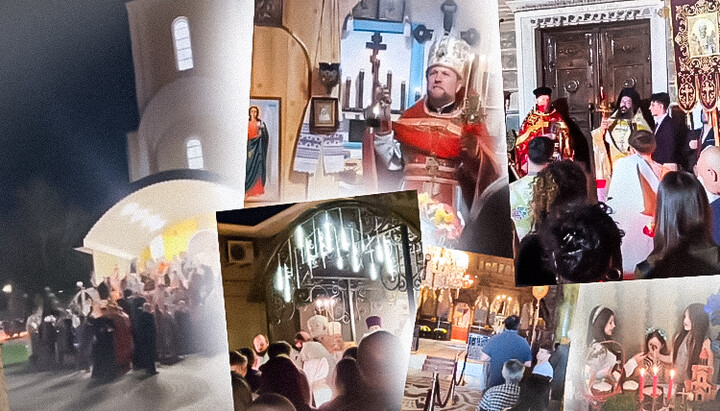
The UOJ held an Easter flash mob. Photo: UOJ
During Holy Week, the UOJ invited its readers to share their testimonies of faith – through photographs, videos, and short written reflections. Our aim was to create a living mosaic of how the Ukrainian Orthodox Church celebrates Easter – in the face of persecution, in every corner of the world, in any circumstance. Whether in a church or a basement, in a ruined building or in a family circle – always with courage, dignity, and deep faith.
And you responded.
Moreover, our initial idea unexpectedly developed – videos were sent by Orthodox Christians from other countries. Footage of Paschal services came to us from communities in Greece, Bulgaria, Georgia, and Germany.
Here are the words shared by our readers.
“This year we celebrated Easter far from an Orthodox church, abroad. So we gathered festive treats, lit the Candle of the Meeting, and at night watched the online broadcast of the Paschal service with the whole family.
I congratulate everyone on the Bright Feast of the Resurrection of Christ, God's blessings to you!”
The St Nicholas parish of the Bila Tserkva Eparchy (UOC) of the village of Medvyn has its the church taken away:
“But a year before that, our bishop Augustine blessed a priest from the village of Lipovets to serve for them and for us. So the priest and I travel 100 km. And we thank God that there is a place to gather and serve. We are few because Lipovets is a small village. And in Medvyn, there are on average 20-25 people.”
“The celebration of Easter in Medvyn. The church was taken away, but the Lord, through the efforts of the parishioners, gave a suitable place. And a priest from a remote village, whose church was also taken away.”
In the village of Dashkivtsi in the Khmelnytskyi region, Easter is celebrated at the Church of the Assumption of the Mother of God. It is attended by not only local residents but also displaced persons from the Donbas temporarily living in the village. That night, an unexpected guest also came to the service – a little hedgehog, which was photographed at the church's doorstep. Its appearance became almost a symbol of the quiet, kind atmosphere created by the parishioners with their faith, care, and unity.
In one of the videos sent to the editorial office from Ostroh, two young parishioners, Sofiika and Daryna – the future of our Church – sing along with adult choir members. As the author recounts, this is part of a special litany: “The priest remembered all our parishioners who are in captivity, who suffer from the war, as well as the sick.”
A photo came from Germany from the Church of Sts Equal-to-the-Apostles Constantine and Helena in Cologne. Most of the parishioners of this community are from Ukraine. In the photo, the author is standing next to a young Pole who recently – last month – converted to Orthodoxy from the Catholic Church. These pictures are not only about the feast but also about the living movement of faith, about how the Church unites the most diverse people into one family.
No less touching footage came from the Polish city of Torun:
“This is how Easter is celebrated in Torun, a Polish city. Ukrainians, Latvians, Russians, Belarusians, and Poles – all together under one roof, responding together to the priest's call: 'Christ is risen!' with: 'Truly, He is risen!'. In the choir, we sing – Ukrainians together with Poles. It is incredible – to feel the celebration in the land where the bells of Catholic churches ring every day. This feast gathered like-minded people under one roof. Incredible!”
And again, Bila Tserkva:
“The city of Bila Tserkva. The Bila Tserkva Eparchy is celebrating the Resurrection of Christ in the midst of faithful parishioners, in a temporary space – it has been two years since our cathedral was taken from us.”
We have published materials from all who responded: every photo, every video, every word was carefully read, viewed, and preserved by us. Sometimes we selected only a few frames from a large archive to create a cohesive report. But no testimony went unnoticed. We are sincerely grateful to everyone who shared their Easter, their trust, and their faith with us.
Each such testimony is a living chronicle of the Church. In these words – faith, pain, hope, and joy. The UOJ thanks everyone who responded, who was not afraid to tell their story in this difficult time for the UOC.
We also received touching footage from Bright Monday from the community of the Holy Spirit Church in the village of Sursko-Lytovske (Dnipro) – a parish with a rich history and active charitable work, where the traditions of Belarusian settlers are preserved.
We are no longer accepting new materials for this project, but we keep every message from you as a priceless testimony of faith.
Read also
A lesson from a speechless donkey
The famous seer struck his donkey three times for refusing to go forward. All the while, she was saving his life – and seeing what he could not.
The time when the soul ripens
Modern society has turned youth into a cult and old age into a period of merely “living out one’s days.” The Christian perspective reveals the profound spiritual meaning of our later years.
Faith is not a checker piece in a spectator sport
Arguments about faith on social media increasingly resemble no-holds-barred fights. We turn to a saint who, sixteen centuries ago, knew how to speak to those interested only in turning theology into a combat arena.
The metropolitan who fought with a pen
St. Cyprian of Kyiv was robbed, expelled, and barred from his see. He answered with letters, books, and canons – and before his death, forgave everyone.
Loneliness under one roof
Spouses can share a home for years, raise children, and faithfully attend church – yet remain strangers to each other.
The cross – the deepest healing of the human soul
Emotional exhaustion and anxiety have become a way of life. Ancient Christian tradition offers an unexpected way out – embracing one's own cross.