
Spiritual spring: Why we congratulate one another on the beginning of Great Lent

From the outside, it can look like a kind of collective lapse of reason. And yet behind this greeting lies one of the deepest mysteries of Christian life.
Something strange happens these days. We meet one another – or write in messages – and we say: “Happy feast day! Happy beginning of the fast!” And what, exactly, are we congratulating each other on? That we can’t have a steak now, or our favorite series? That forty days of self-restraint lie ahead, along with long services in the half-light? For the outer world, giving up familiar comfort is either a tragedy or, at best, an odd diet. But for us it is a special chance to taste, at last, the clean water after months spent captive to excessive flavors and needless words.
We often do not even understand ourselves why it becomes easier in the first, strict day of the fast. Perhaps because the soul, like someone recovering from illness, for the first time takes a deep breath without coughing.
Spring that begins in February
We are used to thinking of spring as a calendar season. But the Church hymnography of the Lenten Triodion sees deeper. In a sticheron at Vespers on Forgiveness Sunday there are words that overturn our whole perception of asceticism: “Let us begin the season of the Fast brightly…” The word “brightly” here is not about electricity or the spring sun. It is about an inner state. Brightly means joyfully, solemnly, with the chest open and the heart uncramped.
It is no accident that the English word Lent is related to the Old Germanic Lenz, meaning “Spring.”
The Church calls Great Lent the springtime of the soul. It is the season when, beneath the melting snow of our habits and everyday bustle, real life begins to push through.
Spring is not when everything is already in bloom, but when the filth slides away and the dark earth is laid bare – black, raw, and ready for sowing. It is not always comfortable, and not always beautiful, but this is precisely what awakening looks like.
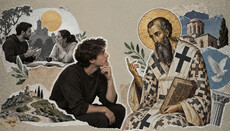
Saint Basil the Great reminded us that fasting is as old as humanity itself – it was ordained even in Paradise. “Because we did not fast, we were cast out of Paradise. Let us fast, then, that we may ascend to Paradise again,” said the great teacher of the Church. We return to that point. The fast is an attempt to rewind the film – back to the state in which a person was not a slave to appetite and caprice.
The weight we do not notice
There is an observation: a person who lives for a long time in a noisy apartment stops hearing the noise. He simply accepts it as silence. And only when real silence descends around him does he suddenly discover how long it has been since he heard the voice of his own soul.
We spend most of our lives in exactly that kind of noise. We grow over with things, habits, needless ties, informational trash. And when the time comes to turn to God, to pray in earnest, we discover that we have unlearned how to listen.
Fasting is not a punishment. It is a return to silence.
In his homilies, Saint John Chrysostom spoke of fasting as “a reliable guard of the soul” and “a faithful companion of the body.” He compared these forty days not to a prison, but to an athlete’s training hall – we enter it in order to set in order the spiritual muscles that have lain idle under the weight of excessive comfort.
In our day, the outer noise has become, first of all, digital. We lose three or four hours a day scrolling news feeds and endless Telegram channels, living in a state of constant anxiety, absorbing other people’s aggression and political quarrels. The fast releases an immense resource – time, attention, inner room of the heart. This is what the holy fathers called nepsis: watchfulness, sobriety of mind, when we finally begin to control the incoming flood of signals and hear something other than our own restless buzzing.
Joyful sorrow: when tears bring light
In the Orthodox tradition there is a term that cannot be translated into one modern word. Saint John Climacus, in his chapter “On Joy-Creating Mourning,” described a state that in Greek is called charmolypē – joyful sorrow. It is an astonishing experience in which tears over sin bring a paradoxical relief.
We weep not because we are “bad” and have been “put in the corner.” We weep the way a child weeps who has lost his mother in a crowd and suddenly sees her face far away.
These are tears of recognition, tears of a wound being cleansed. A quiet light is born in the depth of a contrite heart.
On the first day of Great Lent, vestments in the churches change to black or purple, the light is dimmed, the singing becomes plain and monochrome. Visually, it looks like mourning. But behind this strict façade, the texts of the Triodion call us to “spiritual gladness.” This strange contradiction between form and content creates the atmosphere so beloved in monasteries – the atmosphere of solemn silence.
Saint Theophan the Recluse compared these days to a vacation for the soul. We step away from bustle, from noise, from the endless “must” – toward one thing alone: standing before the Face of the Creator.
A secret feast behind closed doors
In the Gospel of Matthew there are words that set the tone for the whole fast: “But you, when you fast, anoint your head and wash your face” (Mt. 6:17). To understand this, we must remember ancient customs. To anoint one’s head with fragrant oil in those days meant preparing for a feast, for a great celebration. Christ asks of us something almost impossible: to disguise asceticism as triumph.
We are not to walk about with stretched, sorrowful faces, displaying to everyone our “holy” suffering. On the contrary, the face should be bright. Why? Because the fast is a secret feast. We are invited to a meeting where, behind the door of a house – or simply behind closed eyes – there awaits the One Who loves us.
In the first four days of the fast, the Great Penitential Canon of Saint Andrew of Crete is read in church. Its first cry – “Where shall I begin to weep over the deeds of my wretched life?” – is always a question of being born anew. In these lines is the search for a foothold from which one can begin to build oneself differently.
Saint Ephrem the Syrian left the faithful a prayer that will become the rhythm of our breathing in the coming weeks of restraint: “O Lord and Master of my life…” In it we ask God not for punishment, but for gifts – chastity, humility, patience, love. We ask God to return to us our human countenance, which is so easily lost in the bustle.
We enter this fast not as into a prison, but as into a space of freedom.
The joy of the fast is the joy of a recovering person. We relearn how to be ourselves, despite what advertising, instincts, or fears dictate to us.
Today, when anxiety has become our constant companion, the fast gives what no external stability can provide: an inner silence in which our own voice can be heard – and the voice of the One Who has always been near, yet was not heard amid the outer noise.
That is why, on the eve of the fast, we congratulate one another not on deprivation, but on possibility – the possibility of becoming ourselves again.