
Churchly malady of “episcopacy”: collapse of governance or crisis of spirit?
Reflections on a chronic illness of the Church system, in which management has pushed prayer aside.
Today I would like to speak with you about an old, chronic disease of the Church called “episcopacy.” The system of church governance is arranged in such a way that a bishop holds absolute and virtually unchecked authority in his diocese. The clergy depend on the bishop much as serfs once depended on their landowner. Such a medieval model of administration, of course, cannot but produce all kinds of distortions. But the problem of “episcopacy” is not merely one of unchecked power. It runs much deeper.

The role of the bishop in the diocese
The Church’s administrative system is structured so that, by and large, if not absolutely everything, then very, very much within a diocese depends on the bishop. He is the conductor who sets the tone and determines the life of the entire diocese. But the notion that all bishops are scoundrels and villains is, to put it mildly, greatly exaggerated. For the most part, they are believing men, each with his own character, his own outlook, and his own understanding of spiritual life. All the while, they bear a grave responsibility прежде all before God. And we ought not to judge bishops, but to help them carry this difficult cross. That is precisely the purpose of this publication.
Framing the problem: the Manager versus the Man of Prayer
The one supreme task of the Church is to be a hospital for souls, to lead human beings to salvation. And to lead people to salvation, a spiritual leader is needed. That is the bishop’s true role.
But here lies the problem.
First in the Western Church, and later among us as well, the chief requirement for candidates to this office gradually became education rather than holiness. The reins of church governance passed from spirit-bearing men of prayer into the hands of managers and administrators.
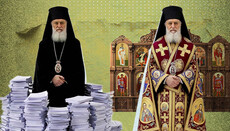
What marks the style of a church manager? He relies chiefly on personnel, money, public relations, and useful connections. He builds a “horizontal kingdom.” The goal of the managerial approach is efficiency, reach, and accountability. Its tools are projects, strategies, and discipline. The result is a neatly assembled diocesan machine and, above all, a satisfied “client.”
And what is wrong with that? Nothing, except for one thing: the manager builds on the foundation of this world, not on the divine energies.
Nor can he do otherwise, because physically he has no time to pray. But if there is no prayer, then the beautifully constructed edifice of the system is nothing more than painted drywall that will crumble in the first storm. A manager neither strives for deification himself nor can he teach it to others. Nor does he need to. What the manager needs is for you to be fitted neatly into the system, for every cog in that system to function properly. But he forgets that the chief “anti-systemic element” in all this is the One who upholds the entire system: the Lord God, who fits into no system at all.
The legacy of Palamas and the “refrigerator” of dogmas
Saint Gregory Palamas foresaw this problem as early as the fourteenth century. His dispute with Barlaam of Calabria was, among other things, also about this. Barlaam was the ideal “crisis manager” of his age. He wanted to make the Church understandable, logical, and neatly fitted into the European intellectual context. Palamas answered: “No, we do not want merely to know about God, we want to BE in God!”
The present-day tragedy of “episcopacy” is Barlaam’s victory in a number of individual offices.
When a bishop or priest speaks like a bureaucrat, thinks like a sociologist, and acts like a politician, he becomes functionally dead to grace. He builds the Church as an institution, but loses it as the Body.
If the Church is led not by men of prayer but by managers, it turns into the most reliable refrigerator in the world. In it, dogmas, icons, and rites are perfectly preserved, but there is no warmth inside. People come to the Church tormented by a thirst for immortality. But instead, managers hand them an “instruction manual for the vessel,” forgetting to give them the Living Water itself. “If the salt loses its savor, how shall it be made salty again?” Christ’s question today sounds like a sentence pronounced over the managerial approach.
Paths toward a solution: spiritual time management
Distinguishing the mind from the reason
The highest art of a spiritual leader is to learn how to distinguish between his mind (nous) and his reason (ratio). In Palamite theology, these are different energies. The place of the mind is in the heart; the place of reason is in papers and meetings. When a professional musician plays an instrument, his fingers execute the most difficult passages outwardly, while his spirit contemplates the very idea of the music inwardly.
Administration as Liturgy
Governance must not become an end in itself. A spiritual leader does not “possess” the system; he brings into its chaos the order of the Divine Logos, first and foremost through himself. The presence of such a leader evokes not fear, but reverence.
Delegation and the silence of Tabor
To preserve a prayerful disposition, a bishop needs capable assistants who can take over logistics and finances. But something else is even more important: periods of complete inaccessibility. Without recharging the “reactor of the heart,” it is impossible to endure the rhythm of diocesan ministry.
The diocesan system must be built not along a vertical of fear, but along a horizontal of love, where the chief generator of energy is the bishop himself.
The “vertical breakthrough” method
It would be very good to train oneself so that before every important phone call or signature there are 10 seconds of the Jesus Prayer. This is a “vertical breakthrough” in time, joining the momentary with the Eternal. Every 60–90 minutes, practice a “micro-hesychia” for 60 seconds: close your eyes, release the tension from your shoulders, and say 3–5 Jesus Prayers.
The mathematics of the spirit
A true monk tries to cultivate within himself detachment from results. Such a bishop does everything perfectly, yet does not cling to success. The effectiveness of his work is professionalism divided by the degree of attachment to outcomes. The less you tremble over success, the more precise your actions become.
An algorithm for the leader’s day
- Morning: the “first glance” rule – no gadgets until prayer is completed. Fifteen to twenty minutes of silence determine whether you will be a reactor or an absorber of other people’s stress.
- Entering into work: sanctify the space with the prayer, “Lord, bless.” Keep at least 10% of your attention in the “place of the heart,” even while 90% is absorbed by schedules and charts.
- In the heat of the day: in conflict, pause for 3 seconds and answer from the point of stillness. In multitasking, remember that God is found only in the present. In success, return glory to the Source.
- Communication: listen not for the answer already forming within yourself, but for the “logos” of the other person. Remember that an excess of words dissipates energy.
- Evening: take inventory of your energies. “Hand over the shift” to God: “Lord, You are the Master of this world. I am going to sleep and leave everything to You.”
Today the Church is suffocating not from a lack of “effective managers,” but from a lack of living bearers of grace.
If a Church leader cannot radiate peace and light from within himself, then all his governance is nothing more than rearranging furniture on the Titanic.
The solution to the problem of “episcopacy” lies in the person. One man who has acquired a peaceful spirit can transfigure the entire structure. A system is not healed systemically; it is healed charismatically. Become a hesychast in the chair of a leader, and the structure itself will become a temple. The life of Saint Gregory Palamas proves that combining the office of a bishop with deep prayer is not only possible, but necessary.