On Zelensky’s accusations that Russian Intelligence is in control of UOC
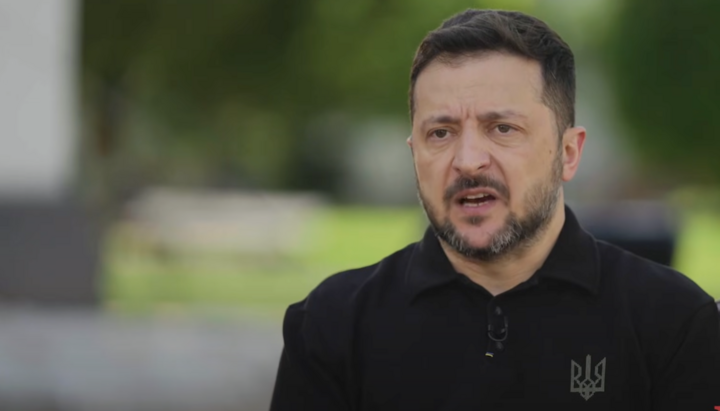
Zelensky during the interview with Shapiro. Photo: Screenshot from Ben Shapiro’s YouTube channel
In his interview with American journalist Ben Shapiro, President Volodymyr Zelensky voiced several assertions that are difficult – or rather, impossible – to reconcile with reality. Let’s examine them point by point.
When Shapiro referred to the UOC as the “Russian Church,” Zelensky echoed this framing, beginning his reply with: “As for the Moscow church...”
There is no registered “Russian” or “Moscow” church in Ukraine. There is only the Ukrainian Orthodox Church. Such language may be acceptable among activists or gossiping neighbors, but not from the guarantor of the Constitution – who is obligated to rely solely on the legal framework of Ukraine in his public statements.
Zelensky claimed that the KGB (which, notably, was dissolved in 1991) and Russian intelligence agencies control or even “run” the UOC.
This is an extremely serious accusation – and one that must be backed by concrete facts and evidence. Since the autumn of 2022, we have witnessed intense scrutiny of the UOC by the Security Service of Ukraine (SBU): sweeping searches in churches and eparchies, dubious criminal charges (such as those brought against Metropolitans Arseniy, Pavlo, and Feodosiy), and more. Yet, not once has any member of the Church’s hierarchy been charged – let alone proven guilty – of links to Russian intelligence. Nonetheless, this claim has effectively become Zelensky’s justification for legislation aimed at banning the UOC:
“That is why legislative changes in Ukraine are tied to the idea that there can be no connection between Moscow and the Ukrainian church. No one has shut anything down, but we cannot allow Russian intelligence services to control a church in Ukraine.”
Zelensky spoke of “legal ties” between the UOC and Moscow that supposedly existed for many years.
In reality, UOC parishes do not even have legal ties among themselves within Ukraine – each is a separate legal entity. Speaking of “legal ties” with Moscow, therefore, is highly questionable. Perhaps Zelensky meant canonical or Eucharistic communion. But these are internal ecclesiastical matters. And according to Article 35 of the Constitution, the state has no right to interfere in them.
“As for the alleged pressure on religious organizations – it simply does not exist,” Zelensky said, referencing his meetings with the UCCRO. He implied that everyone is satisfied and feels no pressure.
Yet, reports of forceful takeovers of UOC churches emerge almost daily. Can one then honestly say that there is “no pressure” on the UOC? That is a rhetorical question.
We have often pointed out that UCCRO members frequently present an untruthful picture of “religious freedom” in Ukraine – especially when addressing foreign audiences. In return, they receive the government’s gratitude for their “advocacy abroad.”
Incidentally, Zelensky stated that representatives of all denominations are invited to his AUCCRO meetings. But once again, this claim does not hold up: UOC representatives have not attended such meetings for quite some time.
Conclusion: It increasingly seems that the UOC is viewed by Zelensky not as one of the faith communities whose rights he is constitutionally bound to uphold, but as a hostile organization – one against which “anything goes.”
And yet, the UOC is the canonical Church of Christ. Historically, those who have waged war against it have never ended well. It is unlikely this time will be different.
Read also
Who destroyed and restored Kyiv Lavra? MinCulture's video reveals the truth
The Culture Ministry’s propaganda about the Kyiv-Pechersk Lavra has inadvertently revealed the truth.
Ternopil post on Feast of Intercession: Has calendar reformn failed?
A significant number of believers have rejected the new church calendar introduced by the OCU and UGCC with government support.
Shoulder straps or a cassock: who writes the script for UOC "fighters"?
Everything indicates that both Veliar and Pshenychny are ordinary performers of someone else's script. There is only one question – does the scriptwriter wear shoulder straps or a cassock?
Why is it legal to kill a person before birth but not after?
Children are the most privileged members of society. Yet that same society officially permits children to be killed – and on a massive scale.
Honoring the Bolsheviks’ successors at Kyiv Lavra
It was under the Reserve that the relics of the saints were desecrated, Lavra churches were turned into an atheism museum, and toilets were installed in sanctuaries.
"Degenerates" and "stupid animals": anti-UOC activists turn on children
Future historians will wonder how a vast country’s information agenda could have been shaped for so long by people so petty, vicious, and utterly contemptible.