“Picaso”: Paradise, the Commandment, and the Contradiction of the Holy Fathers
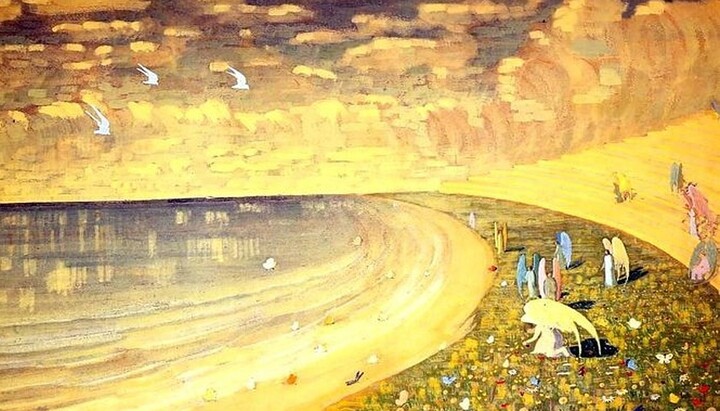
M. Čiurlionis. Paradise. Photo: open sources
Time: 1992
Place: Kyiv
Characters: Fr. Lavr, seminarians
“That will do. What is paradise? Some of the Holy Fathers emphasize that paradise is a place of man’s supreme blessedness. Others say that paradise is the place where man was given the opportunity to grow, to be perfected, to become ever more like God. Yet these Fathers do not contradict one another. Let us recall, brethren, how man was created. When God resolves to create man, He says within Himself: ‘Let Us make man in Our image, after Our likeness.’ What is the image of God in man? Saint John of Damascus, in The Exact Exposition of the Orthodox Faith, says that ‘in the image’ means rational and endowed with free will, while ‘in the likeness’ means likeness through virtue, insofar as this is possible for man. Remember this, brethren – man’s free will is the echo of the image of God within us. God does not violate this human will, nor does He allow anyone else to violate it – above all, the devil. Remember this. It is very important for us. All a man’s actions proceed from the movement of his own will, and for them he will answer before God. Otherwise, there would be nothing for which to punish him, and nothing for which to praise him.
But when we read further about the creation of man, we encounter something striking – God creates man only in His image. He does not create him in His likeness. Read,” Fr. Lavr said, stepping over to the lectern and indicating the place.
The seminarian read: “So God created man in His own image; in the image of God created He him; male and female created He them.”
“This passage is understood in the following way – the image of God is given to man, bestowed upon him. But in order to become like God, man must exert his own effort. Saint Gregory of Nyssa says that to be in the image of God belongs to us by creation, while to become in the likeness of God depends on our will. In this way, man becomes a co-worker with God in the fulfillment of the divine design. He must labor for his moral perfection and become Godlike – to become a god by grace.
The Holy Fathers say that the goal of human life is theosis – deification, union with God. Venerable Macarius the Great writes,” Fr. Lavr took up a notebook from the lectern and began to read, “‘The Lord created the soul in such a way that it might become His bride and companion, with whom He might unite, so that it might become one spirit with Him.’
“There, brethren,” he said, raising his voice slightly, “is the goal of human life – union with God. Yet only beings akin to one another can be united. And man’s task in paradise was to become like God by keeping the commandments of God. This is precisely what is meant by the words: ‘And the Lord God took the man whom He had made and placed him in the paradise of delight, to cultivate it and to keep it.’ To keep the commandment, and through this to become like God, is possible only for a being endowed with free will – that is, a being capable also of breaking the commandment. Otherwise, no moral perfection could arise from keeping it. Man is not a machine, and the commandment is not a program placed within him. At the same time, it is possible that man was also meant to labor in a direct, physical sense. Venerable Ephrem the Syrian writes,” Fr. Lavr again opened his notebook, “‘If it is said that these two tasks were laid upon Adam together with the commandment’ – that is, the keeping of the commandment and physical labor – ‘I do not object to this either.’”
At this, a hand rose from the back rows.
“Fr. Lavr, may I ask a question?”
“Yes.”
A senior seminarian stood up, a notebook in his hand.
“Look, I found this in John Chrysostom,” he said, with a faint smile, and began reading aloud: “‘Blessed Moses recorded even the name of this place so that those who delight in idle talk might not mislead simple listeners by saying that paradise was not on earth but in heaven, and by inventing such myths… Some, puffed up with their eloquence and outward wisdom, have not hesitated to speak against Scripture, saying that paradise is not on earth… Let us stop our ears against all such false teachers and follow the rule of Holy Scripture.’”
Fr. Lavr listened attentively.
The seminarian continued:
“And Venerable Ephrem the Syrian writes… here it is: ‘Paradise was situated at a great height,’” he said with a smirk. “So according to Chrysostom, that would make Ephrem… well…” He did not quite dare to finish the thought.
Pleased with himself, he looked at Fr. Lavr – he had managed to catch not just anyone, but the Holy Fathers themselves, in contradiction.
“My dear brother, may I see your notebook?” Fr. Lavr asked.
The seminarian brought it over. It was a notebook on moral theology, and on its last pages were scattered scribbles along with the excerpts he had just read aloud.
“Very good, brother,” Fr. Lavr said, “that you read the works of the Holy Fathers attentively. What is not good is that from twelve volumes of Chrysostom and eight of Ephrem the Syrian you have copied out only the passage where they appear to disagree. Do you mean to say that this is the most important place in all their writings?” He raised his head and looked around the room.
Everyone waited to see how he would resolve the apparent contradiction.
“As for the substance of the question – I have already told you that such matters are not essential for a person’s salvation. On such questions there may be disagreements in the Church, and there is no reason to be troubled by this. Where paradise was located, how long man dwelt there, what became of it afterward, and many other such matters. The Holy Fathers themselves do not devote much attention to them. The most important truths the Church affirms through her conciliar mind as dogmas. On these matters, no divergence is permitted. And believe me – on dogma there is no contradiction among the Holy Fathers. There is complete unity.
“And dogmas are not abstract speculations without practical value – they are the most concrete teaching imaginable, shaping the entire life of a Christian. When I studied in seminary, our professor of dogmatic theology used to say: ‘There is nothing more practical than dogmatic theology.’ For as your understanding of God is, so you yourself will be – and so will your whole life.
“And if, on some significant question, the Church has not reached a conciliar decision or defined it at the Ecumenical Councils, there is another way – to seek the consensus patrum, the agreement of the Fathers. An opinion is considered true when there is unanimity among the Holy Fathers on that question. Again, this concerns important matters. As for the rest – the main thing is that there be no intolerance and no hostility. I would even say that Saint John is not entirely right in speaking so sharply about those who hold a different view.”
A murmur ran through the room. How could this be – a Holy Father not entirely right? John Chrysostom himself!
“Yes, brethren. The saint did not take into account, for example, the argument that when the Apostle Paul describes his experience of paradise, he says that he ‘was caught up into paradise’ and that he reached ‘the third heaven.’ Yes… There are other arguments as well. So the matter is not so simple. And if my words trouble you – that a Holy Father may be mistaken – then remember the commandment: ‘Do not make for yourself an idol.’ Orthodoxy is distinguished precisely by this from, for example, Catholicism – it is able to acknowledge the errors and limitations of the saints. It was in Catholic thought that Augustine came to be treated as an unquestioned authority in all things. In Orthodoxy, this is not so. The conciliar mind of the Church, and the Holy Spirit abiding in it – this is our criterion of truth. But let us return to the Fall…”
The class smiled: “Let us return to the Fall.”
Fr. Lavr handed the notebook back to the embarrassed seminarian and continued.
“And what commandment did God give man in paradise, besides ‘to cultivate it and to keep it’? Read,” he said, turning to the seminarian who had been reading from Genesis.
Then a voice rang out from the back rows:
“Be fruitful and multiply!”
Fr. Lavr winced slightly, but did not respond.
“And the Lord God commanded Adam, saying: ‘Of every tree of the garden you may freely eat; but of the tree of the knowledge of good and evil, you shall not eat of it – for in the day that you eat of it, you shall surely die.’”
“I want to draw your attention, brethren – we are reading in Church Slavonic. This translation is far more accurate than the Russian one.”
“Why?” someone asked.
To be continued…
The previous episode of the book is available here.
Read also
How a wedding stopped a war
The young princess of Slutsk was married off to keep two powerful noble families from drowning the city in blood. Soon afterward, a Uniate metropolitan complained that Orthodoxy had been reborn in Slutsk.
Man before the forces of nature
A solitary figure on the shore seems insignificant before the immense power of the sea, yet it is he who stands before the Creator.
The mysteries of Golgotha in the light of archaeology
The veil of centuries obscures what really happened in the fourth century. Archaeology and ancient texts shed light on the true history of one of Christianity’s greatest sacred sites.
Zaporozhian Cossacks defend the persecuted faith
The story of how Cossacks drew their sabers to defend abused priests – while sometimes causing violent disturbances inside churches themselves.
A forgery at the foundation of Mohyla Academy
For centuries, historians have repeated an appealing story about a wealthy benefactor’s generous gift. Archival documents, however, paint a very different picture of what happened.
Theology of worn-out shoes
A painting of a pair of old shoes in a Dutch museum preserves the memory of an ordinary working person and a life of hard labor.