The paralysis of the soul will be healed by hatred (John 12:25)
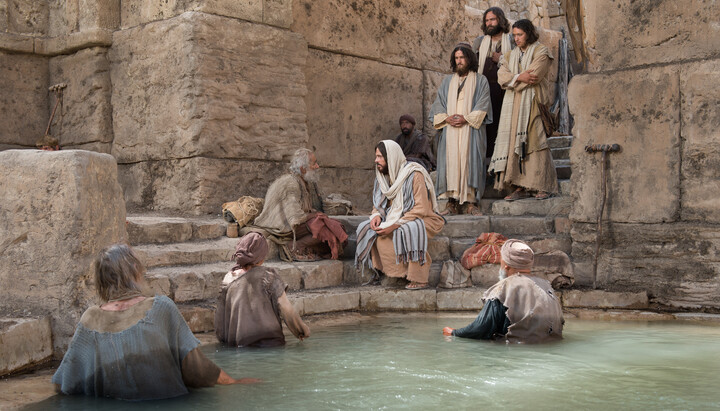
Our soul is paralyzed, like the Gospel paralytic at Bethesda. Photo: taborasj
The joyful Easter days are not yet over, and the Church again reminds us of the paralysis of our soul. The word “paralyzed” in the Gospel context means “disabled”. When a person’s body is paralyzed, they are no longer able to live a full life. They exist as if in the tomb of their own bed.
The paralysis of the soul manifests in the same way. It lives in the tomb of the body, unable to live in the freedom that is given to our spirit. The vain, egoistic mind, detached from the heart, has rolled outward, but it cannot find peace anywhere in the external world. The paralysis of the soul has darkened the person’s eyes and ears. The mind has become a diviner with the cards of deceptive thoughts. Egoism has saddled the person and drives them with the whip of passions, causing them to spend all their strength on satisfying them.
People have exchanged eternal spiritual bliss for temporary fleeting pleasures, seeing the meaning of their life only in these fleeting pleasures. A person has forgotten that what is inside them is much more important than what is outside. Inside us lives Christ, and outside are only changing external impressions. He Who is inside gives us life, while what is outside takes it away. A person has forgotten that they are an immortal image and likeness of God, a radiant spirit or pure ego-less consciousness, the true person with eternal and blessed being in the eternal and blessed God.
The paralysis of the soul can only be healed by returning the mind to the heart. And for this, first of all, it is necessary to pay attention to our inner self. When this attention becomes undistracted and always steadily directed to Christ, the mind gradually releases its attachments and then thoughts about them. Within us is not only the physical heart but also the spiritual heart. In it, there are no thoughts, only the peace of God. Within us lives the lower “I” or ego, and the higher “I” or spirit. Through constant prayer, the mind quiets for a time, but then it starts to wander and scatter again. But our spirit, just like the Spirit of God, knows no agitation or anxiety. Only our inner egoist worries, suffers, hates, judges, and fears.
Hieromonk Gregory (Bezkrovny) teaches that the soul, which arises from the spirit created by God, inherits the sins and virtues of its parents. And, starting to experience the impressions of the world, it creates in itself an egoistic mind, which becomes the mental “I”, attached to the body and experiencing numerous pleasures and sorrows, which are called earthly life. This rapidly moving and changeable consciousness also acts in dreams, imagining various events with the help of the mind. It also experiences painful feelings conditioned by strong attachments to everything worldly. This is the vain life of the soul, about which Christ speaks: "He who loves his life will lose it, and he who hates his life in this world will keep it for eternal life" (John 12:25).
As long as we live by the egoistic and sinful “I”, we need to constantly repent, because we are still wandering on the path of death. In the higher ego-less “I,” there is no repentance but only a perfect union with the Being. There is no need for a Christian to accumulate earthly knowledge, which only increases our egoism. It is better to add grace upon grace, intelligent peace upon intelligent peace, sacred silence upon sacred silence, so that Christ may embrace us with His radiant Light.
We should not trust what our mind thinks, and thus we will find the wisdom of Christ’s word, dwelling in our spirit, quietly and gently admonishing and saving us.
It is the knowledge of the human spirit, the eternal unchanging image and likeness of God, constantly shining in the spiritual heart – the dwelling place of Christ – that unites us with Christ forever.
Such a blessed union comes to one who diligently cuts off egoistic sinful thinking, not sparing oneself. Excessive knowledge accumulated through book learning only distances one from salvation, confusing the mind with endless questions to God. If a person forgets this, they are doomed to spend their life rummaging through the trash heaps of the world in search of various pleasures. If there is no “ego,” there will be no trash heaps. But attachment can also be on the right side, where it successfully masquerades as “love.” That is why Christ says to us these “harsh” words: "If anyone comes to Me and does not hate his father and mother, wife and children, brothers and sisters, yes, and his own life also, he cannot be My disciple" (Luke 14:26).
The egoist cannot love anyone, he can only attach himself, calling his attachment love. Only a free spirit can love. Love with the energy of selfless sacrificial love, which it draws from God. How many inventions have been made by people, how many laws have been discovered, how vast is the amount of knowledge gained! But what is the use of it if humanity has lost, in the process, the First and the Last, the Alpha and the Omega, reducing all its achievements to nothing.
The earth, with all its knowledge, cultural values, works of art, poetry, painting, and architecture – will burn. And in this ash will rise only souls: the good and the evil, the humble and the proud, the holy and the sinful.
Some of them will inherit the Kingdom prepared for humanity from the foundation of the world, and others will go to eternal torment. And all our civilizational gains, military successes, and scientific achievements will no longer matter. So, is it worth it to give up our one and only life for them?
The collective egoism, manipulated by politicians and journalists, is the same manifestation of symptoms of paralysis, but on a global scale. Egoism, with its impure sinful thinking, excites the mind and leads it out of the spiritual heart, inciting it to do all sorts of wrong and commit all kinds of evil, which leads to separation from Christ and the loss of salvation. Our brief earthly life leads its wanderers to one of two doors – either to the one where the light of Divine Grace shines, or to the one where external darkness hangs over the abyss of non-being. The choice of the right path is the essence and meaning of our life.
That is why it is said: “Let the one who does right continue to do right; and let the holy person continue to be holy.” (Revelation 22:11).
Read also
Brother of tax collector and brother of Lord
The Gospel is silent about the son of Alphaeus, and commentators have argued for centuries over who he was. And the Church commemorates two apostles named James in close proximity.
Prayer commemorations instead of loving embraces
At every Orthodox wedding, the choir sings a hymn to the martyrs. For families separated by war, these words carry a special meaning.
Honest atheism vs. spiritual hypocrisy
The 70th anniversary of Albert Camus’s Nobel Prize recalls an uncompromising challenge to Christianity. An honest unbeliever brings theology back to the mystery of the Cross.
The valley of trouble and the gateway of hope
One soldier buried an expensive cloak and some gold beneath his tent. Because of this, all Israel lost a battle. Why did one man’s sin bring disaster upon an entire nation?
From love spells to bishop's throne
Antioch’s most powerful sorcerer sent demons against a devout young Christian woman three times – and failed every time. In the end, a demon himself revealed the truth that led to his conversion.
The Weeping Queen of Blachernae
On the night of the Feast of the Protection, only two people witnessed the miracle in the Church of Blachernae. Everyone else prayed and saw nothing. Yet they, too, received grace.